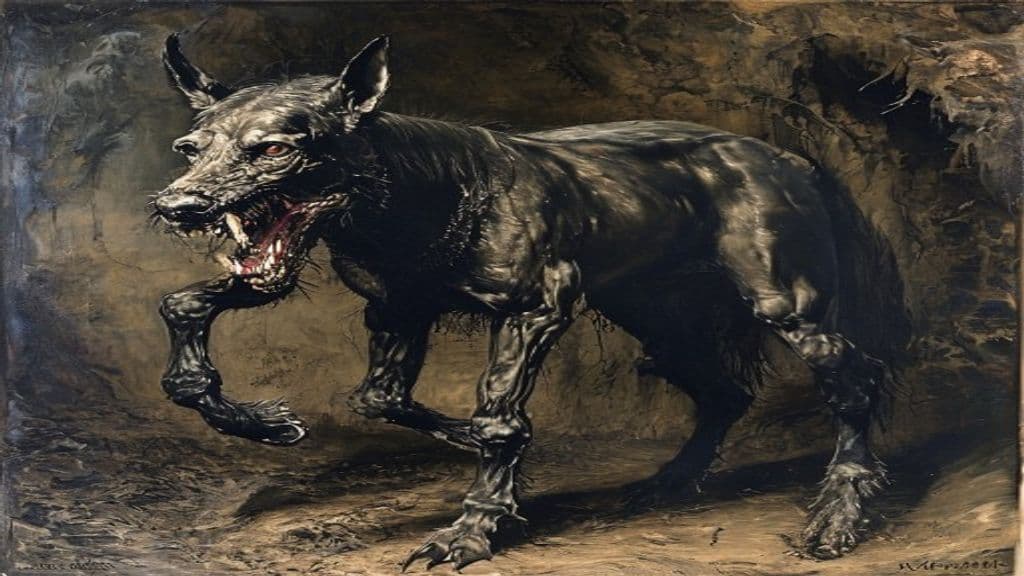
Sources describe Psoglav as a mythic or demonic creature within Balkan popular belief rather than providing a cosmogonic origin. The surviving descriptions place it at the margins of the human world—subterranean caves or a 'dark land' without sun—associating it with death, burial transgression, and the unseen rather than with any specific creation narrative.
Described in available sources as having a human body, horse legs, a dog's head with iron teeth, and a single eye located on the forehead (a cyclopean feature). Regional name-variants (Croatian psoglavac, Slovene psoglavec) reflect the same dog-headed motif. Sources do not provide consistent details on coloration, size, clothing, or additional ornamentation.
Attested behaviors and capacities include anthropophagy (eating people) and exhumation/grave-robbing (digging out corpses from graves to eat them). Psoglavs are reported to inhabit caves or a sunless 'dark land' that contains gemstones. The supplied sources do not attest other supernatural powers (for example, shapeshifting, flight, or speech) beyond these corpse-eating and subterranean associations.

Cynocephalics
In Egyptian tradition, cynocephalics are human beings with dog's heads. (Note: 1. The power tier should be Primordial, given the fact that cynocephalics are described as a widely attested mythical phenomenon existing in many different forms and contexts. 2. Add an origin story b)
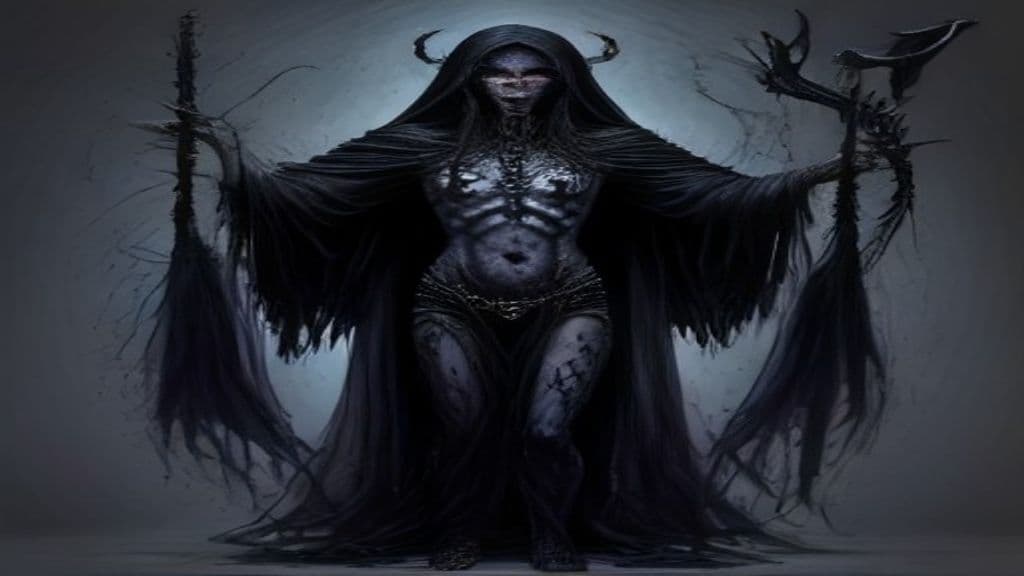
Ghoul
A ghoul is a demon-like or monstrous humanoid originating in pre-Islamic Arabian religion, traditionally associated with graveyards and the consumption of human flesh. The concept later entered broader folklore and has been widely reused and transformed in modern fiction and popular culture.
Adže / Adze
No folkloric entity named 'Adže' is documented in the provided sources. The string appears in heterogeneous, non-folkloric contexts (a Bosnian village name, an English woodworking tool entry, a performer pen name, a CIA document fragment) and one modern podcast episode list that mentions 'the Adze' among other vampire-like beings; none of these supply an ethnographic description of a supernatural being called 'Adže'.
Albanian paganism (traditional/customary beliefs)
A persistent stratum of pre-Christian Albanian religious and cosmological notions—ancestor veneration, animism, and totemic identifications—embedded in oral tradition and customary law (the Kanun) and surviving particularly in mountainous, rural Albanian-speaking regions and diasporas.
Aventinus of Alba Longa
Aventinus of Alba Longa is a legendary king in the Alban/Latial regnal tradition, presented in ancient commentators and later summaries as an eponymous figure whose burial or shrine on the Aventine Hill provided an etiological explanation for that place-name. He appears in king-lists as a successor in the line purportedly descending from Aeneas and is variously dated in later regnal chronologies to the 9th–8th centuries BC.
Baba Marta
Baba Marta (Bulgarian: Баба Марта, 'Granny March') is a Bulgarian folkloric personification of the transition from winter to spring. Celebrated on March 1, she is pictured as a feisty grandmother whose mood is said to affect late-winter weather; communal customs (martenitsi) exchanged on her day symbolize health and good fortune.
Balkan sworn virgins
A culturally recognized gender role in parts of the western Balkans in which people assigned female at birth take an irrevocable vow of celibacy and are socially recognized to live as men, acquiring male privileges and responsibilities within patrilineal customary law.
Bindus
Bindus is an Illyrian theonym attested in Roman-period votive inscriptions from the Iapodes/Dardanian area (1st–3rd centuries CE). Epigraphic and iconographic evidence associates Bindus with springs, streams and maritime motifs and links the deity to the Roman Neptune in local syncretic cult practice.
Chuhaister
Chuhaister (Ukrainian: Чугайстер) is a forest tutelary figure specific to the Ukrainian Carpathians. Portrayed both as an individual-like personage and as a limited-number type (accounts speak of one, or three, four, or seven Chuhaisters), he is an ambivalent forest man who hunts other wild spirits (notably mavkas), is associated with wind and storm phenomena, and interacts with humans—often as a solitary guardian of deep woods and high mountain wilds.
Dhampir
A figure from Balkan folk belief described as the offspring of a vampire and a human. Dhampirs occupy an intermediate social and ontological position — generally living among humans while inheriting certain capacities or markers associated with vampire-kind, and in many traditions are associated with the role of specialist vampire-hunters.
Ileana Cosânzeana
Ileana Cosânzeana is a central feminine figure in Romanian folklore, presented variously as an idealized beautiful princess and as a powerful fairy. She commonly appears as the heroic object of quests (kidnapped by a Zmeu and rescued by Făt‑Frumos) and is associated with healing, floral/vegetal motifs, and astral/seasonal imagery in variant traditions.
Kallikantzaros
A malevolent goblin-like creature in Greek and related Balkan and Anatolian traditions that dwells underground sawing at the world‑supporting tree for most of the year and emerges during the Twelve Days of Christmas (25 December–6 January) to harass households and people.
Kukudh
Kukudh (definite Kukudhi) is an Albanian undead revenant variably depicted as the restless soul of a miser haunting his house, a disease-carrying female demon, or a chain-borne January corpse in some regional accounts. The term also functions as a moral label for an evil person and as a name for a severe sickness in southern traditions.
Olganos
Olganos (Ancient Greek: Ὄλγανος) is a local river-god attested in Macedonian context. Presented as the eponymous divine personification of a river, he is recorded as a son of Beres and brother of Mieza and Beroia and is known from local cult material including an inscribed bust found at Kopanos/Emathia, dated to circa the 2nd century CE.
Community Record
- [1]Psoglav - Wikipedia. Wikipedia contributors, 'Psoglav,' Wikipedia, The Free Encyclopedia, https://en.wikipedia.org/wiki/Psoglavwiki
- [2]Psoglav - Wikidata. Wikidata entry Q3296927, 'Psoglav', http://www.wikidata.org/entity/Q3296927wiki
- [3]Psoglav - EP (archive listing). Archive.org item: 'Psoglav - EP', https://archive.org/details/youtube-I6grxV3CkYAother
- [4]Blood of the Dawnwalker Bestiary Psoglav Entry (archive listing). Archive.org item: 'Blood of the Dawnwalker Bestiary Psoglav Entry', https://archive.org/details/blood-of-the-dawnwalker-bestiary-psoglav-entry-by-rebel-wolves.other
- [5]Soglav (Thingiverse/3D model) (archive listing). Archive.org item: 'Soglav (4873454)', https://archive.org/details/thingiverse-4873454other