
The term and many of the tales about pukwudgies derive from Algonquin-language little-people traditions (Ojibwe forms are recorded and popularized in the 19th century by Schoolcraft and later Longfellow). Schoolcraft published an Ojibwe folktale that features a small invisible being, and that Schoolcraft-to-Longfellow transmission encouraged use of the Ojibwe-derived name in New England narratives. The name literally links them to the wilderness ('person of the wilderness', 'little wild man of the forest') and denotes both individuals and a race; the specific older New England-language names for local little peoples are not recorded in the supplied sources.
Described in ethnographic summaries and later retellings as very short (often given as knee-high, roughly 2–3 feet tall), with gray skin and notably large noses, ears, and fingers. Sources note shape-changing aspects: some accounts indicate they can transform into animals such as cougars or quilled porcupines; popular secondary accounts also emphasize porcupine-like quills or animal-like facial features, but those embellishments are presented in contemporary retellings rather than core ethnographic citations.
Accounts record that pukwudgies can appear and disappear at will (invisibility/vanishing is emphasized in the Schoolcraft tradition) and may shapeshift into dangerous beasts (e.g., cougar or quilled porcupine). They are morally ambivalent: in some Wampanoag contexts they begin as helper spirits (whose bungling help can backfire) and in other accounts turn mischievous or menacing, capable of confusing or luring people and, in some stories, harming or killing (one source notes they 'may also have the power to bring harm to people by staring them down'). They are described as enemies of culture-hero figures such as Maushop and Granny Squanit in the adapted literature.
Weaknesses
- othernone attested in sources
Wards
- othernone attested in sources

Nuckelavee
The most terrifying creature of Orcadian folklore — a skinless, horse-headed demon of the sea whose breath spreads plague and whose presence causes crops to wither. It cannot cross fresh water.

Domovoi
The house spirit of Slavic tradition — a small, invisible guardian of the home bound to a specific dwelling and its family. Protective when respected; dangerous when insulted or forgotten.
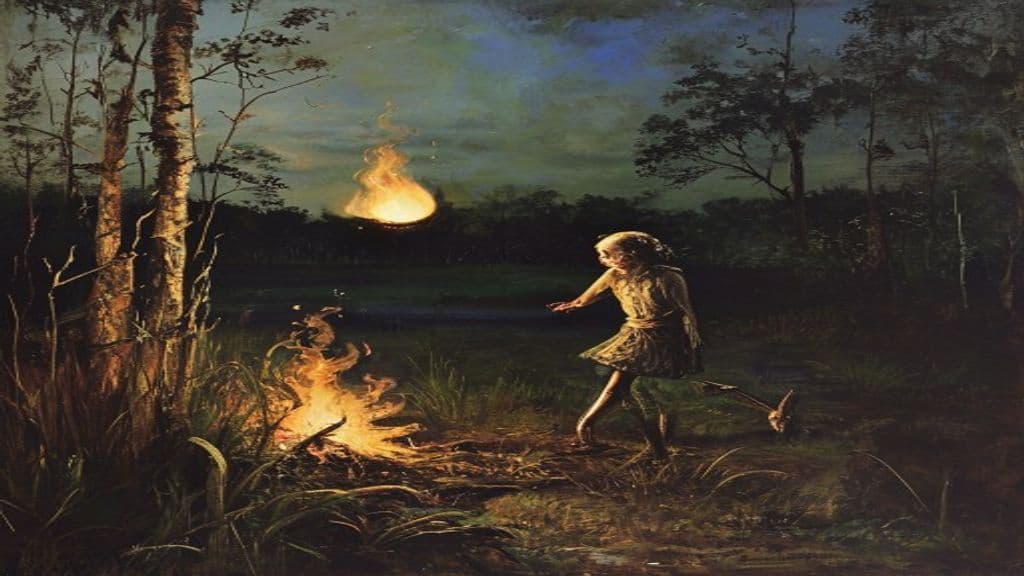
Will-o'-the-wisp
An atmospheric 'ghost light' — a small, mobile, lamp-like light seen at night over marshes, bogs, wet ground, or graveyards. In many cultures the phenomenon is interpreted as a supernatural being or manifestation (wandering nature-spirit, soul of the dead, transformed witch, or treasure-indicator); modern science offers chemiluminescent explanations for some occurrences.
Adekagagwaa
Adekagagwaa is a Haudenosaunee sun deity associated with summer who is described as exercising authority over other weather spirits and participating in an annual cycle of departure and return tied to the seasons.
Agent Liberty
Agent Liberty is a fictional human operative persona in DC Comics and its television adaptation (Arrowverse). The identity—most prominently used by Benjamin 'Benjy/Ben' Lockwood—functions as a costumed, paramilitary/enforcer role tied to political movements (Sons/Children of Liberty) or official security details, driven by ideological 'liberty' rhetoric rather than supernatural agency.
Agropelter
A North American "fearsome critter" of lumbercamp tall-tale tradition said to dwell in hollow conifer trees and hurl broken branches and splinters at unwary people; presented in folklore as an animal-like, mischievous or predatory woodland creature rather than a deity or spirit of formal cosmology.
Alexander the Great (legend)
A pan-cultural legendary hero-king whose historical career was transformed into a body of miraculous and etiological tales (the Alexander Romance). In these traditions he is alternately a divinely sanctioned conqueror, boundary-builder credited with the Gates of Alexander, and a questing culture-hero associated with oracles, votive dedications, and tests of loyalty.
Alfred Bulltop Stormalong
A New England maritime tall-tale hero and giant seafarer, Stormalong functions in sailors' oral tradition and early-20th-century tall-tale collections as a repository for exaggerated seamanship, prodigious physical size, and impossible nautical exploits rather than as a literal supernatural being.
All-Flash
All-Flash (originally All-Flash Quarterly) is a Golden Age American comic-book magazine series published 1941–1947 that served as the first solo magazine vehicle for Jay Garrick, the original Flash. The title is a commercial/branding name later used as an English lexical phrase in unrelated technical and web contexts.
Altamaha-ha
The Altamaha-ha (also called "Altie") is a named legendary creature from coastal Georgia folklore, localized to the mouth of the Altamaha River, nearby marshes, streams, and abandoned rice fields around Darien and McIntosh County. Sources describe it as a place-linked water-associated creature that figures in local storytelling, tourist displays, and contemporary popular culture rather than as a widely attested pan-cultural spirit.
Amikuk
Amikuk is a Yup'ik / Alaskan Inuit spirit-creature associated with the ground and coastal waters; sources describe it as a shapeshifter that lives within the earth, can swim through earth and water, may take human form, and is dangerous to hunters and travelers.
Annie Christmas
Annie Christmas is a tall-tale character from Louisiana folklore, portrayed as a supernaturally strong keelboat (flatboat) captain who in many collected versions is an African-American woman. She functions as a folk-heroic exemplar of exceptional strength, seamanship, and defiance of conventional gender roles within Southern U.S. tall-tale tradition.
Asdzá́ą́ Nádleehé
A creation spirit in Navajo tradition, involved in the formation of the world and creation of the Navajo people. (Note: - Power tier should be Primordial (no issue) - Origin story is accurate - Appearance needs to be added, stating that no physical description is available - Abilities are mostly accurate, but more deta)
Askeladden
Askeladden (Ash-lad, Cinderlad) is a stock human folktale protagonist from Norwegian oral tradition, typically the youngest and least-valued child who, through cleverness, patience, and boldness, succeeds where elder siblings and conventional figures fail, often by outwitting trolls or solving enchanted tasks.
Atmospheric ghost lights
Luminous aerial phenomena reported in folklore and modern observation: balls, orbs, beams, or floating fires that appear in the atmosphere without an obvious physical cause. Traditions variously interpret them as spirits of the dead, yōkai/fairy activity, signs connected to graves or buried goods, weather omens, or as natural optical/electrical phenomena.
Community Record
- [1]Pukwudgie (Wikipedia). Wikipedia: Pukwudgie entry (summary of Ojibwe/Algonquin little-people traditions, Schoolcraft reference, description and name etymology).wiki
- [2]Pukwudgie (Wikidata). Wikidata entry for Pukwudgiewiki
- [3]The Bridgewater Triangle: The Sensational Hot Spot Where UFOs, Demons & Monsters Meet | Documentary. Archive.org documentary referencing modern paranormal localization of pukwudgie lore in New England (Bridgewater Triangle).other
- [4]What the pukwudgie. Archive.org item referencing pukwudgie materials and popular retellings.other
- [5]What Is a Pukwudgie? Explaining the Cryptid and Its Origins (The Portalist). Popular secondary account summarizing origins, appearance, and modern retellings.other
- [6]NEW ENGLAND FOLKLORE: Pukwudgies in Freetown: Some Fairy Sightings in Massachusetts. Blog post documenting modern New England sightings/retellings and folkloric overlay.folk
- [7]Thought Catalog: 20 Facts About The Pukwudgie. Contemporary popular article summarizing descriptive elements and modern lore.other