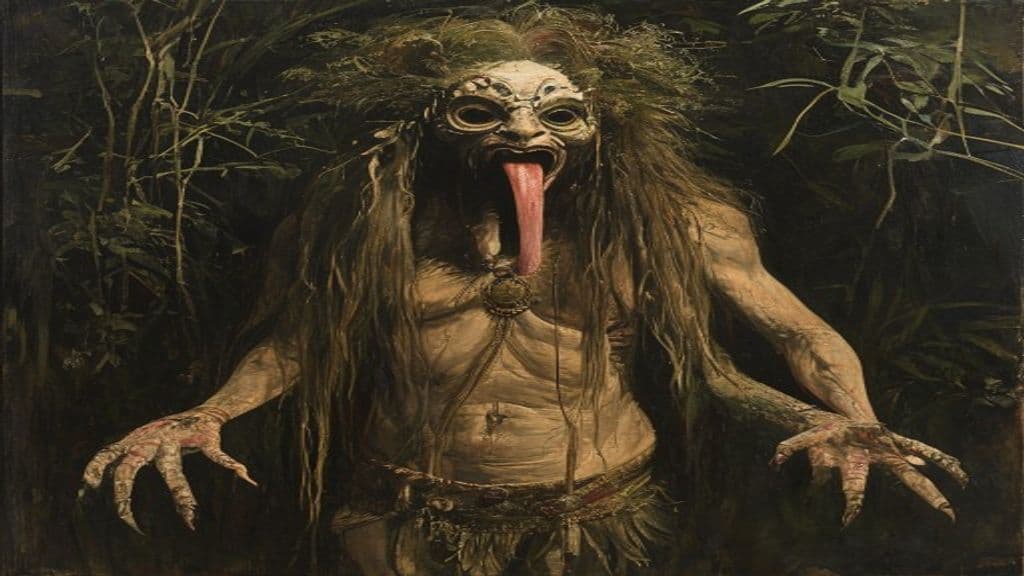
In Balinese narrative and legendarium Rangda is linguistically tied to an Old Javanese term meaning "widow" and is associated in stories with the legendary witch Calon Arang and with accounts of Queen Mahendradatta in Javanese-Balinese histories. In these narratives a grieving or humiliated widow/master of black magic summons Leyaks and evil spirits to wreak disease and crop failure; royal and ritual responses (for example, King Airlangga calling the empu/holy man Empu Bharada and his disciple Empu Bahula) form the story-cycle by which her threat is confronted. Some local traditions and retellings identify or link Rangda with Calon Arang or with Mahendradatta, but sources present these as connected narrative identifications within Balinese myth rather than a single fixed historical fact.
Traditionally represented in Balinese mask-and-costume performance as a frightening, aged female figure: often portrayed as largely nude in theatrical costume, with long unkempt hair, pendulous breasts, clawed hands, and wearing a goggle-eyed fanged mask with a long protruding tongue. This visual type appears consistently in Barong-Rangda dances and related theatrical art forms.
In the Calon Arang legend and related Balinese accounts Rangda is depicted as leading Leyaks (evil witch-spirits) and as responsible for harms such as disease, plague, damage to crops, and attacks on children. She is described as a master of black magic in narrative sources, able to summon or direct malevolent spirits; her menace is principally social and cosmological—providing a personalized supernatural explanation for misfortune that ritual specialists and village protectors must address.
Weaknesses
- ritualIntervention by empu (ritual specialist) and retrieval of the witch's book
- ritualInvocation/assistance of protective deity (Durga) as in the Calon Arang narrative
- ritualConfrontation by Barong (symbolic/performative opposition)
Wards
- ritualBarong cult/ritual presence (village protector)
- ritualEmployment of empu/holy men to counteract witchcraft (narrative remedy)

Leyak
A flying head with entrails, targeting pregnant women and newborn children in Balinese folklore. (Note: - Power tier: Primordial (given the cosmic-level abilities of targeting pregnant women and newborn children) - Abilities: The draft only mentions sucking blood, but source material mentions abducting )

Calon Arang
Calon Arang is a witch figure in Javanese and Balinese folklore, traditionally portrayed as a master of black magic whose cemetery ceremony—including the sacrifice of a young girl to the goddess Durga—brings flood and an incurable plague to the village of Girah. In the tale a royal ritual specialist (Mpu Bharadah) and his disciple (Mpu Bahula) neutralize her by recovering her magic scroll and confronting her in ritual contest.
Acintya
Acintya is an Indonesian Hindu theological-symbolic representation of the ineffable supreme divine principle. In Balinese and Javanese practice it functions as a way to make ultimate reality present in ritual and art—often aniconically as an empty throne (padmasana) or anthropomorphically as a naked, flame-surrounded figure—rather than as a narrative, intervening deity.
Aji Saka
Aji Saka is a legendary Javanese culture-hero and foundational figure credited in tradition with pacifying Java, founding a kingdom at Medang Kamulan, instituting the Saka calendrical era in Java, and composing the hanacaraka mnemonic poem tied to the origin of the Javanese script.
Antaboga
Antaboga is a primordial serpent deity in Javanese and Sundanese traditional beliefs, later incorporated into Balinese Hinduism. Portrayed as an original creative being, Antaboga meditates and brings forth the world turtle Bedawang and other divine figures; its image appears widely in Javanese and Balinese ritual ornament and iconography.
Babi Ngepet
In Indonesian mythology, the Babi Ngepet is a boar demon associated with malevolent intentions towards humans. (Note: * Power tier: Downgrade to Ancient (deity-level) as there's no indication of Primordial powers. * Abilities: Specify what malevolent intentions towards humans implies, e.g., ability to curse or cause )
Barong
In Balinese mythology, the Barong is a panther-like creature and leader of good spirits. (Note: - Power tier: Greater (based on the description as a powerful regional entity, leader of hosts of good spirits) - Abilities: Specify that the Barong opposes Rangda's evil energies, implying a defensiv)
Batara Guru
Batara Guru is a supreme divine figure in multiple Indonesian mythological traditions (Indonesian Hinduism, Batak, Bugis, Javanese). He functions variously as a guru-aspect of Shiva, a creator or world-recoverer in Batak narrative fragments, an ancestor and progenitor in Bugis and Batak genealogies, and a high deity of the kahyangan in Javanese cosmology.
Batara Kala
Batara Kala is a Javanese and Balinese underworld deity associated with death, time, and destruction; feared as an ogre-like devourer of the unlucky, he is also ritually propitiated to avert misfortune, especially for at-risk children.
Batara Sambu
Batara Sambu is a deity in Javanese Hinduized mythology described as the god or patron of teachers, the first-born son of the high god Batara Guru and queen Batari Uma. In wayang (Javanese shadow-play) tradition he is depicted as a ruler of clouds, ancestor of rakshasa (giants), and resident of the southern heavenly realm Kahyangan Swelagringging; his pasaran (Javanese calendar day) is Pa(h)ing and his palace is said to be made of copper.
Bawang Merah dan Bawang Putih
A widely told Malay/Indonesian folktale about two eponymous human stepsisters — Bawang Putih (the humble, patient sister) and Bawang Merah (the vain, cruel sister). The story uses small supernatural motifs (magic pumpkins, a talking fish, a gift-bearing old woman) set in rural liminal spaces to reward virtue and punish vice; it functions as a didactic children's tale rather than an account of a discrete spirit being.
Busang
Busang is not attested as a supernatural being in the supplied sources; rather it is a polyvalent proper name found as a toponym (places in Borneo), a lect name (Busang Kayan), a mining prospect label (Busang deposit in the Bre‑X scandal), and as a personal name. No mythological origin, appearance, powers, or ritual practices directed at a supernatural Busang are recorded in the provided material.
Calon Arang
Calon Arang is a witch figure in Javanese and Balinese folklore, traditionally portrayed as a master of black magic whose cemetery ceremony—including the sacrifice of a young girl to the goddess Durga—brings flood and an incurable plague to the village of Girah. In the tale a royal ritual specialist (Mpu Bharadah) and his disciple (Mpu Bahula) neutralize her by recovering her magic scroll and confronting her in ritual contest.
Chen Fu Zhen Ren
Chen Fu Zhen Ren (陳府真人; Hokkien: Tan Hu Cin Jin) is a deified ancestral/tutelary figure venerated in East Java, Bali, and Lombok. Centered on a historical/legendary migrant craftsman who became a local immortal, his cult is maintained in Chinese temples and by indigenous Kejawen practitioners and functions as a protective, communal ancestor patron.
Community Record
- [1]Rangda (Wikipedia). Wikipedia contributors, "Rangda," Wikipedia, The Free Encyclopedia.wiki
- [2]Barong (mythology) (Wikipedia). Wikipedia contributors, "Barong (mythology)," Wikipedia, The Free Encyclopedia.wiki
- [3]Barong, Rangda, and Calonarang – Asian Traditional Theatre & Dance. Asian traditional theatre overview, "Barong, Rangda, and Calonarang."other