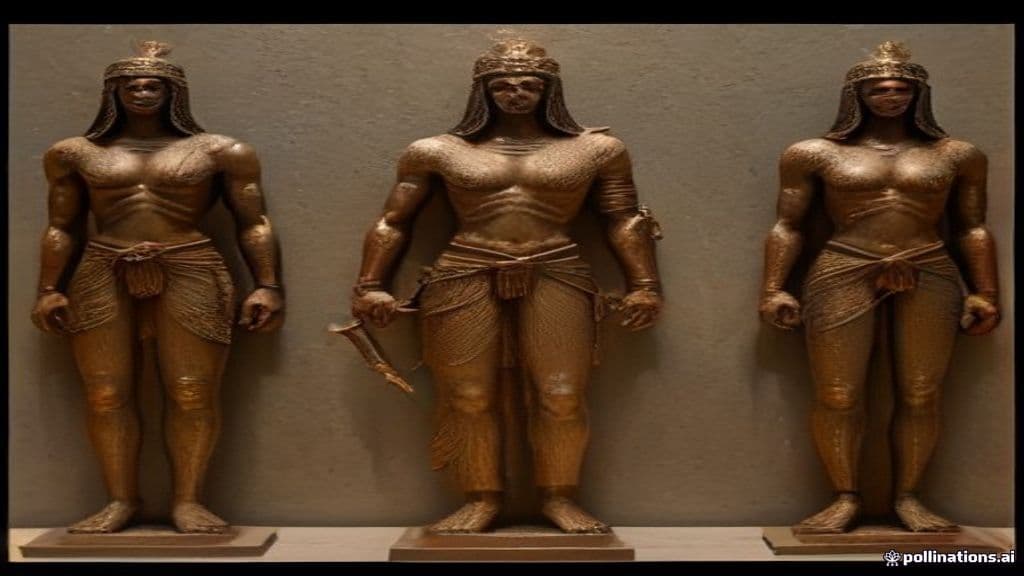
The Sebitti are primarily a collective label meaning 'the seven' rather than a single origin narrative. Different textual traditions variously frame them as independent minor warrior-gods incorporated into the Neo-Assyrian state pantheon and invoked to assist kings; as attendants, creations, or weapons of major war deities (for example in Erra material); as astral counterparts identified with the Pleiades; or in at least one late mythic tradition as hostile sons of Enmešarra defeated by greater gods. These variant portrayals coexist across genres and periods rather than forming a single unified genealogy.
Textual and ritual descriptions depict the Sebitti as seven armed masculine figures. Ritual statue programs describe each figure armed with a hatchet (usually held in the right hand) and a dagger (left hand), wearing a bronze or copper girdle and headband, horned crowns (attested in descriptions), and a bow and quiver at the side; garments and a final coating of red paste are specified for statues mounted on tamarisk pedestals posed as if walking. Relief representations show similarly posed armed figures; sigils of seven dots in groupings are also associated with them. A separate older hymn describes a different heptad with animal attributes (fox, dog, raven, wolf, vulture, owl, shark) that some scholars propose relates to the Sebitti.
Across texts they are foremost martial beings who 'ride to battle' under or with underworld/war deities such as Nergal and Erra and who are invoked to smite enemies. In ritual contexts they function apotropaically: statues of the seven are installed (buried under gates or placed at bedsides) and activated by incantation to repel evil, disease, and hostile forces. In mythic narratives they may appear as subordinate servants or instruments of greater gods, or alternately as antagonistic opponents (e.g., sons of Enmešarra) who are defeated by deities like Marduk or Ninurta.
Weaknesses
- conditiondefeat or subjugation by greater gods (attested in specific myths where Marduk, Nergal, or Ninurta overthrow or subdue the heptad)
Wards
- ritualinstallation of seven armed statues (burial under gate)
- ritualplacement of seven statues at head of bed with accompanying protective figures
- ritualrecitation of incantations over the statues to activate protective power
Apkallu (Abgal)
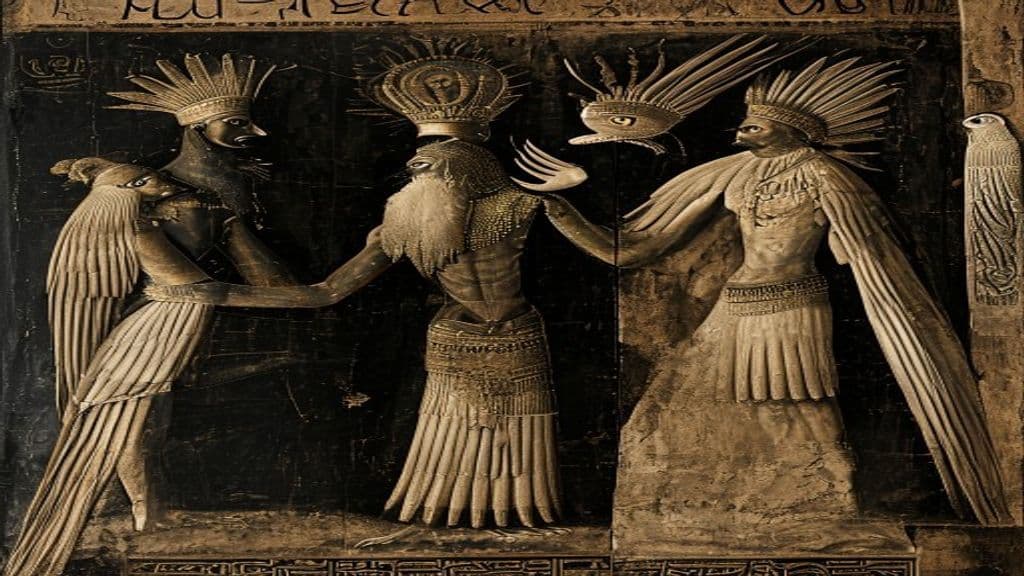
Apkallu (Akkadian; Sumerian: Abgal) are polyvalent Mesopotamian wisdom figures attested as mythic/semi-divine sages (notably a group of seven), as professional human experts (ummânu), and as apotropaic images used in household and cultic ritual. They are closely associated with the god Ea (Nudimmud) as transmitters of secret knowledge and are represented in diverse iconography including fish-man and bird-headed types.
Ninurta
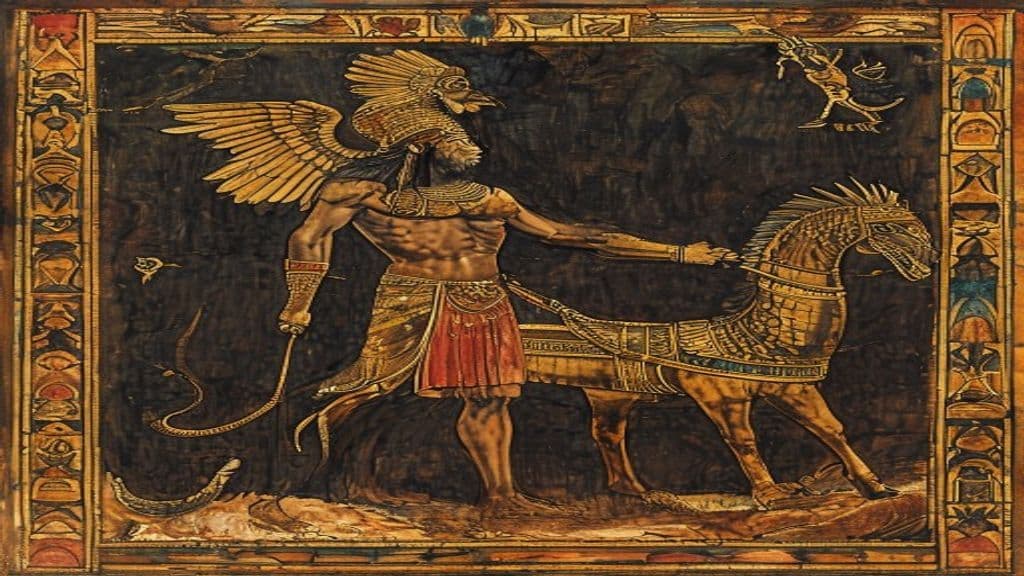
Ninurta is a major deity of ancient Mesopotamia (Sumerian–Akkadian–Assyrian–Babylonian) whose roles include agriculture, healing/exorcism, law and scribal authority, and martial champion of the gods. He is attested from the mid-third millennium BC onward and was venerated at city cult-centers such as Nippur (Eshumesha), Girsu/Lagash (as Ninĝirsu), and later in Assyrian Kalhu.
'Ain Samiya Goblet
Silver cup from the Middle Bronze Age I, discovered in a tomb at Ain Samiya. (Note: 1. Power tier should be "None", but add a note explaining that historical artifacts don't fit into the typical power tier classification. 2. Add a description of its appearance based on it being a sil)
A'annepada
A'annepada (Sumerian cuneiform 𒀀𒀭𒉌𒅆𒊒𒁕; also romanized Aanépàdda) is attested as a historical ruler of the First Dynasty of Ur, flourishing c. 2350 BC. He is recorded in dedicatory and foundation inscriptions as king of Ur and as son of Mesannepada, credited with temple-building and dedication to deities such as Ninhursag and Inanna.
Abu
Abu is a poorly understood Mesopotamian god attested in modern reference summaries. Secondary literature tentatively links him with vegetation and snakes and records that he was often paired with a deity written gu2-la2, but primary details about his cult, iconography, and myths are lacking in the cited sources.
Abzû
Abzû (Sumerian abzû; Akkadian Apsû) is the primordial freshwater abyss in Sumerian–Akkadian cosmology: the deep fresh waters that underlie and surround the earth, source of springs, rivers and ritual holy waters, and a creative principle whose mingling with the salt sea (Tiamat) figures in Mesopotamian cosmogony.
Abī-simtī
Abī-simtī (also rendered Abi-simti, Abisimti) is a named woman attested in third-millennium BCE Mesopotamian documentary and literary texts. She appears in administrative account records as a provider of animals and donor to temple cults and in Sumerian love-song literature as the named beloved/consort addressed by a royal speaker.
Adad
Adad (also Hadad, Haddad; Sumerian Iškur) is the storm- and rain-deity attested in ancient Mesopotamian and Canaanite religious contexts. Sources identify him as a principal weather god whose domain is storms and rainfall and whose name appears across multiple Near Eastern languages and sites, including Ebla (as Hadda, c. 2500 BCE).
Adapa
Adapa is a mythic figure from ancient Mesopotamian (Sumerian and Akkadian) literature: a mortal fisherman and temple sage of Ea at Eridu endowed with exceptional wisdom. He appears in a fragmentary tale in which he breaks the wings of the south wind and is summoned to the divine court; his name was later invoked in exorcistic and ritual contexts as an authoritative identity.
Adonis
Adonis is a mythic mortal youth in ancient Greek tradition, beloved by goddesses (notably Aphrodite and Persephone) whose death and seasonal return are the focus of the women’s midsummer festival Adonia. The cultic practices—planting short-lived 'gardens of Adonis' on rooftops, ritual lamentation, and casting an effigy and withered plants into the sea—symbolically link him to vegetation cycles and Near Eastern dying-and-regenerating god traditions.
Adrammelech
Adrammelech is attested in ancient Semitic textual tradition as a local god of 'Sepharvaim.' The name is commonly glossed as "Magnificent king." In modern times the name has been reused in diverse fictional, musical, and online contexts, but those are creative reworkings rather than continuations of the brief ancient attestation.
Aga of Kish
Aga of Kish (Aga, Agga, Akka) is an Early Dynastic Mesopotamian king recorded in the Sumerian King List, the Tummal Inscription, epigraphic objects, and the Sumerian poem "Gilgamesh and Aga." He functions in texts as a historical/legendary political actor who attempted hegemonic demands on Uruk and was ultimately captured and released by Gilgamesh.
Agasaya
Agasaya is presented in modern secondary sources as a little-attested Semitic war goddess who, according to some summaries, was later absorbed as the warrior aspect of the major Mesopotamian goddess Ishtar. The attestation in available materials is sparse and much inferences about her name, attributes, and later influence are explicitly marked speculative in those sources.
Agum II (Agum‑Kakrime)
Agum II (called Agum‑Kakrime in the inscriptionary tradition) is a Kassite-era Babylonian king known from the Agum‑Kakrime Inscription and later copies. He appears in Akkadian inscriptional and king-list traditions as a royal restorer who recovered and reinstalled the cult statue of Marduk and refurbished the É-sagila, presenting himself as a legitimate shepherd‑king and temple benefactor.
Community Record
- [1]Sebitti. Wikipedia entry 'Sebitti' — summary of scholarly positions and Neo-Assyrian ritual details relating to the Sebitti heptad.wiki
- [2]Mesopotamian pantheon summary (babylon.txt). Pantheon summary noting 'The Seven who ride to battle under Nergal' and related categorizations.other
- [3]Gods of Heaven and Earth (Sebitti discussion). Secondary web summary identifying the Sebitti with the Pleiades and associating them with Nergal/Erra.other
- [4]Nergal — GatewaysToBabylon summary. Summary linking the Sebitti to Nergal/Erra as underworld/war figures.other