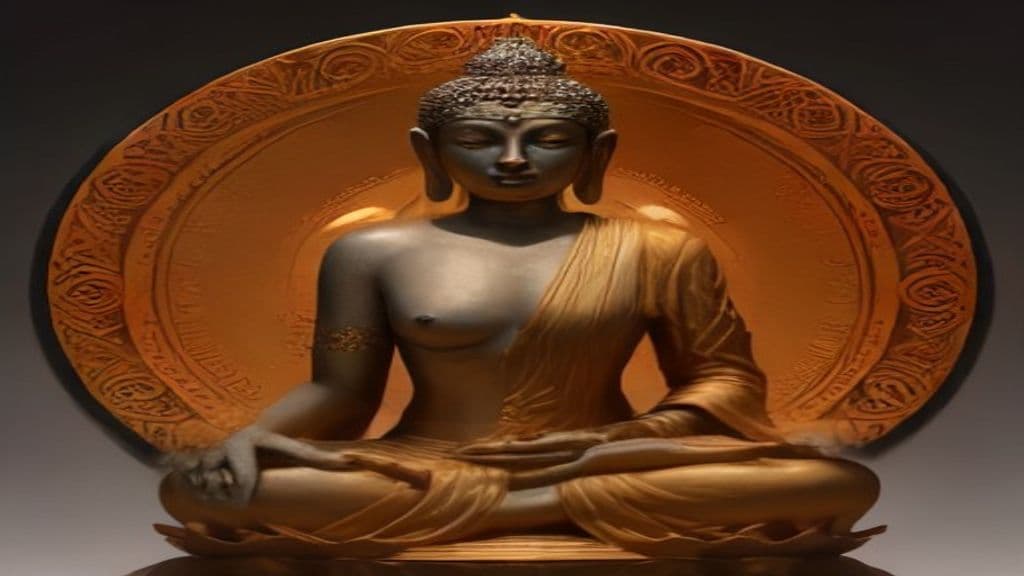
According to the sources, Siddhartha Gautama was born in Lumbini (modern Nepal), renounced princely life to become a wandering ascetic, attained awakening (nirvāṇa) at Bodh Gaya in the presence of the earth as witness, then wandered teaching and establishing a monastic community (saṅgha) before entering parinirvāṇa at Kushinagar. The name Shakyamuni is a Sanskrit compound: Shakya (his clan) + muni (sage), meaning 'Sage of the Shakyas.' Sources place his life historically in the 6th or 5th century BCE, with some modern variants noted in reference works.
Iconographically Shakyamuni is commonly depicted seated on a lotus pedestal in meditation, often shown at the moment of enlightenment with the right hand in the earth-touching/earth-pointing gesture (bhūmisparśa) and typically wearing the patched monastic robe and holding a begging bowl. Regional and temporal variations occur: some portable bronzes (e.g., a late 12th–early 13th-century Cambodian example) show additional motifs such as branches of the pipal tree, an earth goddess beneath the pedestal, and fleeing figures of Mara; Tibetan thangkas and gilt-bronze sculptures likewise emphasize the enlightenment moment but reflect local stylistic conventions. A specific Cambodian icon includes a round object in the left hand interpreted as a probable rice-offering indicating beneficent power; this interpretation is source-specific rather than universal.
Primary functions described in the sources are spiritual attainment (realization of awakening) and pedagogical authority—teaching the Dharma and founding a monastic order. In material and ritual contexts his images and texts act as loci of sacred presence and ritual efficacy: bronze icons have been used ritually to 'transfer a sacred presence from one temple to another,' and in at least one iconographic instance the Buddha is associated with ensuring communal prosperity. The sources also represent narrative motifs (the earth-touching gesture, Mara's defeat) as symbolically demonstrating his triumph over hostile forces at enlightenment. The accounts do not catalogue miraculous feats beyond these canonical and ritual roles; artistic and devotional materials attribute beneficent and consecratory powers to his representations.
Weaknesses
- otherNot applicable — sources do not present Shakyamuni as a harmful spirit requiring countermeasures
Wards
- otherNot applicable — sources do not record protective wards against Shakyamuni; rather devotional practices and images are used to invoke his presence

Acala
Acala (Sanskrit: अचल, 'The Immovable') is a wrathful protective deity (dharmapala) in Vajrayāna and East Asian esoteric Buddhism, classed among the Wisdom Kings (Vidyārāja). He functions as a ritual focus for visualization and mantra practice intended to remove obstacles and bind or destroy hostile forces.
Acalanātha (Acala / Achala)
Acalanātha (also Acala or Achala) is a wrathful deity and dharmapāla — a protector of the Dharma — prominent in Vajrayana and East Asian Mahayana Buddhist contexts. Presented as a fierce, non‑human or semi‑divine protector-figure, Acalanātha functions to defend the teaching and practitioners by removing obstacles and confronting threats to the transmission and practice of Buddhism.
Agni
Agni is the Vedic personification of fire in Hindu tradition: a sacred, mediating principle that manifests as terrestrial fire, atmospheric lightning, and celestial sun, and that receives and conveys sacrificial offerings. Prominent in the Rigvedic corpus, Agni functions as sanctifier, witness of rites of passage, and a transformational inner principle in later Upanishadic literature.
Aizen Myō-ō (Rāgarāja)
Aizen Myō-ō corresponds to the deity Rāgarāja, a wrathful/transformation-oriented figure venerated in Esoteric and Vajrayāna Buddhist traditions. The figure is especially revered in Chinese Esoteric Buddhism in Chinese communities and in the Japanese Esoteric schools Shingon and Tendai.
Akhu Tönpa
A Tibetan trickster figure, sent by Chenrezig to teach the art of being shrewd and witty, while championing the common man against social hierarchies. (Note: - Power tier should be Lesser or Minor Spirit, not Ancient, as it's more aligned with local spirit level of trickster figures. - The ability to outwit those in positions of power suggests Greater or P)
Akshobhya
Akshobhya is a transcendent buddha of Mahāyāna and Vajrayāna Buddhism, one of the Five Wisdom (Dhyāni) Buddhas. He personifies 'mirror knowledge' (ādarśa-jñāna), is conventionally placed in the East, and is lord of the eastern Pure Land Abhirati; in esoteric texts he is associated with the eastern Vajra division and invoked in mantra/mandala ritual contexts.
Akuma
Akuma (悪魔/あくま) in Japanese sources is an evil spirit, devil, or demon associated with misfortune and mental disturbance. The term appears in Buddhist texts and Heian-period literature and was later used to translate the Christian figure of Satan, as well as the Buddhist Mara.
Amanojaku
Amanojaku (天邪鬼 / あまのじゃく) is a Japanese yōkai-type being portrayed as a contrarian, heart-reading trickster. Treated in different contexts as a small ogre (ko-oni), a wicked demon (jaki) in Buddhist iconography, and a folkloric spirit that provokes human vice, it appears across regional tales with variable roles from malicious kidnapper to household oddity.
Amida Nyorai
Amida Nyorai (Amitābha / Amitāyus) is a principal Mahayana Buddha venerated across East Asia as the embodiment of Infinite Light and Infinite Life who presides over a Western Pure Land and is invoked as the savior who receives the dying into rebirth there.
Amitābha
Amitābha is a central celestial Buddha of Mahayana Buddhism who presides over the western Pure Land called Sukhāvatī. Devotional practices invoking his 'measureless' light and life (nianfo/nembutsu) are presented in Pure Land traditions as a path by which beings may be reborn in his buddhafield and quickly attain Buddhahood.
Amitābha Buddha
Amitābha is a principal Mahayana Buddha who presides over the Western Pure Land (the Land of Ultimate Bliss). Devotional practices—most centrally recitation of his name and chanting of Pure Land sutras—are presented in sources as the means by which Amitābha welcomes practitioners for rebirth in his hindrance-free realm.
Amoghapāśa
Amoghapāśa is recorded in the supplied sources as a named manifestation or form of the bodhisattva Avalokiteśvara/Lokeśvara attested in Mahāyāna and Vajrayāna contexts. The evidence in the provided material is archival and bibliographic (sūtra/dhāraṇī/maṇḍala filenames and database entries) rather than descriptive narrative or doctrinal exposition.
Community Record
- [1]Siddhartha Gautama (The Buddha) — general encyclopedia entry. Wikipedia, 'The Buddha' entrywiki
- [2]Wikidata: The Buddha. Wikidata entry Q9441other
- [3]When Sh*t Happens, Where's Buddha? by Dr. Hun Lye (Urban Dharma example). Archive.org, 'When Sh*t Happens, Where's Buddha?' (Urban Dharma NC reference)other
- [4]Heart Sutra (Prajñāpāramitā) commentary / liturgical notes. Archive.org, 'Heart Sutra Prajna Paramita Perfection Wisdom Emptiness' summary and liturgical notesliterary
- [5]Portable icon of Shakyamuni Buddha in the Earth-touching gesture (Cleveland Museum / Archive). Archive.org / Cleveland Art catalog description of a late 12th–early 13th-century Cambodian portable bronzeacademic
- [6]Tibetan Shakyamuni images and museum descriptions. Museum collection entry, Tibetan Shakyamuni Buddha (gilt-bronze)academic
- [7]Questions with Ngak'chang Rinpoche – Shakyamuni Buddha. Aro Encyclopedia, questions with Ngak'chang Rinpoche on Shakyamuniother
- [8]City of 10,000 Buddhas — Shakyamuni Buddha. City of 10,000 Buddhas webpage on Shakyamuniother
- [9]Shakyamuni: etymology and concise doctrinal note. Buddha Museum entry discussing name 'Shakyamuni' and devotional imagesother