
The entity is described in the sources as originating in Persian tales and later distributed into wider Asian folklore. The supplied material presents parīs as a folkloric motif rather than offering a specific cosmogonic origin or creation myth; instead, it emphasizes the being's cultural provenance in Persian storytelling and its diffusion across regional narrative traditions. The sources do not provide a detailed mythic genealogy, rites of origin, or an account of how parīs entered the unseen-world hierarchy beyond noting their Persian roots and broader folkloric presence.
Sources consistently describe parīs as winged creatures of immense beauty. Beyond the characterization of wings and pronounced beauty, the provided excerpts do not supply further specific physical details such as size, complexion, clothing, or transformational aspects. The description in the available materials is therefore limited to a general image of a beautiful, winged supernatural being.
The sources note behavioral and social traits rather than a catalogue of explicit magical powers. Parīs are said to be structured in societies similar to that of humans and to feature in tales involving supernatural elements. One source frames the related motif as 'the jinn in love' or 'the genie who falls in love with a human being,' indicating that forming romantic attachments to humans is a recurring narrative behavior associated with this being. The supplied materials do not list additional powers (such as shape‑changing, control over elements, or specific magic); only wings, beauty, social organization, and involvement in supernatural/romantic tale types are attested.

Jinn
A class of supernatural beings from pre-Islamic Arabian religion later integrated into Islamic theology; jinn are created, morally accountable entities distinct from humans and angels, often unseen but capable of taking visible forms and interacting with people in varied ways.
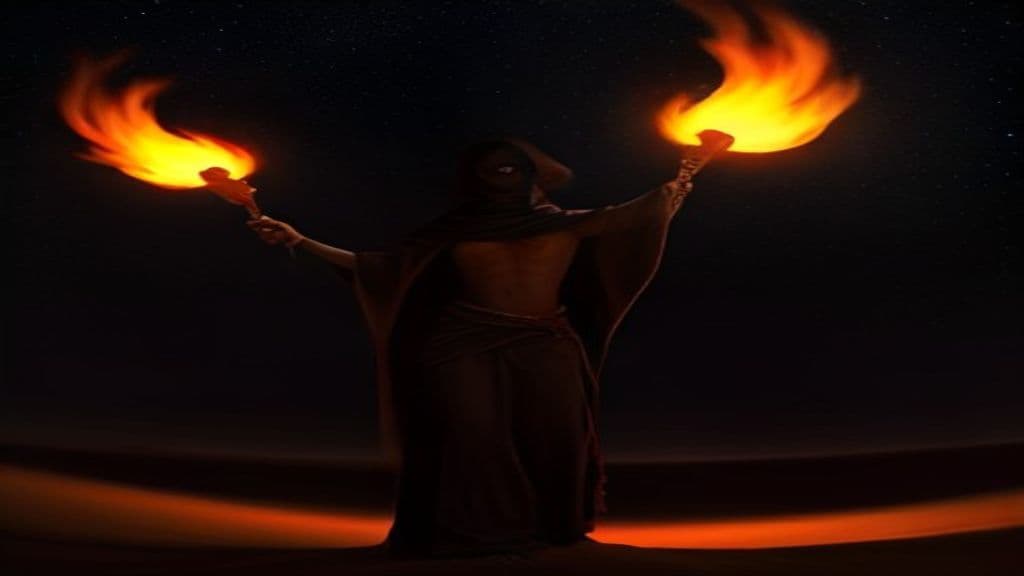
Djinn
The class of supernatural beings created from smokeless fire in Islamic cosmology — a parallel civilization to humanity, capable of belief or unbelief, with their own prophets, society, and judgment before God.
*Perkʷūnos
*Perkʷūnos is the reconstructed Proto-Indo-European thunder‑god hypothesized by comparative linguistics and mythology. Scholarly reconstructions portray him as a storm or thunder figure associated with fructifying rain and as the combatant who fights a multi‑headed water‑serpent to release life‑giving waters; no direct attestations from the Proto‑Indo‑European period survive and the figure is inferred from later Indo‑European traditions.
*Péh₂usōn (reconstructed)
Péh₂usōn is a hypothetical Proto‑Indo‑European pastoral guardian reconstructed by comparative scholars from parallels in Greek and Vedic traditions. Proposed as a Graeco‑Aryan ancestor‑figure, the reconstruction describes a protector of flocks, roads, and travellers rather than an attested historical cultic personality.
57 Mnemosyne
57 Mnemosyne is a large main-belt asteroid (S-type) discovered in 1859 and named after the Greek Titaness Mnemosyne. It is a non-sentient astronomical body studied for its orbital and rotational properties and has been used in dynamical measurements related to Jupiter.
Ab-Zohr
Ab-Zohr is the culminating rite of the Zoroastrian Yasna service: a formal offering to the waters (Aban/Apas) that creates the consecrated liquid parahaoma and functions to purify, strengthen, and atone for damage done to waters. It is a ritual action rather than an independent supernatural being.
Abaddon
In Hebrew scripture Abaddon is primarily a noun meaning 'destruction' or a section/condition of the underworld paired with Sheol; in the New Testament Book of Revelation Abaddon is personified as an angelic figure (Greek Apollyon) described as the king of an army of locusts released from the abyss during the apocalypse.
Aban (Āb/Ābān)
Aban (Avestan apas; Middle Persian āb/ābān) is the collective, sacred principle of the waters in Zoroastrian cosmology — both the element water and its personified hypostases (the Apas/Ahuranis). Aban functions as a primordial, life-giving creation, a calendrical and liturgical focus (day-name, month-name, Abanagan feast), and a ritual object of veneration (ape zaothra, Aban Yasht) rather than a malign force to be expelled.
Aban Yasht
The Aban Yasht is a hymn from the Persian tradition that praises Anahita, a goddess associated with water, fertility, and wisdom. It consists of 132 stanzas and is part of the 21 Yashts collection. (Note: - Power tier should be "Primordial" or possibly "Cosmic", given that it's a hymn of great spiritual significance and associated with a goddess. - The article incorrectly states that Anahita is associa)
Abath
No corroborated folkloric entity named "Abath" is documented in the provided sources. The string appears in the supplied material only as a surname/personal name in Aruban/Dutch-Caribbean archival records and as an unrelated taxonomic or encyclopedic hit; no mythic attributes, origin stories, rituals, or apotropaic practices for an entity called Abath are present in the documents reviewed.
Abatur
Abatur is an uthra (celestial emanation) in Mandaeism described as the 'father of the Uthras' and called the Ancient (ʿattīqā). He resides on the boundary between the World of Light and lower regions, functions as a judge who weighs souls (Abatur Muzania), and supplies instructions and materials to the demiurgic uthra Ptahil in accounts from the Diwan (Scroll) of Abatur.
Abatwa (Twa / Batwa)
Abatwa (also recorded as Twa, Batwa, Mutwa; singular forms Barhwa or Murhwa in some transcriptions) are indigenous hunter‑gatherer peoples of the Great Lakes region of Central Africa, historically identified as some of the earliest inhabitants of the area. The available sources treat them as human ethnic groups whose livelihoods, lands, and populations have been severely affected by conservation policies and modern violence.
Abellio
Abellio is a theonym attested in Roman‑period inscriptions from the Comminges area of the Pyrenees and reported as worshipped in the Garonne Valley of ancient Gallia Aquitania. Surviving evidence is limited to a small number of inscriptions; scholars have variously hypothesized solar or arboreal associations and compared the name to forms of Apollo or to Celtic Belenus, but the deity's precise role in local cosmology remains uncertain.
Abraham
Abraham (originally Abram) is the foundational patriarchal ancestor in the Hebrew Bible whose life establishes a covenantal relationship between his family/people and God. He functions as an exemplar of faith, the progenitor of promised descendants, and a narrative anchor for claims of land, blessing, and communal identity in later religious traditions.
Community Record
- [1]Parī. "A parī or peri is a supernatural entity originating from Persian tales and distributed into wider Asian folklore."; "The parīs are often described as winged creatures of immense beauty who are structured in societies similar to that of humans."; "In contrast to jinn, the parīs usually feature in tales involving supernatural elements." — Wikipediawiki
- [2]The jinn in love (Wikidata entry). "The jinn in love is called the genie who falls in love with a human being." — Wikidatawiki
- [3]Shahadah Stories - Streets 2 Islam (archive recording). Selected archive material provided with no specific ritual or additional folkloric detail about parīs in the supplied excerpts.other
- [4]Lives of the Prophets (Qasas ul-Anbiyah) Collection (archive). Selected archive material provided with no specific ritual or additional folkloric detail about parīs in the supplied excerpts.other
- [5]O Mankind! (A Message to Humanity) — Quran excerpts (archive). Selected archive material provided with no specific ritual or additional folkloric detail about parīs in the supplied excerpts.other