
Classified in international folktale indices as part of the Swan Maiden narrative cycle (ATU/AaTh 400*; local Lithuanian indexing sometimes cited as 404*), the Swan Queen appears across Baltic and adjacent Finno-Ugric oral traditions. Lithuanian folklorists Jonas Balys and Bronislava Kerbelyté record the type within collected Lithuanian variants (Kerbelyté lists multiple Lithuanian entries), while analogous Mari (Cheremis) catalogue entries index closely related 'Swan Girl' stories. Variants share a core pattern: a bird-woman who removes a feathered covering to assume human form, is prevented from reattaching it by humans, and later may be restored by her bird community.
Typically presented as a white swan that can shed wings or a full feathered cloak to become a beautiful young woman; variants include goose- and duck-forms. In most retellings the human form is radiant and attractive; one Lithuanian variant (Stepas Zobarskas) describes cosmic ornamentation—a sun on her breast, stars in her ears, and a moon on her head. The being is ontologically dual: a member of a swan flock who temporarily assumes human personhood when unrobed.
The Swan Queen's defining ability is transformation via a feathered covering (swanskin/swanskin cloak): while wearing or possessing it she is avian and can fly with her flock; by removing it she becomes human and may live among people, perform household tasks, marry, or bear children. Her return to the avian realm depends on regaining or reattaching the feathers; conversely, if humans hide or destroy the swanskin (burning is attested) she remains in human form. Some variants record the swan community restoring a new garment, enabling her flight away; maternal visitation motifs appear in which she intermittently returns to visit or soothe her human offspring.
Weaknesses
- conditionSeparation from swanskin / loss of feathered cloak (destruction or concealment)
Wards
- substanceBurning or destroying the swanskin (fire)
- substanceTar on a windowsill (adhesive binding of wings)
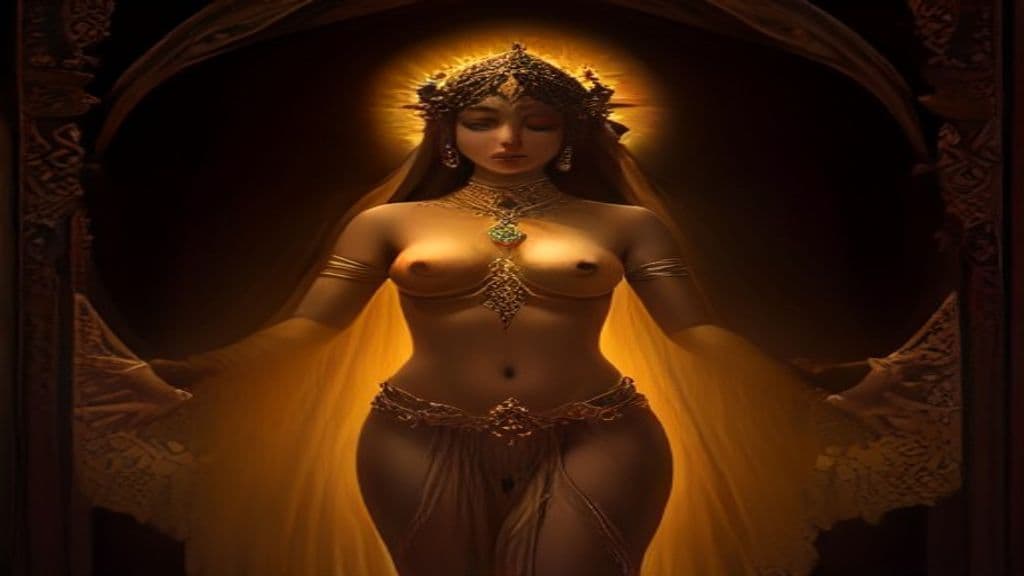
Apsara
Celestial dancers and water nymphs of Hindu cosmology — beautiful semi-divine beings who dance at the court of Indra and, by his command, descend to earth to distract sages from excessive asceticism.
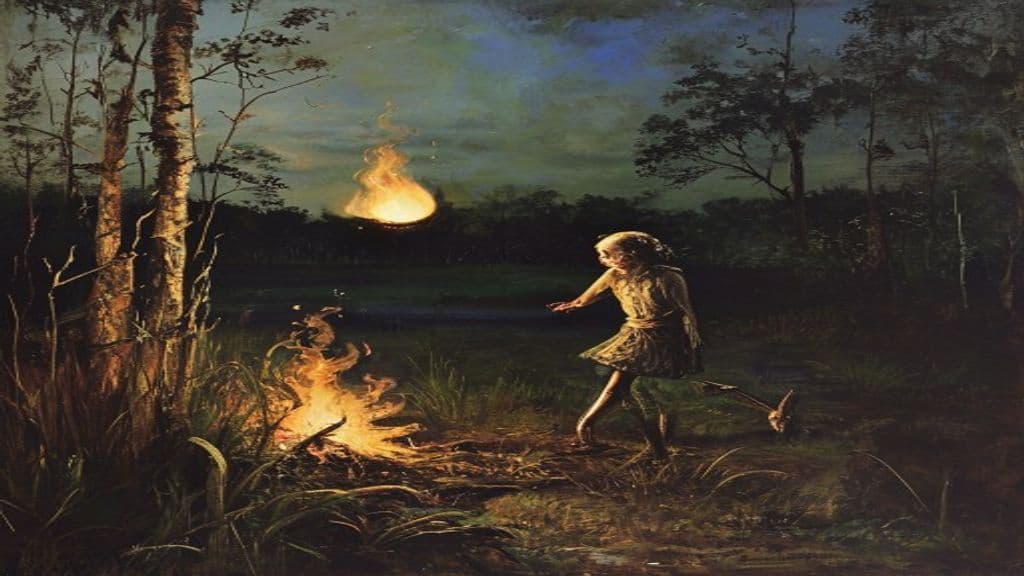
Will-o'-the-wisp
An atmospheric 'ghost light' — a small, mobile, lamp-like light seen at night over marshes, bogs, wet ground, or graveyards. In many cultures the phenomenon is interpreted as a supernatural being or manifestation (wandering nature-spirit, soul of the dead, transformed witch, or treasure-indicator); modern science offers chemiluminescent explanations for some occurrences.
Ahti (Ahto)
Ahti (also Ahto) is a Finnish water haltija — a named supernatural proprietor of the sea and aquatic resources who appears in Kalevala-derived epic material, regional runic fishing songs, and healing spells. He functions as a sea-king/sea-god figure, provider of fish and other water-given wealth, and a ritual addressee in practical subsistence and healing contexts.
Ahtola (Kalevala) (tradition)
In the supplied sources, no supernatural entity named "Ahtola" is attested in the Kalevala or other Finnish mythic texts. The name Ahtola appears in the source set only as a modern Finnish surname and a place-name; the closely related mythic figure attested in the material is Ahti/Ahto, a Finnish water god associated with the sea.
Aino
Aino is a human female figure in Finnish oral tradition as assembled in the Kalevala; originally appearing in folk poems as “the only daughter” or “the only sister,” she was given the proper name Aino by Elias Lönnrot when he compiled and edited the oral material into the national epic. Her story concerns family pressure, courtship by Väinämöinen, refusal, and a tragic drowning that functions as a moral and social episode within the Kalevala narrative.
Aitia (Baltic Finnic)
Primordial figure representing the creative power of the universe, associated with the creation of the world and emergence of life from chaos. (Note: 1. Power tier: Primordial is plausible, but it would be more accurate to indicate "Primordial" as a default power tier without specifying, since there's no further information about its abilities or b)
Aitvaras
Aitvaras is a Baltic (primarily Lithuanian) household/nature spirit that, according to available summaries, lodges in homes and provides its household with material goods—often described as stolen gold and grain—while also bringing misfortune or trouble. It is variously described as a rooster- or chicken-like bird indoors and as a dragon-like or serpentine bird outdoors, often with fiery/meteor imagery.
Ajatar
Ajatar (also Ajattara, Aijotar; runic variants Aattara, Ajaster(i)) is an evil female spirit in Finnish traditional belief associated with wild places, serpents, and the spread of disease and pestilence. She functions in the folk corpus as a dangerous woman-like haltija of forests and mountains who leads people astray and is linked to other hostile powers such as Hiisi and Lempo.
Alatyr
A sacred world-stone in East Slavic and wider Slavic folklore, described as the "father to all stones" and the "navel of the earth." Located at the world's center (often on Buyan island), it is associated with a miraculous spring, sacred letters, healing properties, and liminality between the human world and other realms.
Alka
Alka (plural alkas) is a class of sacred natural places in pre-Christian Baltic religion—Latvian and Lithuanian—functioning as set-apart cult sites where offerings and sacrifices were made. Treated as holy ground rather than a single anthropomorphic spirit, alkas served as loci connecting communities with ancestors and otherworldly realms and frequently appear in toponyms across the Baltic landscape.
Ancient Kings of Finland
In early literary sources, the Ancient Kings of Finland are described as hypothetical or mythical monarchic systems associated with ancient Finland. (Note: 1. Power tier: Lower to Primordial (given the lack of specific abilities and behaviors) 2. Abilities and behaviors are described as 'generally vague', so this section should be reworded or removed 3. )
Antero Vipunen
A giant in Finnish mythology with valuable spells and knowledge, possibly associated with underworldly powers. (Note: * Power tier should be Ancient (deity-level) due to possessing "very valuable spells and knowledge", which suggests immense magical power but not necessarily cosmic-level. * Appearance should clarify )
Arvoitus (Finnish Riddle Entity)
A supernatural entity embodying the concept of a riddle or puzzle, often used in Finnish folklore to test one's wisdom and knowledge. (Note: 1. Power tier: Minor Spirit (Arvoitus does not interact directly with humans but presents itself as a puzzle, suggesting it's more of a subtle, local entity rather than a powerful regional one.) 2. Ap)
Auseklis
Auseklis is a named youthful celestial being in Latvian folk-song tradition (dainas), associated with the dawn and a particular eight-pointed star emblem. He appears among the Dieva dēli (sons of Dievs) as an attendant of the Sun (Saule), a suitor in the mythic 'celestial wedding', and a participant in household-like sky rituals.
Community Record
- [1]The Swan Queen (Wikipedia). Wikipedia article 'The Swan Queen' summarizing Lithuanian and Mari variants and citing Jonas Balys and Bronislava Kerbelyté; accessed via supplied research notes.wiki
- [2]Lithuanian folktale indexing and commentary (Bronislava Kerbelyté; Jonas Balys cited in Wikipedia summary). Summaries and indexing information attributed to folklorists Jonas Balys and Bronislava Kerbelyté as reported in the Wikipedia summary (Kerbelyté's collected variants list Lithuanian entries for the Swan Maiden type).folk
- [3]Mari (Cheremis) tale indexing (S. S. Sabitov note as cited). Reference to Mari catalogue entry 'Девушка-лебедь' and parallels to the Swan Maiden cycle, as reported in the Wikipedia summary and supplied research notes.folk
- [4]Stepas Zobarskas variant (Lithuanian retelling with cosmic ornamentation). Variant retelling summarized in the research notes describing the maiden 'with a sun on the front, stars in her ears and a moon on top of her head' (attributed to Stepas Zobarskas in the supplied notes).folk