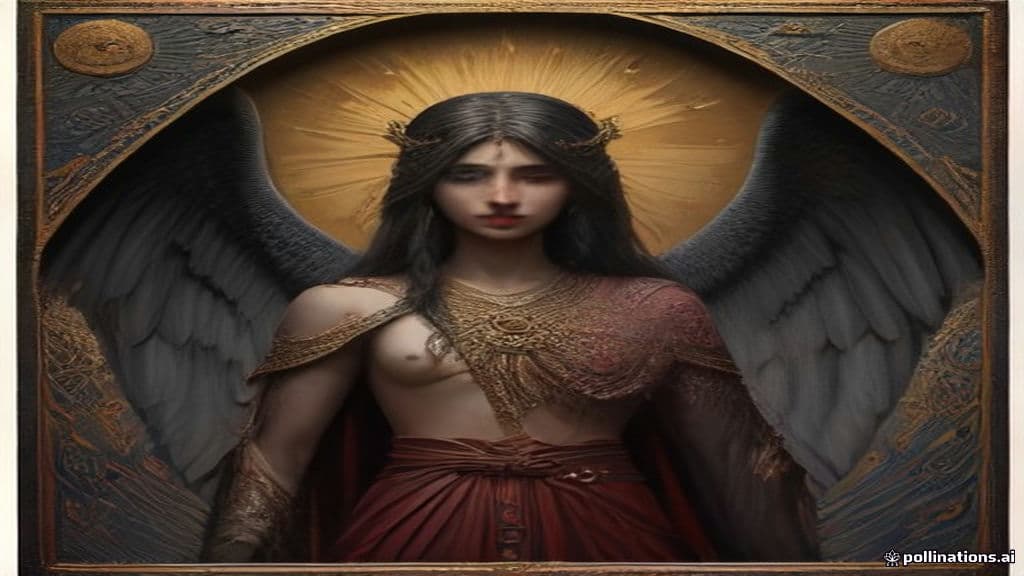
Attestations are fragmentary and do not preserve a full origin narrative. Scholarly etymology connects the name Tsovinar (and forms Covinar/Covean/Coveal) to Armenian cov 'sea', which has led commentators to gloss the name in variants as 'the sea', 'the spirit of the sea', or 'the light of the sea'. Separately, poetic lines (modern usage) present her among 'daughters of dragons', and epic summaries place her as a named agent in the Sasna Tsrer cycle; however, no single coherent traditional origin tale is preserved in the supplied sources.
Detailed iconography is not preserved in the provided materials. A modern poetic vision describes Tsovinar 'flying over Artsakh' with 'eyes ... like the sun'. Epic fragments link her to dragon-descended lineages ('We are the daughters of dragons'), but the sources do not give a consistent or detailed physical morphology beyond these evocative images.
Sources do not catalogue systematic supernatural powers. Poetic and literary attestations attribute flight or movement through the sky and a radiant, sun-like gaze as descriptive motifs. In the Sasna Tsrer summary she displays mortal agency and political resolve—rejecting an Arab Caliph's marriage proposal to avoid betraying her country—indicating an active, consequential role in epic narrative rather than a list of formulaic magical abilities.
Anushawan
In Armenian legendary history, Anushawan is a semi-mythological figure and grandson of the legendary king Ara the Handsome. (Note: 1. Power tier should be Lesser (local spirit) since there's no indication that Anushawan is a cosmic being or deity-level. 2. Add specific information about sensory cues, wards, and weaknesses from so)
Aralez (Aralezner)
Aralez (Aralezner in plural) are ancient Armenian dog-like spirit-beings traditionally credited with resurrecting fallen warriors by licking their wounds. Described in source material as part of the older strata of Armenian sacred imagination, they occupy a liminal role between animals, spirits, and ancient gods.
Astghik
Astghik (older orthography Astłik) is a prominent goddess of pre-Christian Armenian religion, personifying beauty, love, fertility, and water. She is etymologically linked to the Old Armenian word for "star" and is described in sources as the bride of the warrior god Vahagn; later identifications connect her with Aphrodite and the planet Venus.
Astłik
Astłik (Astghik) is an ancient Armenian goddess associated with beauty, love, fertility, and water; in some earlier attestations she is also reported as a creator figure. Her cult is tied to local temples and seasonal ritual life, notably the Vardavar water‑drenching festival, and later identifications connect her with the planet Venus and Greco-Roman love‑goddess types.
Azhdahak
Azhdahak (Old Armenian Աժդահակ, also spelled Ashdahak) is the Armenian form of the Avestan figure Azhi Dahaka. In Armenian reception the name refers to the same mythic adversary of Iranian tradition — an imprisoned serpent/dragon-type antagonist who, in Iranian accounts cited by Armenian sources, is bound (on Mount Damavand) and destined to break out at the end of time before being finally defeated.
Bartholomew the Apostle
Bartholomew is presented in the supplied sources as one of the Twelve Apostles of Jesus, an early Christian missionary and martyr whose life functions in Christian liturgical memory, regional founding traditions (notably Armenian), and in later apocryphal and visionary narratives that expand his missionary itinerary and miraculous acts.
Chuma (Chuma-kik)
No reliable evidence in the provided sources identifies a supernatural entity called 'Chuma' or 'Chuma-kik' in Armenian tradition. The available materials mention the string 'Chuma' in unrelated contexts (personal names, place names, a Slavic word for plague) but supply no folkloric data linking it to Armenian spirits or monsters.
Eleazar
Eleazar (Hebrew: אֶלְעָזָר, Eleazar/Elʿazar) is a biblical and historical personal name borne by several individuals in Hebrew tradition; chief among them is Eleazar son of Aaron, who succeeds his father as Israel's high priest and performs custodial and ritual functions in the Exodus, wilderness, and settlement narratives. He is treated as a human priestly office‑holder and is commemorated in some Christian liturgical calendars.
Hayk
Legendary patriarch and founder of the Armenian nation, considered an ancestral figure without supernatural powers. (Note: 1. Power tier should be set to "Primordial" since Hayk is considered an ancestral figure and a central part of Armenian mythology, implying a cosmic or foundational significance. 2. Sensory cues and w)
Khachkar Spirit (cross-stone guardian)
No primary or folkloric sources in the provided research identify a named supernatural 'Khachkar Spirit' or consistent guardian spirit associated with khachkars. What is documented in the supplied materials is the khachkar as a carved Armenian cross-stone monument (a material cultural object), including an archaeological example dated to 982 found in Wadi al-Natrun, Egypt, demonstrating Armenian presence outside Armenia.
Lake Van Monster
A purported large aquatic creature reported in and around Lake Van (eastern Turkey). The figure exists in modern popular reports (late 19th century accounts, a contested 1997 video, and local publicity such as a statue) and is linked in scholarship to older Armenian vishap (water-dragon) imagery that personifies sudden storms on the lake.
Nhang (Water Dragon)
Nhang, glossed in English as the "Water Dragon," is cited in English-language overviews as a water-associated monstrous figure within Armenian mythic tradition. The available sources note its classification only as a water-dragon label; no detailed native accounts, descriptions, or ritual material are provided in the supplied material.
Community Record
- [1]Tsovinar (goddess) — Wikipedia. Wikipedia, 'Tsovinar (goddess)'wiki
- [2]Tsovinar — Wikipedia. Wikipedia, 'Tsovinar'wiki
- [3]Archive: Արցախ, Պե՞տք Է Ընդմիշտ Բաժանվենք (contains modern poetic lines). Archive.org item including modern poetic/dream-vision lines referencing Tsovinarliterary
- [4]Sasna Tsrer | European Heritage Days (summary). Sasna Tsrer summary (European Heritage Days), referencing Tsovinar's role in the epicliterary
- [5]Etymological commentary (summary in research notes citing Tsovinar Harutyunyan and Armen Petrosyan). Summarized etymological interpretations as reported in the provided sources: Tsovinar Harutyunyan ('the sea, the spirit of the sea, the light of the sea') and Armen Petrosyan (linking Covinar/Covean/Coveal to cov 'sea')academic