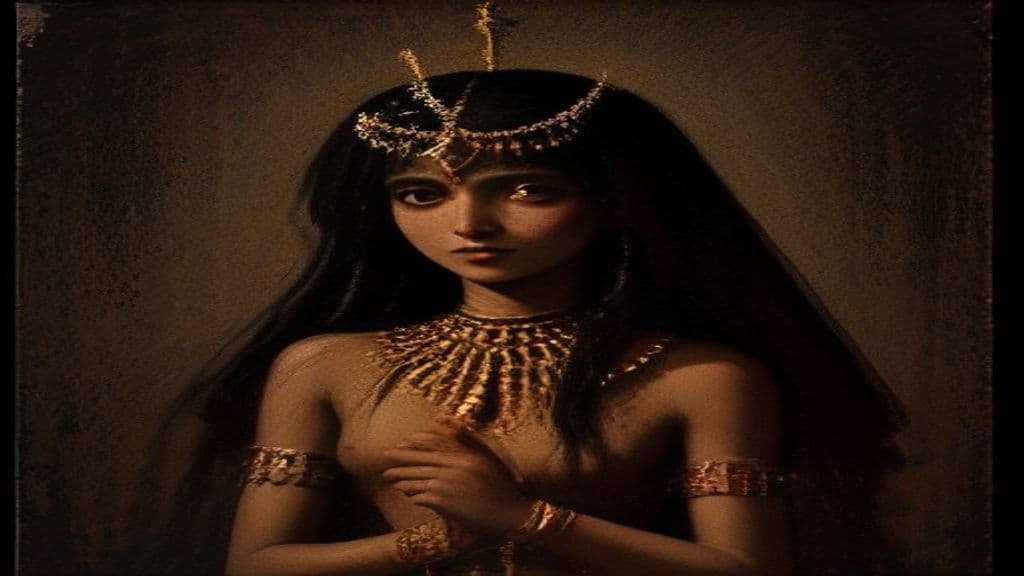
The available sources do not supply a narrative origin story. What is attestable from the provided material is that the label "Tutu" appears on Wikipedia as the name of a god in two separate cultural contexts: an Egyptian god 'during the Late Period' and a Mesopotamian god described there as a 'creation god'. No primary myths or formation accounts are given in the supplied sources.
The provided sources contain no descriptions of appearance or iconography for either instance of Tutu. The Wikipedia disambiguation entry only lists the names and cultural placements; it offers no visual or morphological information.
Specific powers, functions, or behavioral descriptions are not documented in the supplied materials beyond the single phrase on Wikipedia calling one instance a 'creation god'. The sources do not elaborate actions, spheres of influence, cultic functions, or interactions with humans for either the Egyptian or Mesopotamian attestations.
'Ain Samiya Goblet
Silver cup from the Middle Bronze Age I, discovered in a tomb at Ain Samiya. (Note: 1. Power tier should be "None", but add a note explaining that historical artifacts don't fit into the typical power tier classification. 2. Add a description of its appearance based on it being a sil)
A'annepada
A'annepada (Sumerian cuneiform 𒀀𒀭𒉌𒅆𒊒𒁕; also romanized Aanépàdda) is attested as a historical ruler of the First Dynasty of Ur, flourishing c. 2350 BC. He is recorded in dedicatory and foundation inscriptions as king of Ur and as son of Mesannepada, credited with temple-building and dedication to deities such as Ninhursag and Inanna.
Aani
Aani (ancient Egyptian jꜥnr) is the lexical term for the baboon in ancient Egyptian language and functions in religious contexts as an animal icon and theophoric epithet. Attested repeatedly in Egyptian texts and images, the baboon image is used to represent or denote aspects of gods such as Thoth, Hapy, Khonsu, and Osiris rather than implying the animal itself is an independent deity.
Aati
Aati (also rendered Ati) is one of the 42 judges of the dead in ancient Egyptian funerary literature, attested in the Book of the Dead tradition (notably the Papyrus of Nebsemy). Described as originating 'from Heliopolis', Aati's documented function is to question the deceased about a specific moral accusation during the Duat judgment; the funerary texts supply a formulaic denial the soul must recite.
Abadiu of Antinoe
Abadiu of Antinoe was a fourth‑century bishop of Antinoe (Antinoopolis, in Roman Egypt) commemorated as a martyr and saint in the Coptic Orthodox Church, with a feast day on 26 December. Sources record that he was killed during a theological dispute with Arian opponents and reference him in collections of Egyptian martyrs.
Abaset
Abaset is a localized ancient Egyptian goddess attested in tomb decoration at El‑Bawiti in the Bahariya Oasis during the 26th Dynasty. She is depicted anthropomorphically with a hedgehog motif incorporated into her headdress and appears on the walls of Qarat Qasr Salim, including twice in the Tomb of Bannentiu. No cult texts, myth narratives, or ritual prescriptions for her are recorded in the cited corpus.
Abib and Apollo
Abib and Apollo are Christian ascetics and hagiographic saints of Akhmim (Upper Egypt) attested in Coptic sources and the Historia Monachorum. Remembered for extreme asceticism, monastic leadership, angelic encounters, and inclusion in the Coptic Synaxarion (feast day November 4).
Abu
Abu is a poorly understood Mesopotamian god attested in modern reference summaries. Secondary literature tentatively links him with vegetation and snakes and records that he was often paired with a deity written gu2-la2, but primary details about his cult, iconography, and myths are lacking in the cited sources.
Abyzou
Abyzou is a female malignant supernatural figure in Near Eastern and medieval European magico-medical and demonological traditions, blamed especially for miscarriages, stillbirths, and infant mortality. She appears in literary sources (notably the Testament of Solomon) and on Byzantine and medieval amulets where her flight or subjugation is commanded by names, images, and saints/archangels.
Abzû
Abzû (Sumerian abzû; Akkadian Apsû) is the primordial freshwater abyss in Sumerian–Akkadian cosmology: the deep fresh waters that underlie and surround the earth, source of springs, rivers and ritual holy waters, and a creative principle whose mingling with the salt sea (Tiamat) figures in Mesopotamian cosmogony.
Abāmūn of Tarnūt
A fourth‑century Coptic Christian presented in later hagiography as a martyr from the city of Tarnūt (Therenuti). Known primarily from a single late medieval Synaxarion notice, he is commemorated liturgically for his voluntary confession and violent martyrdom.
Abī-simtī
Abī-simtī (also rendered Abi-simti, Abisimti) is a named woman attested in third-millennium BCE Mesopotamian documentary and literary texts. She appears in administrative account records as a provider of animals and donor to temple cults and in Sumerian love-song literature as the named beloved/consort addressed by a royal speaker.
Community Record
- [1]Tutu - Wikipedia (disambiguation). Wikipedia contributors, 'Tutu,' Wikipedia, The Free Encyclopedia, https://en.wikipedia.org/wiki/Tutu (accessed via provided research notes).wiki
- [2]Tutu - Wikidata. Wikidata entry Q37450687 (referenced in provided research notes).wiki
- [3]Humanitarian Hot Spots, UN Silence & Pride Parade - 8/21/18. Archive.org listing included in provided research notes (contains the string 'tutu' in modern context).other
- [4]Jan Osei Tutu - Intellectual Property. Archive.org listing included in provided research notes (contains the string 'tutu' as a personal name).other