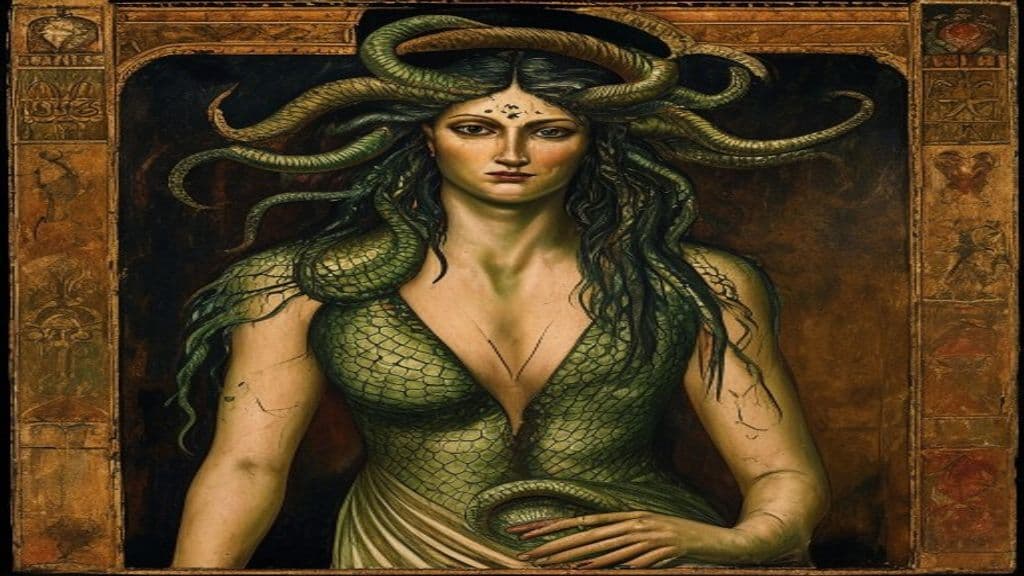
Across the sources summarized, Abyzou is presented as a namable, personified cause of obstetric and neonatal misfortune rather than as a single unified origin-myth. The Testament of Solomon portrays her among a roster of hostile supernatural agents whom Solomon binds and interrogates; that narrative emphasizes her sleepless wandering in search of women about to give birth. Modern scholarship (A. A. Barb, as cited in secondary summaries) has proposed a historical link between the name-form and primeval-sea terms (Mesopotamian Abzu, Greek ábyssos), a hypothesis offered as an interpretive etymology rather than a primary-source self-identification. Regional syncretism is evident in later identifications (e.g., Gylou in Byzantine contexts, Alabasandria in Coptic Egypt) and the recurring motif that she possesses many names, a feature used in magico-medical strategies to control her.
Testamental and amuletic descriptions present Abyzou as a female monstrous figure with serpentine or fish-like features and a troubling visage. The Testament of Solomon (as Obizuth) describes her as having 'a greenish gleaming face with dishevelled serpent-like hair' while the remainder of her body is 'covered by darkness' and she does not sleep. Amulet iconography often renders her with fish- or serpent-like attributes and shows her bound, kneeling with hands tied behind her back, whipped by a standing figure (identified as Solomon or an archangel figure) or trampled beneath a horseman; some commentators note that the dominant amulet image that subdues the figure has womb-like resonances, though that reading is interpretive and tentative in the sources.
Sources consistently attribute to Abyzou a focus on childbirth-related harm: she is said to seek out women in labor and to be responsible for strangling newborns, causing miscarriages and infant mortality. The Testament of Solomon additionally credits her with inflicting deafness, eye trouble, obstructions of the throat, madness, and bodily pains. In magico-medical contexts she functions as a named affliction who can be compelled to 'flee' when confronted with authoritative names, images, or seals; narrative and amuletic traditions emphasize that knowledge or inscription of controlling names and the presence of Solomon/archangelic authority can constrain or expel her.
Weaknesses
- ritualWriting her name on papyrus (Testament of Solomon: 'if her name is written on a scrap of papyrus when a woman is about to give birth, "I shall flee"')
- mantraRecitation/invocation of controlling names (a magic text records that the archangel Michael compelled Abyzou to reveal forty names that can control her)
- symbolImages or seals of Solomon / Seal of Solomon (amuletic inscriptions and depictions show these commanding her flight)
- ritualInvocation of saints/archangels (e.g., Sisinnios/Sisinnia, Raphael/Afarof/Arlaph) — sometimes substituted for Solomon on amulets
Wards
- ritualAmulets depicting Abyzou bound or trampled with inscriptions commanding 'Flee, flee, Abyzou' together with names of Solomon, Sisinnios, or archangels (attested on Byzantine bronze and medieval lead amulets)
- substancePapyrus scrap inscribed with her name placed at childbirth (Testament of Solomon attestation)
- symbolSeal of Solomon and ouroboros inscriptions used on amulets to compel her departure

Aani
Aani (ancient Egyptian jꜥnr) is the lexical term for the baboon in ancient Egyptian language and functions in religious contexts as an animal icon and theophoric epithet. Attested repeatedly in Egyptian texts and images, the baboon image is used to represent or denote aspects of gods such as Thoth, Hapy, Khonsu, and Osiris rather than implying the animal itself is an independent deity.
Aaron
Aaron is a central human figure in Israelite sacred literature: the elder brother of Moses, the first high priest (progenitor of the Aaronide priesthood), and a spokesman/prophet who mediates between Israel and God in Exodus–Deuteronomy narratives. His role in the texts establishes hereditary priestly authority, ritual functions (sacrifices, blessing, use of Urim and Thummim), and institutional norms for Israelite cultic life.
Aati
Aati (also rendered Ati) is one of the 42 judges of the dead in ancient Egyptian funerary literature, attested in the Book of the Dead tradition (notably the Papyrus of Nebsemy). Described as originating 'from Heliopolis', Aati's documented function is to question the deceased about a specific moral accusation during the Duat judgment; the funerary texts supply a formulaic denial the soul must recite.
Abaddon
In Hebrew scripture Abaddon is primarily a noun meaning 'destruction' or a section/condition of the underworld paired with Sheol; in the New Testament Book of Revelation Abaddon is personified as an angelic figure (Greek Apollyon) described as the king of an army of locusts released from the abyss during the apocalypse.
Abadir
Abadir is a polysemous name attested in distinct cultural contexts: a legendary founding saint and clan ancestor in eastern Ethiopia (Sheikh Abadir Umar Al‑Rida / Aw Abadir), a term applied to cone‑shaped cult stones in Phoenician religious description, and a personal name of a martyr (Abadir/Apater) in the Coptic Synaxarium. The attestations are independent usages of the same name rather than a single supernatural being.
Abadiu of Antinoe
Abadiu of Antinoe was a fourth‑century bishop of Antinoe (Antinoopolis, in Roman Egypt) commemorated as a martyr and saint in the Coptic Orthodox Church, with a feast day on 26 December. Sources record that he was killed during a theological dispute with Arian opponents and reference him in collections of Egyptian martyrs.
Abagtha
Abagtha (Hebrew: אבגתא, ’Ǎḇaḡṯā) is a named human court official in the Hebrew Bible’s Book of Esther, listed among seven chamberlains who ministered before King Ahasuerus and were commanded to bring Queen Vashti before the king. He is attested only in Esther 1:10 and is presented as an institutional palace attendant rather than a supernatural being.
Abanoub
Abanoub is a 4th‑century Egyptian Christian child martyr venerated in the Coptic tradition. Remembered for his public confession of Christ, miraculous healings associated with his passion, and the translation and veneration of his relics, his feast is observed on July 31 (Epip 24) and his cult centers include Nehisa and Samanoud.
Abaset
Abaset is a localized ancient Egyptian goddess attested in tomb decoration at El‑Bawiti in the Bahariya Oasis during the 26th Dynasty. She is depicted anthropomorphically with a hedgehog motif incorporated into her headdress and appears on the walls of Qarat Qasr Salim, including twice in the Tomb of Bannentiu. No cult texts, myth narratives, or ritual prescriptions for her are recorded in the cited corpus.
Abaskhiron the Soldier
A Coptic Orthodox martyr venerated for refusing imperial idolatry during the Diocletian persecution; reputedly healed by the Archangel Michael, preserved in monastery relics, and commemorated on 14 June (7 Paoni).
Abdel Messih El-Makari
Abdel Messih El-Makari (1892–1963) was a Coptic Orthodox monk and priest venerated as a 20th‑century Coptic saint. Associated with the Monastery of Saint Samuel the Confessor and the Monastery of Saint Macarius (Scetes/Wadi El‑Natrun), he is remembered for humility, asceticism, charity, and reported spiritual gifts such as prescience, discerning of spirits, and healing.
Abdiel
Abdiel (Hebrew עֲבְדִּיאֵל) is primarily a theophoric Hebrew personal name meaning "servant of El/servant of God," attested once in the Hebrew Bible (1 Chronicles 5:15). In later literature—most notably John Milton's Paradise Lost—Abdiel is reimagined as a faithful seraph who opposes Satan's revolt. The provided sources do not treat Abdiel as an autonomous folkloric spirit type or record rituals or wards associated with the name.
Community Record
- [1]Abyzou - Wikipedia. Wikipedia entry 'Abyzou' (summarizing Testament of Solomon, amulet evidence, and scholarship such as A. A. Barb)wiki
- [2]Wikidata entry Q4748 (Abyzou). Wikidata identifier and linked statements for Abyzouother
- [3]Testament of Solomon (summarized in research notes). Paraphrase and attestations from the Testament of Solomon tradition as provided in the research notes (description of Obizuth; sleepless wandering; strangling newborns; bodily afflictions)literary
- [4]Byzantine and medieval magico-medical amulet evidence (summarized). Descriptions of early Byzantine bronze and medieval lead amulets depicting Abyzou bound or trampled, inscriptions commanding 'Flee, flee, Abyzou,' and invocation of Solomon/Sisinnios/archangels as reported in the research notesacademic
- [5]The new wave of Jewish horror: Ancient folklore (and a child-stealing demoness) in modern movies - UW Stroum Center. Discussion of modern film receptions and the use of Abyzou in contemporary storytelling (cited in the research notes)other
- [6]Archive: Abyzou (various modern/creative sources). Collection references to modern creative or audiovisual materials titled 'Abyzou' (not primary magico-medical sources) as listed in the provided URLsother