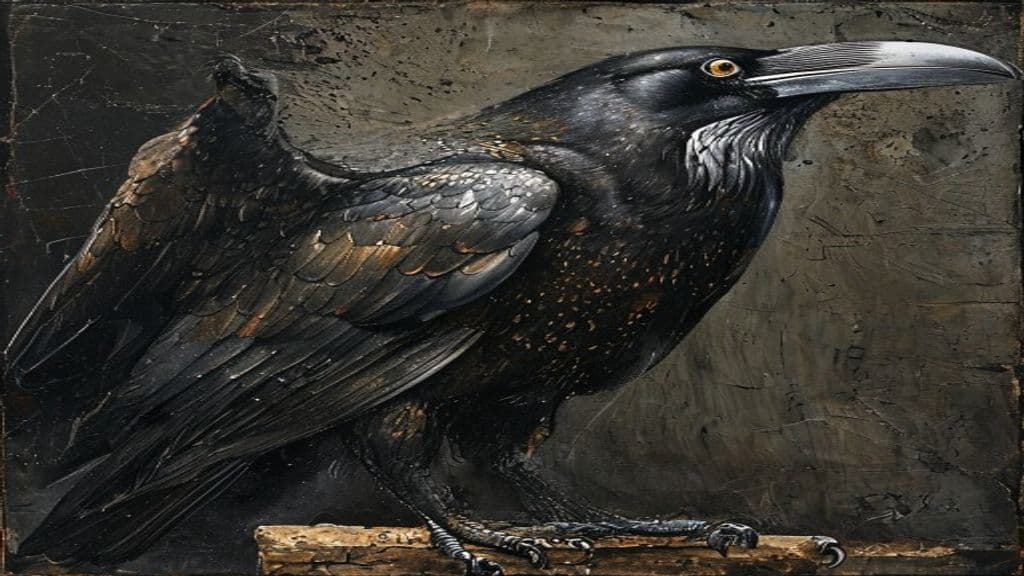
Manuscript ballad versions from late medieval/Renaissance contexts commonly present the valravn as the transformed form of a knight — a human warrior changed into a raven — and frame the creature's condition as a curse tied to that human past. Variant manuscript spellings (val-/vild-/verne- etc.) and later scholarship indicate uncertainty in the compound's original sense, and at least one anecdotal informant tradition records valravne as ravens with human speech rather than transformed humans.
Traditional sources emphasize the raven form and its identity as a former knight rather than giving detailed avian morphology. The ballad depicts a raven that is understood to be a transformed human warrior; a separate anecdote records ravens with human speech (implying ordinary raven appearance but human-like communication). Modern popular culture adaptations invent further hybrid or monstrous depictions, but these are not attested in the traditional sources summarized here.
In the ballad narrative the transformed knight's curse is narratively linked to a single condition: the curse 'can only be broken by consuming the blood of a boy.' This is presented as the plot device for breaking the transformation. Other documented behaviors from the sources are battlefield association and, in one collected anecdote, human speech. Scholarly commentary compares the valravn's place in song to diabolical or trollish figures, implying dangerous or uncanny roles in folk-song contexts, but the primary folkloric attestations center on transformation, battlefield scavenging association, and the ballad's blood-consuming curse-condition.
Weaknesses
- conditioncurse-break by consuming the blood of a boy (ballad motif)
Wards
None recorded.
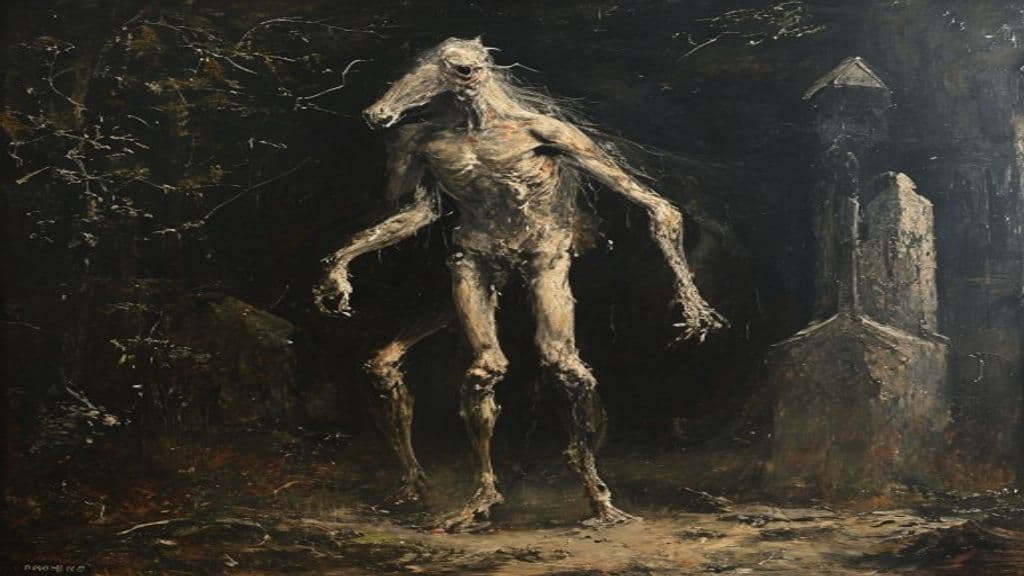
Helhest
A three‑legged supernatural horse in Danish folklore associated with Hel, graveyards, and outbreaks of disease; it functions in tradition as an omen and agent linked to death rather than as a moralized devil-figure.
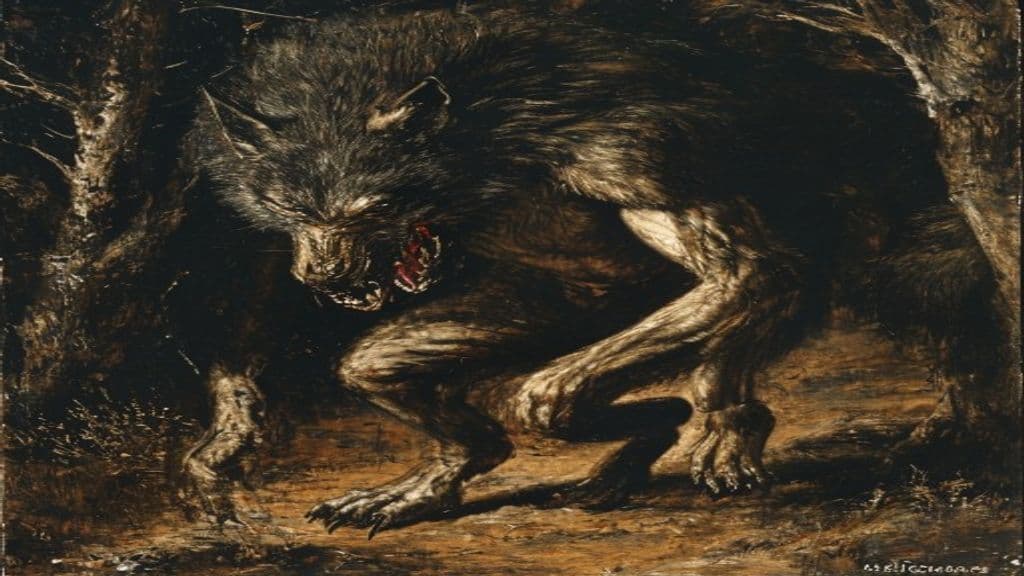
Werewolf
A figure of European folklore of a human who can change into a wolf or wolf–human hybrid, variously portrayed as voluntary shapeshifter, cursed afflicted person, or clinical delusion (lycanthropy). Belief in werewolves was entwined with medieval and early modern witchcraft accusations and persisted into Gothic and popular fiction.
Abraun
Abraun is an attested name in German-language plant-legend scholarship (Der abraun, ein beitrag zur pflanzensagenkunde, 1916) and a short database entry (Wikidata) labels it as a spirit from German mythology. Surviving accessible documentation is extremely limited: the principal academic treatment is a 1916 contribution to pflanzensagenkunde (plant-saga studies), but the excerpts available here contain only bibliographic metadata and do not record tales, descriptions, or rituals.
Adils
Adils (Old Norse Aðils; also Eadgils, Adillus, Athisl, Adhel) is a semi‑legendary sixth‑century Swedish king attested in Old Norse saga material and later medieval traditions. He appears in saga episodes as a storied royal figure involved in warfare, court acts, and marriage suits rather than as a supernatural being.
Agilaz (Egil)
Agilaz (reconstructed Proto-Germanic) — commonly recorded in medieval sources as Egil or Ægil — is a legendary archer attested in Germanic heroic tradition. He appears as the brother of Völund (Wayland/Weland) in the Old Norse poem Völundarkviða and in the Thidreks saga, and his name is also inscribed on early medieval objects (Franks Casket, Pforzen buckle). The attested material presents him as a named heroic human archer within saga and inscriptional contexts rather than as a recurrent supernatural species.
Alaisiagae
A group of Germanic female deities attested in Roman Britain, worshipped by continental auxiliary troops at a shrine near Vercovicium (Housesteads) on Hadrian's Wall. Epigraphic evidence records dedications to named members (Beda, Fimmilena, and in other lists Baudihillia and Friagabis) alongside Mars Thincsus and the numen of the emperor; modern scholarship interprets them variously as war/victory goddesses, as goddesses associated with assembly/justice, or as part of Matronae‑type fertility/ancestor cults.
Alberich
In Germanic heroic legend, Alberich is a dwarf associated with elven qualities and power. (Note: 1. Power tier: Reduce to Ancient as Alberich's abilities are not described beyond being a dwarf with elven qualities. 2. Origin story: Clarify that Alberich is mentioned in multiple Germanic texts, bu)
Alcis
A pair of youthful brother-deities worshipped by the Naharvali, attested only in Tacitus' Germania (c. 98 CE). They were venerated in a sacred grove under the care of a priest in female attire and are compared by Roman ethnography to the Graeco‑Roman Dioscuri (Castor and Pollux).
Alf and Alfhild
Alf and Alfhild are legendary human figures from Old Norse/early Scandinavian narrative tradition preserved principally in Saxo Grammaticus' Gesta Danorum. The tale presents Alf as a Danish prince and Alfhild as a Geatish princess who becomes a shieldmaiden and leader of a fleet of female raiders; their story includes combat, recognition, marriage, and later dynastic conflict.
Allerleirauh
Allerleirauh is the eponymous heroine of a Brothers Grimm fairy tale (Grimm no. 65; ATU 510B) who flees an enforced-marriage crisis by disguising herself in a mantle of many furs, takes menial service in another court, and later reveals her identity through three magnificent dresses and token objects to secure recognition and marriage.
Alp
A German-speaking folkloric figure associated with nocturnal disturbance of sleepers. Historically tied to the broader Germanic family of 'elves' and treated variously as an eerie nature-being in medieval glosses and as a male nocturnal spirit in later folk accounts that sits on sleepers' chests and causes nightmares (Alptraum) and 'elf-pressure' (Alpdruck).
Alraune
Alraune is the German folkloric figure identified with the humanoid-shaped mandrake (Mandragora officinarum) and the eponymous female character in Hanns Heinz Ewers's 1911 novel. In folklore the mandrake/Alraune is associated with love philtres, fertility, and a medieval gallows-origin legend; in literature the name labels a woman artificially conceived from a criminal's semen, whose emotional life and actions dramatize the folk moral about such origins.
Altgermanische Religionsgeschichte
A historical survey of Germanic religious history, providing an overview of the pantheon of gods and goddesses. (Note: - Power tier is not applicable to historical surveys - The article should reflect that it's a historical survey, not an entity with abilities or appearance - Consider adding information on the signifi)
Amleth
Amleth (Old Norse: Amlóði; Latinized Amlethus) is a legendary medieval Scandinavian prince and saga-hero best known from Saxo Grammaticus' Gesta Danorum. He is a human protagonist whose story centers on feigned madness, cunning survival, exile to Britain, marriage, wealth-gathering, and eventual vengeance against his father's murderer; the tale later inspired the character of Shakespeare's Hamlet and numerous adaptations.
Community Record
- [1]Valravn — Wikipedia. Wikipedia: 'Valravn' (summary of ballad and tradition)wiki
- [2]Evald Tang Kristensen collection (anecdote). Evald Tang Kristensen, Tale no. 120, chapter C — informant Peder Johansen (as summarized in research notes)folk
- [3]Jacob Grimm commentary (quoted in summaries). Jacob Grimm — comparative remark that 'vilde ravn / vilde valravn' take the place of the diabolical trold and proposed Old High German *walahraban (as cited in provided notes)academic
- [4]Coasterpedia gloss (modern popular gloss). Coasterpedia entry glossing valravn as 'raven of the slain' (used as modern explanatory gloss in sources)other