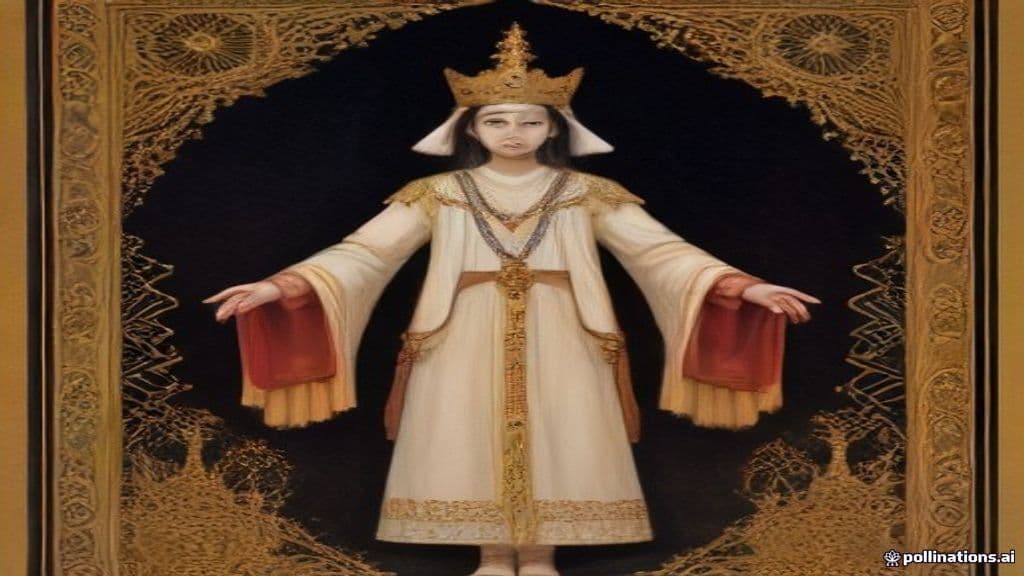
The yazatas arise within the Avestan cosmological and ritual vocabulary as entities 'worthy of worship' (from the root yaz- 'to worship, to honor'). In Zoroastrian theology they are the good, beneficent powers under Ahura Mazda; some of the great divine emanations (Amesha Spentas) overlap with or are identified as yazatas. The category functions across hymn, ritual and calendar: individual yazatas are invoked in Avesta hymns (Yashts) and were fixed as patrons in a day-name calendar that placed each day under a particular yazata's protection.
Scriptural and later traditional materials generally present some yazatas with anthropomorphic attributes in hymnic and exegetical contexts: certain figures are described as bearing emblems (e.g., a mace) or crowns, keeping vigil against demons, or otherwise shown in dignified investiture imagery (for example, Mithra in Sassanian reliefs interpreted as a yazata). These descriptions pertain to particular named yazatas or artistic depictions rather than asserting a single uniform appearance for the class as a whole.
Yazatas function as beneficent divine powers with roles tied to elements of creation, moral order, ritual life and cosmology. Specific yazatas are associated with particular domains: Aredvi Sura Anahita with waters (in later tradition described also as a world-encircling river), Tishtrya and Verethragna figure in rain and victory narratives, and Sraosha, Mithra and Rashnu are named in tradition as guardians involved in the Chinvat bridge judgment. They are invoked in hymns, honored in ritual, and serve as patrons for days of the month; beyond these attributions, later summaries sometimes ascribe further element-linked or physical abilities (e.g., vegetation guardianship, flight) to some yazatas, but such claims reflect interpretive expansions rather than consistent statements in the earliest Avesta.
Weaknesses
None recorded.
Wards
- ritualinvocation and hymnic praise (Yashts)
- ritualday-name dedication (calendar observance)

Apsara
Celestial dancers and water nymphs of Hindu cosmology — beautiful semi-divine beings who dance at the court of Indra and, by his command, descend to earth to distract sages from excessive asceticism.

Mormo
A Greek child-eating bogeywoman used to frighten children into obedience, sometimes depicted as a shape-shifting female phantom who bit naughty children.
*Perkʷūnos
*Perkʷūnos is the reconstructed Proto-Indo-European thunder‑god hypothesized by comparative linguistics and mythology. Scholarly reconstructions portray him as a storm or thunder figure associated with fructifying rain and as the combatant who fights a multi‑headed water‑serpent to release life‑giving waters; no direct attestations from the Proto‑Indo‑European period survive and the figure is inferred from later Indo‑European traditions.
*Péh₂usōn (reconstructed)
Péh₂usōn is a hypothetical Proto‑Indo‑European pastoral guardian reconstructed by comparative scholars from parallels in Greek and Vedic traditions. Proposed as a Graeco‑Aryan ancestor‑figure, the reconstruction describes a protector of flocks, roads, and travellers rather than an attested historical cultic personality.
57 Mnemosyne
57 Mnemosyne is a large main-belt asteroid (S-type) discovered in 1859 and named after the Greek Titaness Mnemosyne. It is a non-sentient astronomical body studied for its orbital and rotational properties and has been used in dynamical measurements related to Jupiter.
Ab-Zohr
Ab-Zohr is the culminating rite of the Zoroastrian Yasna service: a formal offering to the waters (Aban/Apas) that creates the consecrated liquid parahaoma and functions to purify, strengthen, and atone for damage done to waters. It is a ritual action rather than an independent supernatural being.
Abaddon
In Hebrew scripture Abaddon is primarily a noun meaning 'destruction' or a section/condition of the underworld paired with Sheol; in the New Testament Book of Revelation Abaddon is personified as an angelic figure (Greek Apollyon) described as the king of an army of locusts released from the abyss during the apocalypse.
Aban (Āb/Ābān)
Aban (Avestan apas; Middle Persian āb/ābān) is the collective, sacred principle of the waters in Zoroastrian cosmology — both the element water and its personified hypostases (the Apas/Ahuranis). Aban functions as a primordial, life-giving creation, a calendrical and liturgical focus (day-name, month-name, Abanagan feast), and a ritual object of veneration (ape zaothra, Aban Yasht) rather than a malign force to be expelled.
Aban Yasht
The Aban Yasht is a hymn from the Persian tradition that praises Anahita, a goddess associated with water, fertility, and wisdom. It consists of 132 stanzas and is part of the 21 Yashts collection. (Note: - Power tier should be "Primordial" or possibly "Cosmic", given that it's a hymn of great spiritual significance and associated with a goddess. - The article incorrectly states that Anahita is associa)
Abath
No corroborated folkloric entity named "Abath" is documented in the provided sources. The string appears in the supplied material only as a surname/personal name in Aruban/Dutch-Caribbean archival records and as an unrelated taxonomic or encyclopedic hit; no mythic attributes, origin stories, rituals, or apotropaic practices for an entity called Abath are present in the documents reviewed.
Abatur
Abatur is an uthra (celestial emanation) in Mandaeism described as the 'father of the Uthras' and called the Ancient (ʿattīqā). He resides on the boundary between the World of Light and lower regions, functions as a judge who weighs souls (Abatur Muzania), and supplies instructions and materials to the demiurgic uthra Ptahil in accounts from the Diwan (Scroll) of Abatur.
Abatwa (Twa / Batwa)
Abatwa (also recorded as Twa, Batwa, Mutwa; singular forms Barhwa or Murhwa in some transcriptions) are indigenous hunter‑gatherer peoples of the Great Lakes region of Central Africa, historically identified as some of the earliest inhabitants of the area. The available sources treat them as human ethnic groups whose livelihoods, lands, and populations have been severely affected by conservation policies and modern violence.
Abellio
Abellio is a theonym attested in Roman‑period inscriptions from the Comminges area of the Pyrenees and reported as worshipped in the Garonne Valley of ancient Gallia Aquitania. Surviving evidence is limited to a small number of inscriptions; scholars have variously hypothesized solar or arboreal associations and compared the name to forms of Apollo or to Celtic Belenus, but the deity's precise role in local cosmology remains uncertain.
Abraham
Abraham (originally Abram) is the foundational patriarchal ancestor in the Hebrew Bible whose life establishes a covenantal relationship between his family/people and God. He functions as an exemplar of faith, the progenitor of promised descendants, and a narrative anchor for claims of land, blessing, and communal identity in later religious traditions.
Community Record
- [1]Yazata - Wikipedia. Wikipedia, 'Yazata'wiki
- [2]KHORDA AVESTA: YASHTS (Mithra yasht excerpt). Avesta: Khorda Avesta, Yashts (Mithra)literary
- [3]The Religious Ceremonies and Customs of the Parsees (excerpt). J. J. Modi, The Religious Ceremonies and Customs of the Parsees, Part 5 (excerpt)folk
- [4]Taq-e-Bustan investiture relief description (Mithra as yazata). Taq-e-Bustan relief discussion (interpretation of Mithra in investiture imagery)other