
Within syncretic Shinto–Buddhist frameworks, when a person dies their reikon (霊魂) leaves the body and enters a liminal purgatorial state, waiting for proper funeral and post-funeral rites; if rites are incomplete, death is sudden or violent, or intense emotions (revenge, love, jealousy, sorrow) remain, the reikon can become a yūrei that returns to the world of the living. Social factors such as rank and the circumstances of death shape how and whether a reikon manifests as a potent haunting (examples in tradition include tales of Oiwa and Okiku as victims whose violent deaths produced powerful revenants).
Sources treat yūrei as attenuated or insubstantial presences (the name itself combines kanji for 'faint/dim' and 'soul/spirit'). While no single canonical physical description is exhaustively given in the supplied material, visual and narrative traditions frequently portray partial, faint apparitions; artistic series and popular tales often show pale, floating figures and regional accounts commonly report sightings of a 'ghostly woman in white.' The supplied excerpts caution that these motifs are common in art and local legend but stop short of defining a universal costume or exhaustive iconography.
Yūrei are described as reikon that bridge back to the physical world: they linger, haunt locations or people connected to their death or emotional ties, and remain until the missing rites are performed or their emotional cause is resolved. Specific subtypes display characteristic behaviors—onryō (vengeful spirits) may cause disaster or possession, ubume return to care for children, funayūrei haunt seas or ships, and zashiki-warashi act as mischievous child-spirits. Living spirits (ikiryō) can exhibit similar agency while their body remains alive. Sources emphasize these social and ritualized behaviors rather than grand cosmological powers.
Weaknesses
- conditionavoidance of reflective gaze (local anecdote)
Wards
- conditionavoidance/physical avoidance of haunted loci (practical caution as attested in Kiyotaki Tunnel accounts)
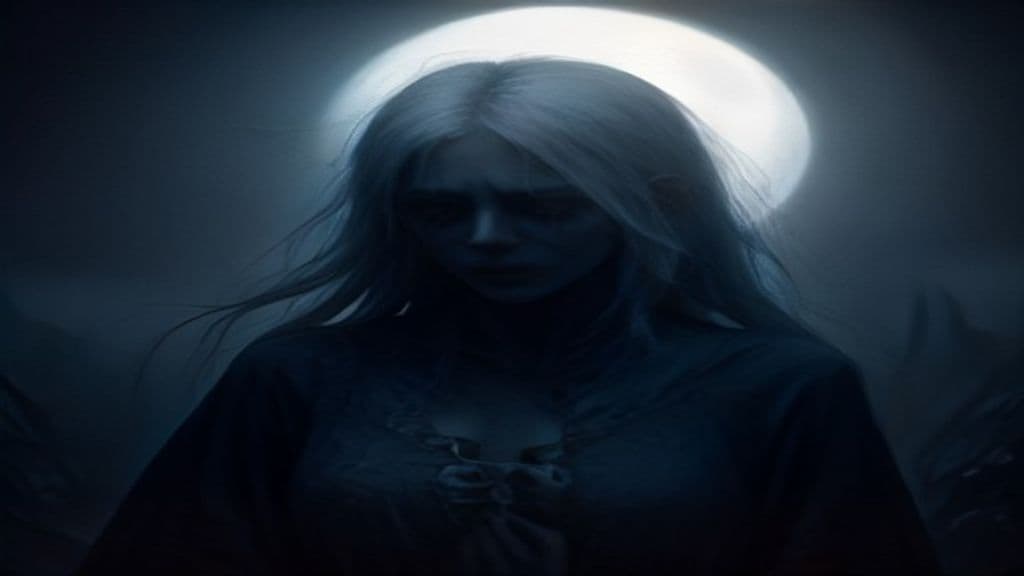
Banshee
A female spirit of Irish and Scottish folklore whose wail heralds an impending death in a family of Gaelic descent. Not a cause of death — a witness to it.
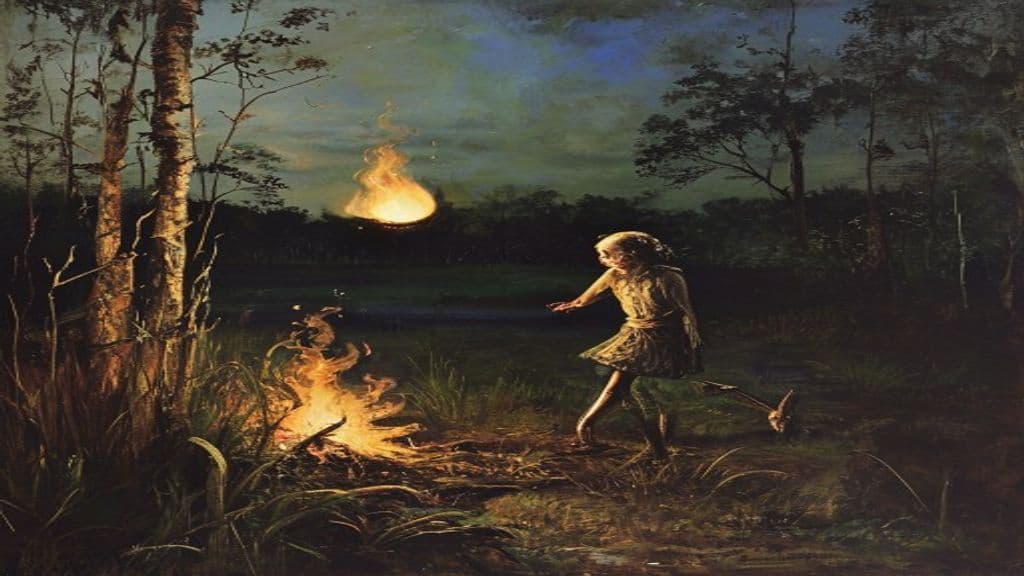
Will-o'-the-wisp
An atmospheric 'ghost light' — a small, mobile, lamp-like light seen at night over marshes, bogs, wet ground, or graveyards. In many cultures the phenomenon is interpreted as a supernatural being or manifestation (wandering nature-spirit, soul of the dead, transformed witch, or treasure-indicator); modern science offers chemiluminescent explanations for some occurrences.
5 Ronin
5 Ronin is a 2011 Marvel Comics five-issue limited series that reimagines five Marvel superhero archetypes as rōnin (masterless samurai) in a fictionalized post‑Sekigahara feudal Japan. The work places Wolverine, Hulk, Punisher, Psylocke, and Deadpool analogues into period roles to explore displacement, revenge, and identity in an era of political upheaval.
Abumi-guchi
A Japanese yōkai classed as a tsukumogami: an animated stirrup (abumi) depicted in Sekien Toriyama's Gazu Hyakki Tsurezure Bukuro. Traditional accounts say it is formed from a stirrup that belonged to a soldier who fell in battle and that it waits where the stirrup lies for its dead owner to return.
Abura-akago
An Edo-period yōkai depicted as an oil‑licking infant or a ball of flame. First recorded in illustrated compendia (notably Toriyama Sekien's Konjaku Gazu Zoku Hyakki), the Abura-akago is tied to tales of oil‑stealing fires and functions in part as an etiological warning about wasting or stealing oil.
Abura-sumashi
A yōkai spirit from the Amakusa region of Kumamoto Prefecture, Japan, said to inhabit mountain passes. Traditionally explained as the ghost of a person who stole oil, it appears to surprise travelers and is represented in modern media with a straw-coat body and a potato- or stone-like head.
Aburabō / Abura-bōzu / Aosaginohi (traditions)
Two distinct Japanese traditions appear under related flame imagery: Aosaginohi/Aosagibi is presented as a will-o'-the-wisp type luminous night phenomenon interpreted as reflections from herons; aburabōzu (abura bōzu, "oil monk") appears in a separate anecdote as a reported fire-breathing apparition in a 12th-century Yasaka Shrine tale. The sources treat them as separate portrayals rather than a single unified being.
Acala
Acala (Sanskrit: अचल, 'The Immovable') is a wrathful protective deity (dharmapala) in Vajrayāna and East Asian esoteric Buddhism, classed among the Wisdom Kings (Vidyārāja). He functions as a ritual focus for visualization and mantra practice intended to remove obstacles and bind or destroy hostile forces.
Acalanātha (Acala / Achala)
Acalanātha (also Acala or Achala) is a wrathful deity and dharmapāla — a protector of the Dharma — prominent in Vajrayana and East Asian Mahayana Buddhist contexts. Presented as a fierce, non‑human or semi‑divine protector-figure, Acalanātha functions to defend the teaching and practitioners by removing obstacles and confronting threats to the transmission and practice of Buddhism.
Agaru
Agaru (attested historically as Agarum) appears in the supplied sources as a Bronze Age Near Eastern toponym—often identified with Failaka Island—and as a modern personal or media name. The provided material contains no evidence that Agaru is a supernatural being in any traditional cosmology.
Agni
Agni is the Vedic personification of fire in Hindu tradition: a sacred, mediating principle that manifests as terrestrial fire, atmospheric lightning, and celestial sun, and that receives and conveys sacrificial offerings. Prominent in the Rigvedic corpus, Agni functions as sanctifier, witness of rites of passage, and a transformational inner principle in later Upanishadic literature.
Aizen Myō-ō (Rāgarāja)
Aizen Myō-ō corresponds to the deity Rāgarāja, a wrathful/transformation-oriented figure venerated in Esoteric and Vajrayāna Buddhist traditions. The figure is especially revered in Chinese Esoteric Buddhism in Chinese communities and in the Japanese Esoteric schools Shingon and Tendai.
Ajisukitakahikone
Ajisukitakahikone is a kami in Japanese mythic literature (Kojiki/Nihon Shoki). He appears in the transfer-of-rule cycle between heaven and earth, is described as a son of Ōkuninushi, associated with the Kamo cult (called Kamo no ōmikami in some modern museum/catalog entries), and features in narratives that explain landscape formation and meteorological genealogy.
Aka Manto
Aka Manto (赤マント, "Red Cloak") is a Japanese urban legend and schoolyard ghost-story about a masked, cloaked figure who appears in public or school toilet stalls and forces occupants to choose between colored toilet paper; each choice in the tale produces a violent supernatural consequence. The legend is part of modern popular folklore recorded in school contexts from the 1930s onward rather than a formal religious myth.
Community Record
- [1]Yūrei (Wikipedia). Wikipedia, entry 'Yūrei' (accessed via provided notes)wiki
- [2]Haunted Kyoto — Kiyotaki Tunnel accounts (Archive). Haunted Kyoto (archive source describing Kiyotaki Tunnel legends and local warnings)folk
- [3]Yurei (Magical Japanese) — NHK WORLD / Lafcadio Hearn reference. NHK WORLD program description referencing Lafcadio Hearn and Kwaidan (linking Matsue and literary treatment of yūrei)literary
- [4]Kosodate Yūrei – The Child-Raising Yūrei | Hyakumonogatari Kaidankai. Hyakumonogatari Kaidankai site (local tale and commentary on yūrei requiring a 'tether')folk
- [5]Aizuwakamatsu no Yurei – The Yurei of Aizuwakamatsu | Hyakumonogatari Kaidankai. Hyakumonogatari Kaidankai (regional yūrei tale)folk
- [6]One Hundred Ghost Stories. Reference to the Hyakumonogatari / kaidan storytelling tradition and its role in yūrei literaturewiki
- [7]Yurei: Discover the Chilling World and Tales of Japanese Ghosts (Voyapon). Popular overview summarizing cultural and visual traditions around yūreiother
- [8]Wikidata: Q135044606 (Yurei — video game entry). Wikidata entry Q135044606. http://www.wikidata.org/entity/Q135044606other
- [9]MIRROR MAN COMPLETE JUNIPERCLAW MINI MAP (Archive.org participant list). Archive.org. "MIRROR MAN COMPLETE JUNIPERCLAW MINI MAP" (participant list includes the string 'YUREI'). https://archive.org/details/mirror-man-complete-juniperclaw-mini-mapother
- [10]Yūrei (Mingei Gallery: Rosetsu entry / Hyakumonogatari Kaidankai context). Mingei Gallery entry linking Edo-period storytelling, Rosetsu paintings, and the codification of yūrei imagery; notes Hyakumonogatari Kaidankai as a cultural context.other
- [11]What’s the Difference Between Yurei and Yokai? | Hyakumonogatari Kaidankai. Hyakumonogatari Kaidankai: discussion of classification distinctions and storytelling practice.folk
- [12]Shinto Deities in Japan, Japanese Shinto-Buddhist Syncretic Deities. Summary noting syncretism between Shinto and Buddhist frameworks in Japan and their mutual influence on spirit beliefs.other