Entity Index

A record of the unseen, drawn from world folklore.

7631 entities · page 15 of 128

Andariman
Lesser

Andariman

Andariman is a named antagonist in the Shahnameh cycle of Greater Iran, depicted in manuscript illustrations and genealogical lists as an enemy combatant—described in a manuscript caption as "one of the Turkman host"—who fights the Iranian hero Gorgin (Gurgin) and is shown slain in illustrated episodes.

Andarta
Greater

Andarta

Andarta is a local Celtic goddess attested by votive inscriptions in and around the town of Die (modern Drôme) in the territory of the Vocontii during the Roman imperial period. She is recorded in seven dedications as Dea Augusta Andarta (c. 150–200 AD) and appears to have functioned as a tutelary deity associated with civic welfare, victory, and Romanized cultic practice.

Andhaka
Greater

Andhaka

Andhaka is a Puranic asura (demon) figure in Hindu literature who, born in an episode of darkness, attains great power through tapas and a boon from Brahmā, contests the gods and Shiva, and is ultimately defeated or transformed—sometimes repenting and becoming a Gaṇa chief. His story appears across multiple Puranas and Skandapurāṇa material.

Andhrímnir
Minor Spirit

Andhrímnir

Andhrímnir is the named cook of the Æsir and the einherjar in Old Norse myth, responsible for slaughtering and preparing the beast Sæhrímnir daily in Valhalla and for producing the gods' mead from Heiðrún's milk. He is attested in the Poetic Edda and summarized in modern reference works.

Andjety
Ancient

Andjety

Andjety is an ancient Egyptian regional deity of the ninth nome (Andjet/Busiris) associated with kingship, funerary renewal, and local underworld functions; he appears in Pyramid and Coffin Texts and is often syncretized with Osiris in temple imagery and royal ritual.

Andlang
Lesser

Andlang

Andlang (Old Norse Ǫndlangr / Andlang) is presented in Snorri Sturluson's Prose Edda as the second of a ninefold scheme of heavens, placed between the first heaven (containing the halls of the gods) and the third heaven, Vídbláin. In Snorri's account Andlang functions as a shelter and dwelling-place for the souls of the dead during and after the destruction of Ragnarök.

Andraemon
Lesser

Andraemon

Andraemon (Ancient Greek: Ἀνδραίμων, Andraímon) is a personal name borne by several mortal figures in Greek myth and genealogical tradition. The name appears across variant accounts as husbands, fathers, kings, colonists, and a suitor; it functions within heroic genealogies and local foundation stories rather than as a supernatural being.

Andragius
Minor Spirit

Andragius

Andragius (also attested Androgius) is a legendary king of the Britons recorded in Geoffrey of Monmouth’s pseudo‑historical regnal lists and later compilations. He appears as a node in a constructed sequence of rulers—not described as a supernatural being—and is principally attested by name, genealogical relationships, and position in succession.

Andras
Greater

Andras

Andras is a named infernal spirit from the Western grimoire/Goetic tradition, described as a hostile officer who sows discord and is dangerous to conjurers; modern roleplaying adaptations recast him as a demon raised from murderous souls with a purpose to destroy mortals.

Andrast
Minor Spirit

Andrast

Andrast is a Sindarin place-name in J. R. R. Tolkien's Middle-earth, denoting a long coastal cape or peninsula in southwest Gondor (also identified with Ras Morthil). It is a geographic toponym recorded in Tolkien's maps and scholarly indexes rather than a sentient or supernatural being.

Andraste
Lesser

Andraste

Andraste (also attested as Andrasta or Andate in some passages) is a named supernatural figure invoked by the Iceni in the Roman account of Boudica's rebellion (AD 60). Recorded by Dio Cassius as a recipient of Boudica's rallying prayer, Andraste functions in surviving sources as a tutelary war figure associated with victory and the preservation of liberty.

Andrea Beaumont (the Phantasm)
Lesser

Andrea Beaumont (the Phantasm)

Andrea Beaumont is a fictional human character in the DC Animated Universe who, as the masked vigilante known as the Phantasm in Batman: Mask of the Phantasm (1993), stages a Death‑like avenger persona. Her apparent supernatural effects are produced by theatrical devices (not innate powers) and she functions narratively as a foil and dark parallel to Bruce Wayne/Batman.

Andrealphus
Lesser

Andrealphus

Andrealphus is a spirit named in the Ars Goetia (Lesser Key of Solomon) tradition, described as a Marquis who governs thirty legions. He is classically credited with teaching geometry, mensuration, and astronomy and with the ability to assume or cause bird/peacock form.

Andrew the Apostle
Ancient

Andrew the Apostle

Andrew the Apostle (Greek Ἀνδρέας, Latin Andreas) is one of the Twelve Apostles in the New Testament, a fisherman from Bethsaida, the brother of Simon Peter, described as the “first-called” who introduced others to Jesus. Post-biblical traditions depict him as an early missionary and founder of Christian communities (notably claims of missions to Thrace, Scythia, and founding the see of Byzantium) and as a martyr crucified at Patras.

Androgeos
Lesser

Androgeos

Androgeos (Greek Ἀνδρόγεως, Latin Androgeus) is a personal name borne by mortal figures in classical Greek and Roman literary tradition, most notably a son of Minos and Pasiphaë whose death in mythic narratives precipitates Athenian tribute to Crete. A separate, less-detailed bearer of the name is listed as a Greek soldier present at the sack of Troy in some sources.

Androgeus
Lesser

Androgeus

Androgeus is a mythic human name borne by at least two distinct figures in Classical Greek and Roman tradition: a Cretan prince, son of Minos and Pasiphaë, famed for athletic victories and whose death in some accounts is linked to the Marathonian/Cretan bull; and Androgeos, a Greek soldier named by Virgil in the Aeneid who, during the sack of Troy, mistakes Aeneas and his companions for fellow Greeks. Both are mortal figures woven into larger heroic and epic cycles rather than supernatural beings.

Androgynos (Judaism)
Minor Spirit

Androgynos (Judaism)

In rabbinic Jewish literature, the androgynos (Hebrew: אַנְדְּרוֹגִינוֹס, ʾandərôg̲înôs) is a human juridical category for a person who possesses both male and female sexual characteristics. It is treated as a special halakhic classification that raises questions about which gendered legal obligations, prohibitions, and ritual statuses apply.

Androktasiai
Lesser

Androktasiai

Androktasiai (Ἀνδροκτασίαι, sing. Androktasia) are plural personifications in ancient Greek poetry that embody manslaughters or the slayings of men in battle. They appear chiefly as named offspring of Eris in Hesiod's Theogony and as elements in Homeric/Hesiodic ekphrasis (the Shield of Heracles), functioning as poetic embodiments of wartime slaughter rather than individualized cult-deities.

Andromache
Minor Spirit

Andromache

Andromache (Ancient Greek Ἀνδρομάχη) is a human figure of ancient Greek literary tradition: the wife of Hector of Troy who exemplifies virtuous fidelity, ritual mourning, and the losses suffered by women in war. She appears in Homeric epic and later classical sources as grieving spouse, captive concubine after Troy's fall, and later queen in post-war narratives.

Andromachus
Minor Spirit

Andromachus

Andromachus (Ancient Greek: Ἀνδρόμαχος, Andromachos) is a personal name borne by multiple historical and mythological figures in classical Greek and later sources — including commanders, rulers, physicians, a grammarian/philologus, and a minor mythic warrior from Knossos. The name literally means "fighting with men" and in the cited traditions denotes human individuals rather than a supernatural being.

Andromalius
Greater

Andromalius

Andromalius is a named spirit from post-medieval grimoire tradition (Ars Goetia–style catalogues) presented as a ranked officer who recovers stolen goods, exposes thieves and dishonest dealings, and punishes wrongdoers. He appears primarily in modern occult reference compilations derived from the Goetia; ritual details and physical description are not attested in the supplied grimoire excerpts.

Andromeda
Minor Spirit

Andromeda

Andromeda is a mortal princess in ancient Greek myth, daughter of Cepheus and Cassiopeia, who is offered as a sacrificial victim to the sea monster Cetus and rescued by the hero Perseus. Her story links human hubris, divine punishment, heroic rescue, and catasterism—she is later placed among the stars as the constellation Andromeda in some accounts.

Andron
Lesser

Andron

Andron (Ancient Greek: Ἄνδρων) is an ancient Greek personal name attested for multiple historical individuals (writers, a dancer/composer, historians, a sculptor, a physician) in classical biographical and bibliographical sources; it also appears as a modern given name/surname in contemporary records. The provided sources do not present Andron as a supernatural being.

Andvari
Minor Spirit

Andvari

Andvari is a dwarf from Old Norse sources (attested in the 12th century) who lives beneath a waterfall, hoards gold, owns a magical ring called Andvaranaut, can change into a pike, and curses the gold when it is stolen—events that set in motion tragic outcomes in Norse heroic narrative.

Anemoi
Lesser

Anemoi

In ancient Greek religion and myth the Anemoi (Ἄνεμοι, 'Winds') are the personified winds: a group of minor wind-gods each associated with a compass direction and with characteristic weather or seasonal phenomena that come from that direction.

Anethus
Minor Spirit

Anethus

Anethus (Ancient Greek Ἄνηθος, Ánēthos) is a fragmentarily attested mythic figure from Greek tradition who is named as a beautiful youth transformed into the dill plant (Anethum graveolens). He functions as an aetiological or name-origin figure preserved only in late-antique grammatical/mythographic commentary.

Anextiomarus
Lesser

Anextiomarus

Anextiomarus (Gaulish Anextlomāros; feminine Anextlomara) is an ancient Celtic theonym or epithet attested in Romano-British and Gallo-Roman inscriptions. In the sources it functions as an epithet of a solar deity syncretized with the Roman god Apollo and is glossed in one source as meaning roughly "Great Protection," indicating a protective, beneficent cult function in votive contexts.

Anextlomarus
Greater

Anextlomarus

Anextlomarus (also Anextiomarus; feminine Anextlomara) is a Romano-Celtic theonym attested in inscriptions from Roman Britain and Gaul. The name, interpreted as 'Great Protector', appears in dedicatory contexts and in one instance is equated with the Roman god Apollo, indicating a locally venerated protective deity integrated into Roman civic-religious practice.

Angada
Lesser

Angada

Angada (Sanskrit: Aṅgada) is a legendary vanara prince in the Rāmāyaṇa tradition who serves as a warrior, envoy, and later king of Kiśkindhā. He is presented as the son of Vāli and Tārā, nephew and lieutenant of Sugrīva, a commander in the expedition to Laṅkā, and a dramatic figure in later literary and performative adaptations.

Angak (Angak'china)
Minor Spirit

Angak (Angak'china)

Angak, or Angak'china, is a male Hopi kachina spirit represented both by spirit dancers in village ceremonies and by carved kachina dolls. He is a rain‑bringing, fertility, healing, and protective figure whose songs and slow dances are intended to bring rain and flowers to Hopi villages.

Angalo
Primordial

Angalo

Angalo is a primordial culture-hero and giant in Ilocano mythology credited with shaping the landscape of Luzon and explaining natural phenomena; narratives present him as the first man and an ancestral figure whose bodily acts produced mountains, valleys, seas, and celestial features.

Angel
Greater

Angel

A spiritual or heavenly being functioning primarily as a messenger and intermediary between a transcendent deity and humanity; angels also act as protectors, guides, and executors of divine will across several Abrahamic and adjacent traditions.

Angel Moroni
Ancient

Angel Moroni

In Latter Day Saint narratives, Moroni is a post‑mortem, angelic messenger and custodian of sacred scripture who is said to have appeared to Joseph Smith beginning in 1823 to reveal and deliver the golden plates that became the Book of Mormon. He is portrayed as a resurrected/ministering human who functions as intermediary, guardian of records, and revealer to a chosen prophet.

Angel Salvadore
Lesser

Angel Salvadore

Angel Salvadore is a fictional Marvel Comics character, a mutant who manifests insect-like physiology (butterfly-like wings, acid projection, and sonic blasts produced by wing vibrations). Introduced in X‑Men comics, she is depicted as a teenage mutant rescued and educated at the Xavier Institute and later appearing in other teams and media.

Angel of Hadley
Lesser

Angel of Hadley

A New England colonial legend of a sudden, providential defender who appeared in Hadley, Massachusetts during attacks in King Philip's War. The figure is commonly identified in tradition with the fugitive regicide Colonel William Goffe; accounts blend possible historical actions, contemporary silence or obfuscation, and later legendary embellishment that calls the rescuer an 'angel.'

Angel of Portugal
Greater

Angel of Portugal

A Catholic devotional national guardian angel venerated as the heavenly custodian of Portugal. Recognized in popular devotion, private revelation narratives (notably the 1916 visitations connected to Fátima), and in Portuguese liturgical practice through a feast instituted in the early 16th century and restored in the 20th century.

Angel of the Lord
Ancient

Angel of the Lord

A recurring divine messenger in the Hebrew Bible and New Testament who appears on behalf of the God of Israel, acting as God's representative in speech and deed. The figure—Hebrew מַלְאַךְ יְהוָה (mal’ākh YHWH)—functions as intermediary, guide, protector, judge, and announcer at decisive narrative moments.

Angel of the Presence
Ancient

Angel of the Presence

A high-ranking heavenly attendant described in Hebrew and Second Temple literature as one who "stands in the presence" of God and acts on God's behalf toward Israel. Sources treat the figure either as an elite created angelic office (one of the attendants who enter before the Lord) or, alternately, as a scriptural idiom referring to God's own saving presence.

Angelia
Minor Spirit

Angelia

Angelia (Ancient Greek: Ἀγγελία) is an ancient Greek poetic personification of 'Message', attested in Pindar (5th century BC) as named a daughter of the messenger-god Hermes. She functions in the literary-cosmic vocabulary as the embodiment of a delivered message rather than as a separately attested cultic deity or independent supernatural class.

Angelos (Angelia)
Lesser

Angelos (Angelia)

Angelos (Ancient Greek: Ἄγγελος) or Angelia (Ἀγγελία) is a minor divine figure in Greek myth attested only in a scholion on Theocritus' Idyll 2. She is described as a daughter of Zeus and Hera who was entrusted to and raised by nymphs; the preserved account is fragmentary and breaks off abruptly.

Angels (Malāk) in Islam
Ancient

Angels (Malāk) in Islam

Heavenly beings in Islamic doctrine created from light, part of the unseen (ghayb) and the divine order, who obey God and perform functions such as conveying revelation, recording deeds, and executing divine commands. Belief in angels is one of the six articles of faith in Islam and they occupy roles across cosmology, eschatology, and devotional teaching.

Angels of Mons
Greater

Angels of Mons

A World War I legend of a supernatural force that intervened to protect British troops during the Battle of Mons (23 August 1914). Originating in Arthur Machen's short story "The Bowmen" and amplified by wartime press, spiritualist magazines, sermons and memoirs, the phenomenon was variously described as phantom medieval bowmen, a luminous cloud, or angelic warriors associated with Christian figures such as St. George, Joan of Arc, or the archangel Michael.

Angerona
Ancient

Angerona

Angerona (also Angeronia; local form Ancharia at Faesulae) is a polyvalent goddess in ancient Roman religion associated with relief from pain and sorrow, protection of Rome (including custody of the city's "sacred name"), and a calendrical role at the year's turning (Angeronalia/Divalia near the winter solstice). She is attested in state cult practice (pontiff-offered sacrifice) and in local altars, and is discussed by modern scholars as a tutelary, healing, and liminal deity.

Anggitay
Lesser

Anggitay

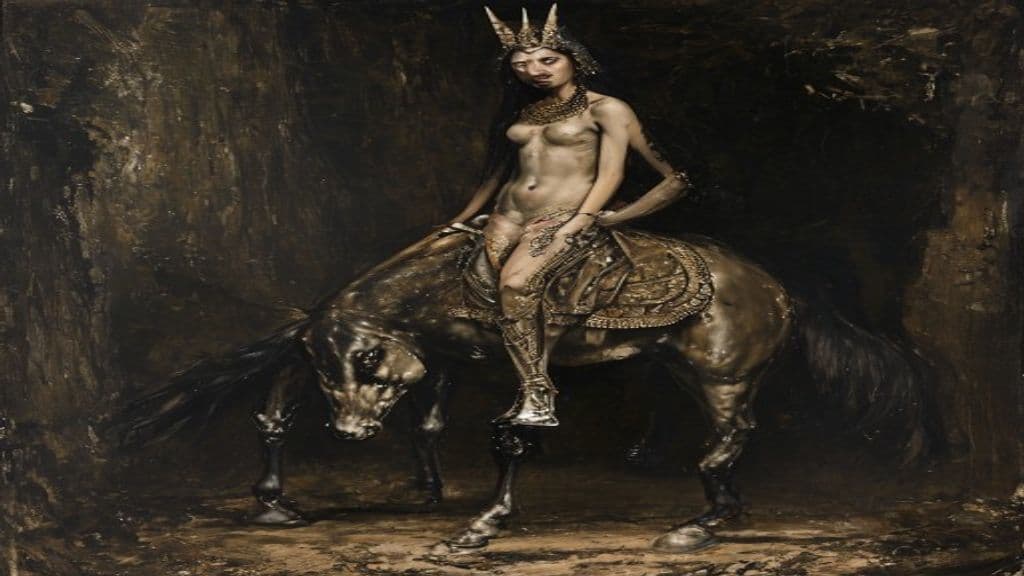
A Philippine folkloric female equid–human hybrid often described with the upper body of a woman and the lower body of a horse. Frequently compared to the Greek centauride and sometimes presented as a female counterpart to the tikbalang; traditionally associated with an attraction to gemstones and jewelry and with a local homeland in Santo Tomas, Batangas in some accounts.

Angharad Golden-Hand
Lesser

Angharad Golden-Hand

A literary heroine of medieval Welsh romance, Angharad Golden-Hand (Welsh: Angharad Law Eurawc) appears as a lady of King Arthur's court in the tale of Peredur son of Efrawg. She functions in the narrative as Peredur's beloved whose spoken declaration of love for the Mute Knight permits Peredur to break his vow of silence. The name is later reused in Renaissance and modern literature with different meanings.

Angharradh
Greater

Angharradh

Angharradh is a triune elven deity of the Seldarine in the Forgotten Realms setting, described in sources as a single greater goddess who contains three aspects. She is associated thematically with motherhood, union, and triadic unity and is worshiped by elven clergy within the setting's fiction and game materials.

Angiras
Ancient

Angiras

Angiras (Sanskrit Aṅgiras/Aṅgirāḥ) is primarily a Vedic rishi (sage) and eponymous lineage (Angirasa) associated with authorship of Vedic hymns, priestly/fire functions, and transmission of mantras; later Puranic accounts multiply his identities in genealogies and lists of sages.

Anglo-Saxon Deities
Primordial

Anglo-Saxon Deities

A list of deities from the Anglo-Saxon pantheon, likely derived from Old English and other Germanic languages. (Note: 1. Power tier: Primordial seems too high given the sparse written record and limited information on abilities. 2. Appearance: Delete statement as no physical descriptions are provided in available sou)

Angolan talapoin
Minor Spirit

Angolan talapoin

The Angolan talapoin (Miopithecus talapoin), also called the southern talapoin, is a real species of small Old World monkey in the family Cercopithecidae. The provided sources describe it in biological and ecological terms rather than as a mythic or supernatural being.

Angra Mainyu
Ancient

Angra Mainyu

In Zoroastrian tradition Angra Mainyu (Avestan) — often rendered Ahriman in later sources — is the personified destructive spirit and the principal adversary of the beneficent divine power (Spenta Mainyu) and, in some formulations, of Ahura Mazda. The figure functions as the opposing brother‑power within a foundational Mazdean dualism.

Angrboða
Lesser

Angrboða

Angrboða is a jötunn (giantess) in Norse myth attested briefly in the Poetic Edda and Prose Edda as the partner of Loki and the mother of three world‑shaping offspring: Fenrir, Jörmungandr, and Hel. Surviving medieval attestations are sparse; most descriptions of her beyond genealogy derive from modern retellings and popular culture.

Anguila peluda
Lesser

Anguila peluda

A Canary Islands (Tenerife, Anaga massif) popular-legend creature described as an enormous eel-like animal with a head covered in hair; locals historically regarded it as malign and believed it to be a demon in disguise that required exorcism, after which it disappeared or died.

Anguiped
Lesser

Anguiped

The anguiped is an iconographic/divine motif in the Graeco‑Roman world depicting a human upper body with serpentine lower limbs (literally 'snake‑foot'). It functions as a pictorial property or amuletic emblem—found on magical amulets, gems, and in public art—rather than as a single named personal being.

Anguipede (motif)
Lesser

Anguipede (motif)

The anguipede is a Greco‑Roman visual motif depicting a human torso above serpentine lower limbs, found widely on magical gems, amulets, coins, and architectural reliefs. It functions primarily as an apotropaic or symbolic image in varied contexts rather than as a named mythic personage with a single coherent cult or narrative.

Anguish of Ireland
Ancient

Anguish of Ireland

A mythological character in King Arthur's stories, described as a king and enemy of Arthur. (Note: - Power tier should be Greater (Anguish is a regional power in the context of King Arthur's stories, not a deity-level Ancient being) - Abilities description is partially accurate; Anguish does acknow)

Angul
Lesser

Angul

Angul is a legendary human eponymous ancestor attested in medieval Nordic origin narratives, most notably Saxo Grammaticus' Gesta Danorum, where he and his brother Dan are presented as forefathers and founders of the Danes; Angul is also named as ancestor of the Angles who later migrated to Britain and gave their name to England.

Anguta
Ancient

Anguta

Anguta is an ancestral/parent figure in Inuit cosmology associated with the sea-goddess Sedna and the underworld Adlivun. Different traditions variously portray him as a creator or supreme being (especially in some Greenlandic accounts), a mortal ancestor, and most consistently as a psychopomp or lord of the dead who ferries souls and supervises part of the afterlife journey.

Anhur (Onuris)
Lesser

Anhur (Onuris)

Anhur, also called Onuris, is an Ancient Egyptian war god worshipped especially at Abydos and Thinis. His name is glossed as "(one who) leads back the distant one," reflecting a myth in which he brings his consort Mehit from Nubia; he appears in Egyptian inscriptional and decorative programs such as polychrome inlays from Ashmunein (Hermopolis).

Ani-Men
Lesser

Ani-Men

Ani-Men is the name applied to several fictional teams in Marvel Comics that adopt animal-themed identities; incarnations range from costumed human criminals to scientifically altered operatives and High Evolutionary-created "New Men." They function in stories as criminal teams, henchmen for villains, or independent anthropomorphic militants rather than supernatural beings.

Anigrides
Lesser

Anigrides

The Anigrides are local freshwater nymphs (naiads) of the river Anigrus/Anigros in southern Elis (Triphylia), venerated at a coastal grotto near Samicum. In antiquity they were petitioned by those with skin diseases and associated with healing via prayers, sacrifices, and bathing in the sulfuric springs.