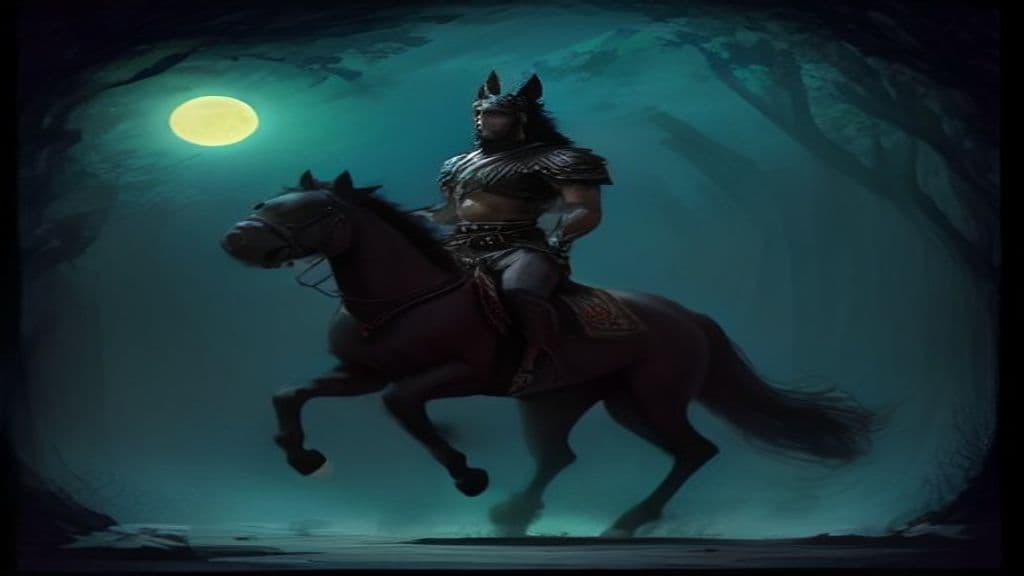
Sources present Akvan as an individual member of the div class appearing in the Shahnameh cycle during the reign of Kay Khosrow and within Rostam's labors. The narrative frames him as a hostile supernatural adversary who haunts a particular fountain or spring and hides among onager herds; no etymology or cosmogonic origin for the proper name 'Akvan' is supplied in the cited materials.
In story summaries Akvan is described when masquerading among onagers as an unusually brilliant wild ass or big horse: "the color of the body, like the glowing sun," with "a black line from its edge to its tail," and "four strong hands and feet." He also appears in non-animal manifestations by becoming wind or a storm or by disappearing from view.
Narrative-attested abilities include shape-changing (appearing as an onager, becoming wind or a storm, or vanishing), deception by hiding among ordinary onager herds, sudden digging/earth-moving around a sleeping Rostam (cutting away earth), lifting Rostam into the air and offering to throw him, and the capacity to hurl the hero long distances (throwing him into the sea). The episode emphasizes Akvan's evasion and endurance, repeatedly avoiding capture until Rostam finally snares him with a lasso and beheads him.
Weaknesses
- conditionfatigue/exhaustion of pursuers — the tale shows Akvan acts when the hero is tired
- conditionopportunity for physical capture — when Akvan reappears Rostam succeeds in lassoing and beheading him
Wards
None recorded.
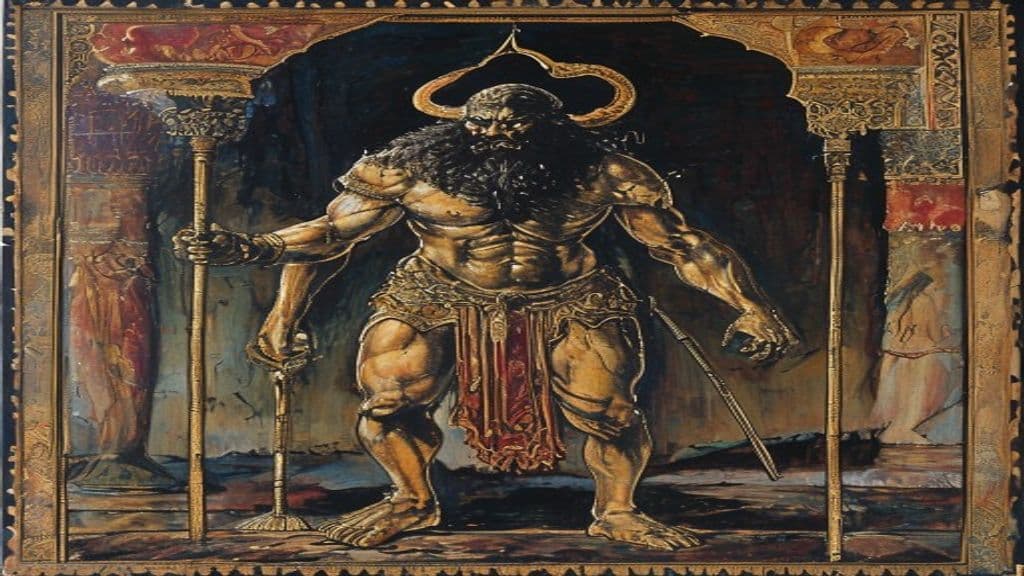
Ab-Zohr
Ab-Zohr is the culminating rite of the Zoroastrian Yasna service: a formal offering to the waters (Aban/Apas) that creates the consecrated liquid parahaoma and functions to purify, strengthen, and atone for damage done to waters. It is a ritual action rather than an independent supernatural being.
Aban (Āb/Ābān)
Aban (Avestan apas; Middle Persian āb/ābān) is the collective, sacred principle of the waters in Zoroastrian cosmology — both the element water and its personified hypostases (the Apas/Ahuranis). Aban functions as a primordial, life-giving creation, a calendrical and liturgical focus (day-name, month-name, Abanagan feast), and a ritual object of veneration (ape zaothra, Aban Yasht) rather than a malign force to be expelled.
Aban Yasht
The Aban Yasht is a hymn from the Persian tradition that praises Anahita, a goddess associated with water, fertility, and wisdom. It consists of 132 stanzas and is part of the 21 Yashts collection. (Note: - Power tier should be "Primordial" or possibly "Cosmic", given that it's a hymn of great spiritual significance and associated with a goddess. - The article incorrectly states that Anahita is associa)
Abtin
Abtin (Persian: آبتین), attested also as Athwya, is a mythic ancestral figure in Iranian tradition described in Avestan and later epic literature as one of a small set of formative human-like figures involved in preparing the corporeal world and as the father of the epic hero-king Fereydun in the Shahnama.
Adur Burzen-Mihr
Adur Burzen-Mihr is a consecrated Atash Behram — one of the three Great Fires of late antique Sasanian Zoroastrianism — historically associated with the farmer social estate and with a cultic location in northeastern Iran. Medieval texts (e.g., the Bundahishn) and later summaries record it as a major pilgrimage fire with legendary associations of protection and miraculous efficacy; its documentary history after the early Islamic period is unclear.
Adur Farnbag
Adur Farnbag is one of the three Great or Royal fires in the Zoroastrian ritual/topographical system of pre‑Islamic Iran. Presented in the sources as a continuously tended sacred fire housed in a temple, it is attested in secondary accounts as a focus of cultic activity, miracle stories, and association with elite ritual geography in the Parthian–Sasanian eras.
Adur Gushnasp
Adur Gushnasp (Middle Persian: Ādur ī Gušnasp; New Persian: Āzargušnasp) is a pre-Islamic Zoroastrian Great Fire — one of the three highest grade sacred temple fires (Atash Behram) of Sasanian-era Iran. Housed at the temple-site historically called Shiz (modern Takht-e Soleymān, Adurbadagan), it functioned as a continuously tended cultic fire, a pilgrimage destination, and a focal point of royal patronage and warrior-class identity.
Aeshma
Aeshma is the Zoroastrian hypostasis of wrath — a fiendish being who personifies rage and functions as an ontological opponent to Ahuric principles and ritual discipline. In scripture and later tradition he distracts worship, foments violence and drunkenness, can be driven off by prayer or by divine agents such as Sraosha and Mithra, and will be overthrown or flee at the final renovation.
Afrasiab
Afrasiab is the legendary king and arch-enemy of Iran in Iranian epic and Zoroastrian-influenced tradition. Attested from the Avestan Fraŋrasyan through Middle Persian and the Shahnameh, he functions as a powerful Turanian ruler associated with sorcery, subterranean dwellings, and opposition to Iranian heroes and divine agencies.
Aghrirat
Aghrirat is a named Turanian noble and peacemaker in the Shahnameh and Iranian mythic tradition, presented as a son of Pashang and brother of Afrasiab and Garsivaz. He is notable for his kind and gentle character and for attempting, largely unsuccessfully, to end the hostilities between Iran and Turan.
Ahriman (Angra Mainyu)
Angra Mainyu (Middle Persian Ahriman) is the hypostasis or personification of destructive, deceitful, and disordering mentality in Zoroastrian tradition. In the earliest (Gathic) layer it is presented as a choiceful destructive mainyu opposed to the constructive Spenta Mainyu; in later Pahlavi exegesis it becomes a personified cosmic antagonist who nevertheless is described as ontologically deficient and non-divine.
Ahura
Ahura is an Avestan term that designates a class of divinities in the Indo‑Iranian and Zoroastrian tradition, marking the sacred ‘lords’ who are to be reverenced and opposed to the rejected class of daevas. In Zoroastrian scripture the label functions as both a technical category and an honorific applied to high divine figures such as Ahura Mazda, Mithra, and Apam Napat.
Community Record
- [1]Akvan Div (Wikipedia). Wikipedia article summarizing the Shahnameh (Moscow Ferdowsi) episode of Akvan Div.wiki
- [2]Wikidata: Akvan Div. Wikidata entry for Akvan Div.wiki
- [3]The Div Akvan throws Rustam into the Sea (archive item). Archived art/description related to the Akvan episode.other
- [4]Rostam: tales of love & war from the Shahnameh (archive). Retellings and collections referencing the Rostam and Akvan episode.literary
- [5]Fairy Tales: Their Origin and Meaning (excerpt referencing Akvan). Secondary retelling noting Akvan as a powerful div haunting a fountain/spring.folk
- [6]Mazandarani mythology (Wikipedia). Contextual reference to regional adversaries and div traditions related to Shahnameh material.wiki
- [7]Pathfinder/Planescape and other modern bestiary entries (not primary tradition). Modern gaming bestiary entries that reuse the term 'div' and the name 'Akvan' in later fantasy taxonomies (not used as primary traditional evidence).other
- [8]Poets Corner: Rostam and Akvam Div. Blog retelling and discussion of the Rostam and Akvan episode.other