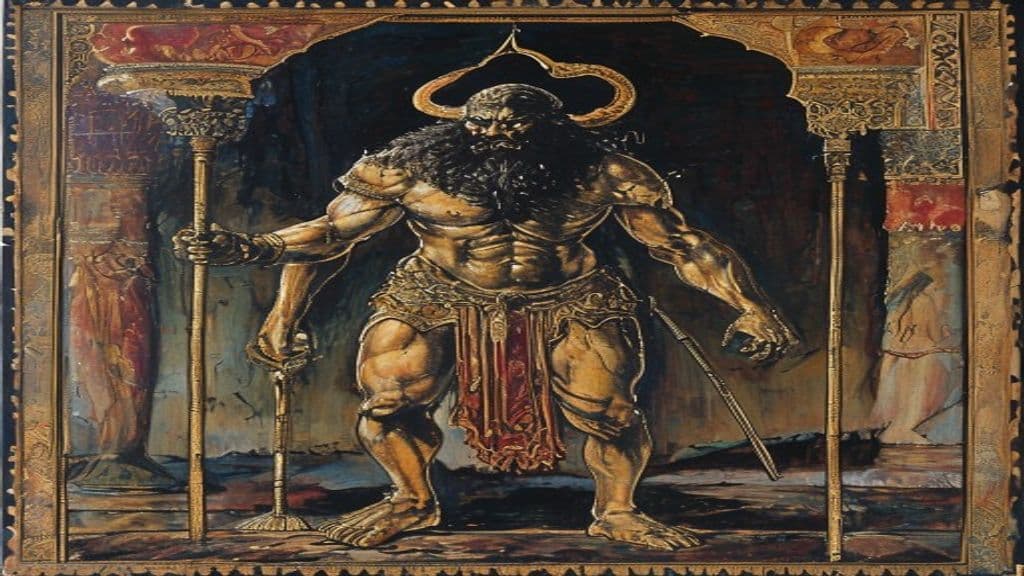
Accounts vary across sources. Later Persian tradition and medieval compilers present the divs as an ancient class of beings distinct from humans: Abu Ali Bal'ami's rendition of Tarikh al-Tabari is cited as saying divs were created before humans and jinn. Another medieval source (the Süleymanname) states that God created divs from the "fires of the stars, wind, and smoke," some with wings or exceptional speed; angels later fought and greatly reduced their numbers. Historically and conceptually the div are also described as a monotheistic reinterpretation or demonization of the Indo‑Iranian devas (deva → daeva → div), a process by which formerly divine or semi‑divine figures became classified as hostile or monstrous in Persian religious memory. In Islamicized contexts authors often equated divs with ʿifrīt and shayāṭīn, folding them into broader categories of evil spirits subject to God's final judgement.
Epic and folkloric sources give a variable but recurring physical profile. Typical descriptions render divs as humanlike in form but of gigantic size, frequently depicted with two horns on their heads and teeth compared to the tusks of a boar. Individual divs in the Shahnameh appear with variant attributes (e.g., named figures such as a "White Div" or a "Div King"), and armament ranges from primitive stones to full warrior's armour and metal weapons. Some medieval accounts (Süleymanname) attribute wings or extreme speed to certain divs. Narrative episodes also record shapeshifting or transformation motifs (for example, a Div King briefly taking the form of stone when captured).
Across the materials divs combine prodigious physical strength and martial capacity with magical faculties. They are portrayed as powerful and cruel, often preying upon humans and presenting a "relish for the taste of human flesh" in epic imagery. Many are described as masters of sorcery, able to afflict enemies with nightmares or magical assaults and to employ enchantment in combat. Their mobility may include flying or rapid movement in specific accounts. Behaviorally they are adversarial toward human communities and heroes (Shahnameh episodes cast them as principal antagonists whose harassment of peoples demands heroic response). Narrative motifs show they can be killed, bound, or executed by human heroes or royal authority, and in cosmological accounts angels or divine agents were able to slay many of them.
Weaknesses
- conditionvulnerable to heroic/martial defeat (slain in combat)
- otherparts/organs may have curative or ritual efficacy (narrative instance: Div's liver blood used to cure a king)
Wards
- ritualheroic combat / slaying
Ab-Zohr
Ab-Zohr is the culminating rite of the Zoroastrian Yasna service: a formal offering to the waters (Aban/Apas) that creates the consecrated liquid parahaoma and functions to purify, strengthen, and atone for damage done to waters. It is a ritual action rather than an independent supernatural being.
Ababil
Ababil (Arabic: أبابيل, romanized abābīl) are miraculous birds mentioned in the Qur'anic account of Surah Al‑Fil. In Islamic tradition they appear as a divinely sent avian host that defended the Kaaba by pelting an invading army with small clay stones; tradition places the event in the year traditionally given as 570 CE.
Abadir
Abadir is a polysemous name attested in distinct cultural contexts: a legendary founding saint and clan ancestor in eastern Ethiopia (Sheikh Abadir Umar Al‑Rida / Aw Abadir), a term applied to cone‑shaped cult stones in Phoenician religious description, and a personal name of a martyr (Abadir/Apater) in the Coptic Synaxarium. The attestations are independent usages of the same name rather than a single supernatural being.
Aban (Āb/Ābān)
Aban (Avestan apas; Middle Persian āb/ābān) is the collective, sacred principle of the waters in Zoroastrian cosmology — both the element water and its personified hypostases (the Apas/Ahuranis). Aban functions as a primordial, life-giving creation, a calendrical and liturgical focus (day-name, month-name, Abanagan feast), and a ritual object of veneration (ape zaothra, Aban Yasht) rather than a malign force to be expelled.
Aban Yasht
The Aban Yasht is a hymn from the Persian tradition that praises Anahita, a goddess associated with water, fertility, and wisdom. It consists of 132 stanzas and is part of the 21 Yashts collection. (Note: - Power tier should be "Primordial" or possibly "Cosmic", given that it's a hymn of great spiritual significance and associated with a goddess. - The article incorrectly states that Anahita is associa)
Abdul Qadir Gilani
A historical 11th–12th century Hanbali jurist, preacher, and Sufi shaykh who became the eponym and principal early figure of the Qadiriyya tariqa; venerated in Sunni Sufi traditions as an Awliya (saint) and often given exalted hagiographical ranks such as Muḥi al‑Dīn and Ghawth.
Abel
Abel is the second son of Adam and Eve in the Genesis narrative, a shepherd whose accepted offering and subsequent murder by his brother Cain form the biblical account of the first death. Later interpretive traditions expand his role, treating him as an archetypal righteous victim, a postmortem avenging or adjudicating figure, and in some systems (notably Mandaean) identifying him with an angelic lightbeing.
Abraham (Ibrāhīm) in Islam
Ibrāhīm (Abraham) in Islam is a human prophet and messenger chosen by God, a paradigm of pure monotheism (hanīf), patriarchal ancestor to later peoples and prophets, and traditionally regarded as having helped establish the Kaʿbah with his son Ismāʿīl. He is called Khalīl Allāh ('Friend of God') and is central to rites commemorated in Hajj and Eid al‑Adha.
Abtin
Abtin (Persian: آبتین), attested also as Athwya, is a mythic ancestral figure in Iranian tradition described in Avestan and later epic literature as one of a small set of formative human-like figures involved in preparing the corporeal world and as the father of the epic hero-king Fereydun in the Shahnama.
Abū Lahab
Abū Lahab (ʿAbd al-ʿUzzā ibn ʿAbd al-Muṭṭalib) is a historical Meccan figure — a paternal uncle of the Prophet Muḥammad and a Quraysh leader who opposed the Prophet; he is singled out and condemned in Qurʾān 111 (Sūrat al-Masad) and functions in Islamic textual memory as an exemplar of divine punishment for opposition.
Adam (ʾĀdam)
In Islamic theology Adam (Arabic: آدم, ʾĀdam) is presented as the first human being and the first prophet (nabī), created by God from earth/clay, granted life by God's spirit, placed in a paradisal Garden, taught knowledge (the "Names"), tested by divine command, tempted by Iblīs, and ultimately sent to live and die on Earth while remaining eligible for repentance and forgiveness.
Adur Burzen-Mihr
Adur Burzen-Mihr is a consecrated Atash Behram — one of the three Great Fires of late antique Sasanian Zoroastrianism — historically associated with the farmer social estate and with a cultic location in northeastern Iran. Medieval texts (e.g., the Bundahishn) and later summaries record it as a major pilgrimage fire with legendary associations of protection and miraculous efficacy; its documentary history after the early Islamic period is unclear.
Community Record
- [1]Div (mythology) - Wikipedia. "Div or dev are monstrous creatures of Middle Eastern lore and probably of Persian origin." (Wikipedia: Div (mythology))wiki
- [2]Rustam's seventh course: He kills the White Div, folio 124 from a Shah-nama (Book of Kings) of Firdausi. Cleveland Museum of Art caption: "The legendary hero Rustam brutally takes the demon chief’s liver blood, needed to cure his king of blindness."literary
- [3]Div-e Sepid - Wikipedia. "In the Persian epic of Shahnameh Div-e Sepid (Persian: دیو سپید , lit. White Div), is the chieftain of the Divs (demons) of Mazandaran. He is a huge being. He possesses great physical strength and is skilled in sorcery and necromancy. He destroys the army." (Div-e Sepid article)wiki
- [4]Rostam’s Fight with the White Dīv in the Context of the Primeval Myth of the 'Rain Shaman' (Persica Antiqua article). Scholarly article discussing Shahnameh episode and interpretive contexts (cited in research notes).academic
- [5]Pre‑Zoroastrian Aryan Religions & Religious Wars (Heritage Institute). Comparative‑religious context describing transformations of Indo‑Iranian religious figures; cited in research notes on devas → div reinterpretation.other
- [6]Wikidata entry: div (mythology). Wikidata Q1157107other
- [7]Folio 124r: Rustam Finds and Kills the White Div (Shahnameh manuscript). Shahnameh folio 124r (archive caption)literary
- [8]Folio 127v: Rustam Brings the Div King to Kay Kavus for Execution (Shahnameh manuscript). Shahnameh folio 127v (archive caption)literary
- [9]The Safavids - Epic Music (archive page linked in research notes). Archive catalogue entry referenced in supplied materialsother