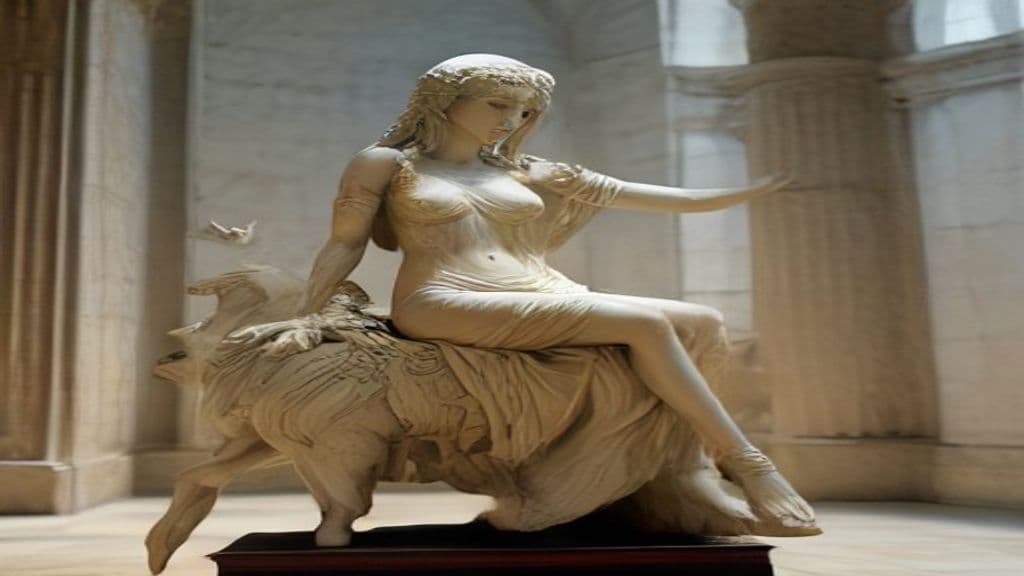
Aphrodite Urania is a deity in Greek folklore, from Greece. An epithet/aspect of the Greek goddess Aphrodite denoting her 'heavenly' or 'celestial' form. In Greek philosophical and cultic discourse Urania is contrasted with Aphrodite Pandemos as a nobler, more spiritual principle of love and is attested in temples, iconography, and Hellenistic syncretism.
Aphrodite Urania is etymologically linked to Ouranos (the sky). The broader origin of Aphrodite in Hesiod describes her birth from the severed genitals of Uranus and emergence from sea-foam; Plato (as presented in summaries of the Symposium and Pausanias' account) and later authors treat an 'elder' heavenly Aphrodite—Urania—as daughter of Uranus (motherless) and contrast this literary/philosophical genealogy with a younger Aphrodite Pandemos (daughter of Zeus and Dione). The two-Aphrodite distinction is a conceptual and rhetorical tradition in literature and cult rather than a single unanimous mythic genealogy across all sources.
In ancient art and cultic description Aphrodite Urania is represented on or with motifs including a swan, a tortoise, or a globe. The Venus Anadyomene (Aphrodite rising from the sea-foam) derives from the Hesiodic birth narrative for Aphrodite generally and is used in visual traditions connected with her birth; it is not uniquely exclusive to the Urania epithet. Archaeological and sanctuary records also attest to cult images and an altar associated with her worship at named sanctuaries.
Urania functions as the celestial or spiritual principle of love and attraction: philosophical and cultic sources frame her as governing a nobler, intellectual or soul-directed form of love in contrast to Pandemos' association with bodily, civic, or common attraction. Sources occasionally describe the epithet in wider terms (for example, a Western-Asian titulary 'queen of the heavens') that imply broad sway across sky, sea, and earth, but surviving materials present this chiefly as a descriptive or honorific dimension of the epithet rather than a discrete catalogue of sovereign powers. Ritually she is worshipped rather than treated as a malefic force; sources do not attribute possession phenomena or list vulnerabilities.
Weaknesses
- otherNo documented vulnerabilities — sources do not record malefic or possessive traits
Wards
- ritualLibation rule — wine not used
Aphrodite Pandemos
Aphrodite Pandemos is an epithet of the Greek goddess Aphrodite denoting either her role as goddess of communal, bodily/sensual love or her civic function as ‘Aphrodite of all the people’ who unites the demos. The epithet appears in literary, epigraphic, and archaeological sources and is attested in sanctuaries and festivals in multiple Greek locales.

Hathor
Hathor (Ancient Egyptian ḥwt-ḥr, 'House of Horus') is a major polyvalent goddess of ancient Egypt associated with the sky, maternal and royal motherhood, music, joy, fertility, and the Eye of Ra; she appears in multiple local manifestations and assisted the deceased into the afterlife.

Urania
Urania is the Greek Muse presiding over astronomy and astrology, daughter of Zeus and Mnemosyne, traditionally portrayed as a heavenly inspirer who elevates human thought toward the cosmos and is depicted with a celestial globe and staff.
*Péh₂usōn (reconstructed)
Péh₂usōn is a hypothetical Proto‑Indo‑European pastoral guardian reconstructed by comparative scholars from parallels in Greek and Vedic traditions. Proposed as a Graeco‑Aryan ancestor‑figure, the reconstruction describes a protector of flocks, roads, and travellers rather than an attested historical cultic personality.
Aani
Aani (ancient Egyptian jꜥnr) is the lexical term for the baboon in ancient Egyptian language and functions in religious contexts as an animal icon and theophoric epithet. Attested repeatedly in Egyptian texts and images, the baboon image is used to represent or denote aspects of gods such as Thoth, Hapy, Khonsu, and Osiris rather than implying the animal itself is an independent deity.
Aati
Aati (also rendered Ati) is one of the 42 judges of the dead in ancient Egyptian funerary literature, attested in the Book of the Dead tradition (notably the Papyrus of Nebsemy). Described as originating 'from Heliopolis', Aati's documented function is to question the deceased about a specific moral accusation during the Duat judgment; the funerary texts supply a formulaic denial the soul must recite.
Aba (disambiguation / name-form)
Aba is a polyvalent name-form attested across many unrelated contexts (place names, personal names, animal names, and brief mythological listings). The provided sources do not support a single, coherent supernatural entity called "Aba" and offer no descriptive or ritual material for such a being.
Abadiu of Antinoe
Abadiu of Antinoe was a fourth‑century bishop of Antinoe (Antinoopolis, in Roman Egypt) commemorated as a martyr and saint in the Coptic Orthodox Church, with a feast day on 26 December. Sources record that he was killed during a theological dispute with Arian opponents and reference him in collections of Egyptian martyrs.
Abarbarea
Abarbarea is a name attested in classical Greek and Roman sources for freshwater nymphs (naiads). The name appears for at least two individual mythic figures — a naiad wife of Bucolion and a naiad counted among ancestors of the Tyrians — and Hesychius records plural forms that may indicate the name was also used as a class-name (Abarbareai / Abarbalaiai).
Abaris the Hyperborean
Abaris the Hyperborean is a semi-legendary Hyperborean sage, healer, seer, and priestly envoy of Apollo in Greek tradition, famed for traveling with a magical arrow/dart, expelling pestilence, and transmitting ritual and prophetic knowledge to Greece.
Abas
Abas (Ancient Greek: Ἄβας, gen.: Ἄβαντος) is not a single mythic being but a recurring personal name borne by multiple mortals and minor mythic figures in Greek epic and genealogical traditions — kings, founders, seers, warriors, attendants, a centaur, and a youth transformed by a goddess. The name is glossed in the sources as 'guileless' or 'good-hearted' and appears across Argive, Theban, Trojan, Euboean, and other local cycles.
Abaset
Abaset is a localized ancient Egyptian goddess attested in tomb decoration at El‑Bawiti in the Bahariya Oasis during the 26th Dynasty. She is depicted anthropomorphically with a hedgehog motif incorporated into her headdress and appears on the walls of Qarat Qasr Salim, including twice in the Tomb of Bannentiu. No cult texts, myth narratives, or ritual prescriptions for her are recorded in the cited corpus.
Abderus
Abderus (Ancient Greek: Ἄβδηρος, romanized Ábdēros) is a mortal heroic figure in Greek myth closely associated with Heracles, remembered as the youth left in charge of the Mares of Diomedes who was killed by them. He functions as an eponymous local/divine-hero ancestor for the city of Abdera and received funerary commemoration and athletic agones at his tomb.
Abib and Apollo
Abib and Apollo are Christian ascetics and hagiographic saints of Akhmim (Upper Egypt) attested in Coptic sources and the Historia Monachorum. Remembered for extreme asceticism, monastic leadership, angelic encounters, and inclusion in the Coptic Synaxarion (feast day November 4).
Abomination of Desolation
An apocalyptic prophetic phrase originating in the Book of Daniel designating a profaning thing or act that renders the Jerusalem Temple cult desolate; later reused in the Synoptic Gospels as an eschatological sign prompting urgent flight. The term denotes ritual/cultic impurity (Hebrew shiqquts) and is variously interpreted as pagan offerings or altar, a foreign cult statue, or (in some New Testament readings) an acting agent.
Community Record
- [1]Aphrodite Urania — Wikipedia. Wikipedia, 'Aphrodite Urania' article (as provided in research notes)wiki
- [2]Urania — Wikipedia. Wikipedia, 'Urania' article (note on possible confusion between muse and epithet)wiki
- [3]Foundation plaque for a temple dedicated to Hathor / Aphrodite at Cusae (archive item). Archive item: foundation plaque recording a dedication to 'Aphrodite Urania' equated with 'Hathor Who-is-in-Heaven' at Cusaeother
- [4]Sanctuary of Aphrodite Urania — Wikipedia. Wikipedia entry on the sanctuary and archaeological notes (as cited in research notes)wiki
- [5]Aphrodite Urania Favorites (archive collection). Archive collection referencing images and materials related to Aphrodite Uraniaother
- [6]La porta d'Oriente. Cipro e la molteplicità delle culture. Quaderni, n. 39 (2023). Archive: essays referencing Aphrodite Urania in Cypriot/Hellenistic contextsother
- [7]Herodotus (as cited). Herodotus as reported in the compiled sources: Arabs called the aspect 'Alitta' or 'Alilat' (reported in the provided corpus via Wikipedia summary)literary
- [8]Selected classical summaries (Plato/Pausanias/Hesiod as preserved in secondary summaries). Summaries of Hesiod's account of Aphrodite's sea-foam birth and Plato/Pausanias' Symposium distinction between Urania and Pandemos (as preserved in the provided materials)literary