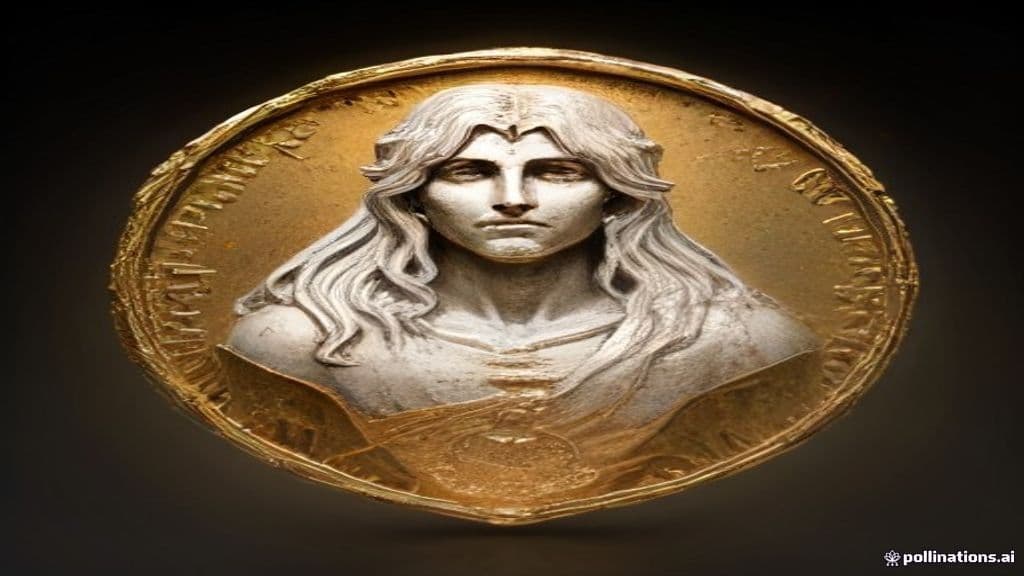
The available materials provide no mythological origin for an entity named 'Aureily'. Instead, one source discusses the Latin noun 'aureus' (plural 'aurei'), a Roman gold coin derived from aurum, meaning 'gold' — a historical numismatic term rather than a supernatural origin. A separate contemporary news source shows 'Aureily' only as part of an image-credit string (e.g., 'Prostock-Studio, Aureily Shutterstock, CanvaPro'), indicating use as a contributor or stock-image name in modern commercial media. No indigenous cosmology, oral tradition, or mythic narrative for a being called 'Aureily' appears in the provided sources.
There are no descriptions of a physical or supernatural appearance for 'Aureily' in the sources. The only physical description present relates to the Roman 'aureus' coin: it was about the same size as the denarius but heavier, as gold is denser than silver. That description pertains to a historical coin and not to any sentient or spiritual form. The contemporary source offers no visual description beyond an image-credit string containing the name.
No abilities, behaviors, or interactions are attributed to a being named 'Aureily' in the provided materials. The historical source attributes economic functions and values to the aureus coin (it was the main gold coin of ancient Rome from the 1st century BC to the early 4th century AD, originally valued at 25 denarii and 100 sestertii, and later replaced by the solidus), but these are numismatic facts about currency rather than supernatural powers or behaviors.
Aun the Old
Aun (Old Norse: Aunn inn gamli; Latinized Auchun) is a legendary Swedish king of the Yngling dynasty attested in Old Norse sources (Ynglingatal, Ynglinga saga in Heimskringla, and Historia Norwegiae). He is portrayed as a mortal ruler who prolonged his life by performing human sacrifices to the god Odin until his community refused a final offering.
Aunt Em (Emily Gale)
Aunt Em (Emily "Em" Gale) is a fictional human character in L. Frank Baum’s Oz series, the married partner of Uncle Henry and the guardian/aunt of Dorothy Gale. Presented as an ordinary Kansas farmwife whose life is altered by Dorothy’s voyage to Oz, she later relocates to the Emerald City and is given a ceremonial civic occupation there.
Aupamanyava
Aupamanyava is a Vedic patronymic and teacher-name cited in Vedic literature (not a supernatural being). Appearing in the Vamsa Brahmana and other Vedic and philological texts, the name marks a sage or lineage (descendant of Upamanyu) associated with teaching the Sama Veda and with lexical/grammatical work cited by later commentators such as Yaska.
Aura
Aura (Ancient Greek Αὔρα, plural Αὔραι) is a minor Greek and Roman divine figure personifying a cool breeze. She appears both as an individual breeze-nymph in literary accounts (most fully in Nonnus) and as a class of breeze-spirits (Aurae) in other sources and lexica.
Aura (paranormal)
Auras are described in modern esoteric and New Age sources as subtle, nonmaterial emanations or energy fields that surround living beings and objects, presented as part of a 'subtle body' and used diagnostically to indicate health, personality, or moral/spiritual state. The concept was popularized in late-19th/early-20th-century Western occultism (notably Theosophy) and later adapted by New Age and holistic-health practitioners; scientific investigation finds no reproducible evidence for literal aural perception and offers physical explanations for photographic effects often labeled as 'auras.'
Aurboða
Aurboða is a jötunn (giantess) in Norse mythology attested as the wife of the jötunn Gymir and mother of the jötunn Gerðr; the name also appears separately as one of the nine maidens in the poem Fjölsvinnsmál. Her name is debated etymologically as either 'gravel-bidder' (aurr + boða) or, in an alternative reading, 'gold-bidder' (aur + boða).
Aurnavabha
Aurnavabha (also attested as Aurṇavābha) is a name occurring in Vedic hymnic material (Rigveda) and later cited in bibliographic/theosophical indexes as a Vedic commentator. The sources present the name as textual/authorial rather than as an independently attested supernatural being.
Aurora (Sleeping Beauty)
Aurora is the princess protagonist of the Sleeping Beauty tale as popularized in Charles Perrault's literary tradition and later by the 1959 Disney film and stage/ballet adaptations. She is a mortal royal whose fate is determined by the interventions of beneficent and maleficent fairies, most notably being placed under a death-sleep curse that is altered to a prolonged enchanted sleep.
Aurva
Aurva (Sanskrit: और्व) is a Vedic/Purāṇic rishi of the Bhargava (Bhrigu) line remembered for a miraculous birth from his mother's thigh, a birth-radiance that blinded attackers, and for austere tapas that produced the submarine fire Vadavagni. He functions as a canonical sage, ancestor (father of Richika and grandfather of Vatsa), and a figure whose ascetic power threatened cosmic destruction until persuaded otherwise by the Pitrs.
Aurvandill
Aurvandill is a figure attested in medieval Germanic onomastics and Norse narrative, most famously remembered in an Old Norse tale where Thor carries him across icy rivers and his frozen toe is cast into the sky as the star called Aurvandils-tá. Comparative linguistic study reconstructs a Common Germanic name associated with dawn or the morning star.
Auseklis
Auseklis is a named youthful celestial being in Latvian folk-song tradition (dainas), associated with the dawn and a particular eight-pointed star emblem. He appears among the Dieva dēli (sons of Dievs) as an attendant of the Sun (Saule), a suitor in the mythic 'celestial wedding', and a participant in household-like sky rituals.
Austri, Vestri, Norðri and Suðri
A quartet of named dwarfs in Old Norse cosmology positioned at the four cardinal points who are described in medieval sources as holding up the sky after the gods made heaven from Ymir’s skull. They function as structural/cosmogonic supports and are attested in the Prose Edda and the Dvergatal of Völuspá, with echoes in skaldic kennings and in later scholarly interpretation linking their role to roof-beam terminology.
Community Record
- [1]Aureus. Wikipedia: Aureus — 'The aureus was the main gold coin of ancient Rome from the 1st century BC to the early 4th century AD, when it was replaced by the solidus.'wiki
- [2]Nanny Threatens To Quit After She's Not Allowed To Fly First-Class With Family She Works For. YourTango article — image credit sequence includes 'Prostock-Studio, Aureily Shutterstock, CanvaPro' (used as attribution for photograph/media).other