
Accounts vary. In late-antique narrative (Nonnus) Aura is presented as a daughter of the Titan Lelantos (with variant genealogical attributions in some summaries) and a Phrygian resident whose encounter with Dionysus leads to rape, infanticide, and her metamorphosis into a spring after drowning in the Sangarios. Other sources treat Aura more generically: the plural Aurae are breeze-nymphs sometimes listed as daughters of Boreas, and lexica and brief poetic references provide alternate localetiologies (e.g., a maiden from Pontus). The traditions are not harmonized across sources.
Literary descriptions emphasize lithe, swift, athletic features rather than elaborate ornament. Nonnus calls her a nymph "as fast as the wind" and uses the adjective translated as "manlike" to suggest a lean, athletic, perhaps flat-chested huntress and virgin companion of Artemis. Iconographic evidence is scarce but includes a 5th-century BC skyphos from Taranto showing a figure labeled "Aura" seated by the sea with velificatio (billowing drapery forming an arch), a visual trope emphasizing motion and wind.
Sources attribute superhuman swiftness and hunting prowess to Aura (Nonnus describes her as "as fast as the wind" and a capable huntress who runs down large game). In Nonnus’s narrative her fate includes metamorphosis: after drowning she is transformed into a spring/stream, with poetic reimaginings of her body and gear becoming features of the watercourse. Beyond poetic description, the sources do not provide systematic accounts of ongoing elemental control or ritual powers.
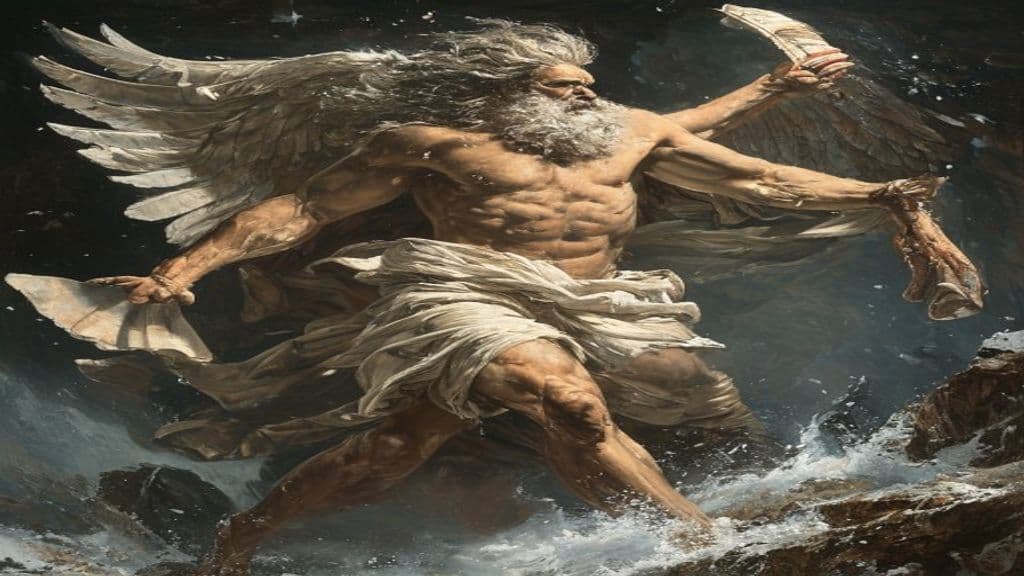
Boreas
Boreas is the ancient Greek personification and god of the cold north wind, storms, and winter; a member of the Anemoi who is both a meteorological force and an independent divine agent active in myth and civic cult (notably Athens). He is associated with Thrace as his homeland and with the mythical Hyperborea beyond the north wind.
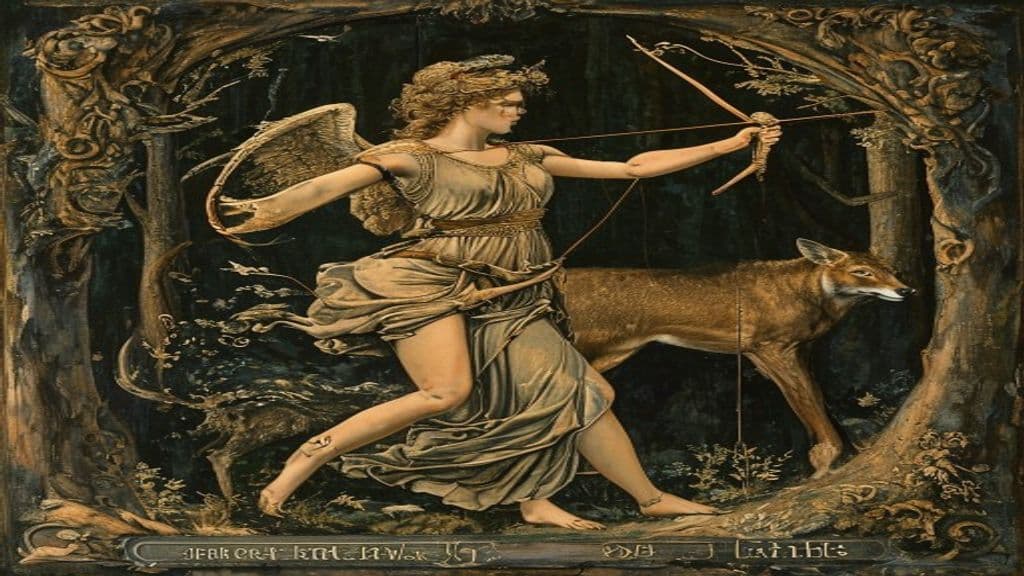
Artemis
Artemis is an ancient Greek goddess of hunting, the wilderness and wild animals, transitions (especially childbirth and puberty), vegetation, and chastity. Twin sister of Apollo and daughter of Zeus and Leto, she functions as a protector of young children and maidens while also capable of inflicting disease or punishment for transgressions against her sacred laws.
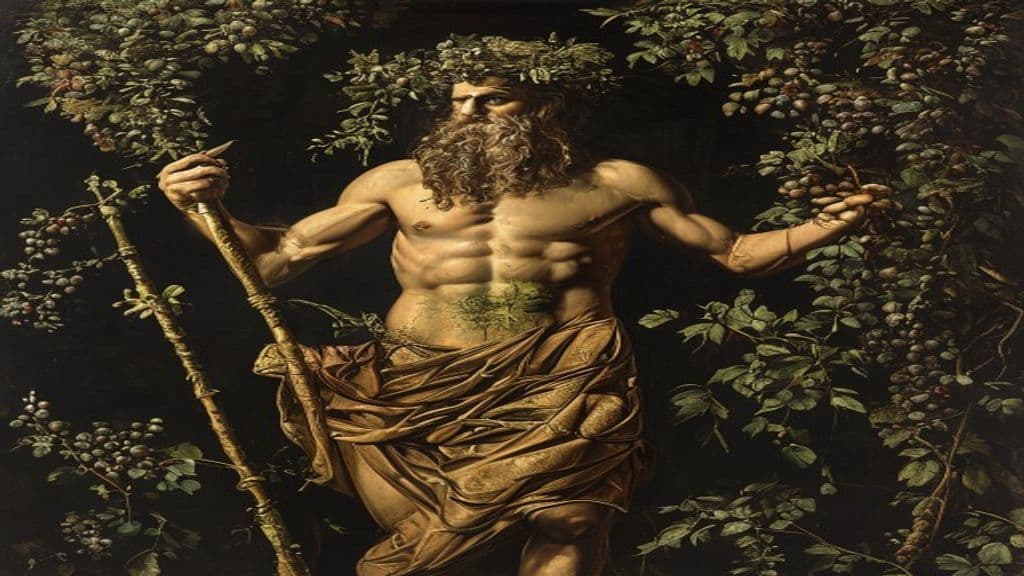
Dionysus
Dionysus (Ancient Greek: Διόνυσος) is a major ancient Greek deity associated with wine and winemaking, vegetation and fertility, festivity and theatre, ritual ecstasy and possession, and liminal links with death and the underworld. He is an epiphany-god who travels between worlds, whose cult includes ecstatic rites and mystery initiation.
*Péh₂usōn (reconstructed)
Péh₂usōn is a hypothetical Proto‑Indo‑European pastoral guardian reconstructed by comparative scholars from parallels in Greek and Vedic traditions. Proposed as a Graeco‑Aryan ancestor‑figure, the reconstruction describes a protector of flocks, roads, and travellers rather than an attested historical cultic personality.
Aba (disambiguation / name-form)
Aba is a polyvalent name-form attested across many unrelated contexts (place names, personal names, animal names, and brief mythological listings). The provided sources do not support a single, coherent supernatural entity called "Aba" and offer no descriptive or ritual material for such a being.
Abandinus
Abandinus is a locally attested Romano‑Celtic theonym known from a single inscribed bronze feather (votive object) dedicated at Godmanchester (the Roman fort Durovigutum) in Cambridgeshire. Scholars interpret him as a local god or male spirit tied to a specific place and possibly associated with a nearby spring or stream; this association is tentative and based on etymological readings of the name.
Abarbarea
Abarbarea is a name attested in classical Greek and Roman sources for freshwater nymphs (naiads). The name appears for at least two individual mythic figures — a naiad wife of Bucolion and a naiad counted among ancestors of the Tyrians — and Hesychius records plural forms that may indicate the name was also used as a class-name (Abarbareai / Abarbalaiai).
Abas
Abas (Ancient Greek: Ἄβας, gen.: Ἄβαντος) is not a single mythic being but a recurring personal name borne by multiple mortals and minor mythic figures in Greek epic and genealogical traditions — kings, founders, seers, warriors, attendants, a centaur, and a youth transformed by a goddess. The name is glossed in the sources as 'guileless' or 'good-hearted' and appears across Argive, Theban, Trojan, Euboean, and other local cycles.
Abderus
Abderus (Ancient Greek: Ἄβδηρος, romanized Ábdēros) is a mortal heroic figure in Greek myth closely associated with Heracles, remembered as the youth left in charge of the Mares of Diomedes who was killed by them. He functions as an eponymous local/divine-hero ancestor for the city of Abdera and received funerary commemoration and athletic agones at his tomb.
Abellio
Abellio is a theonym attested in Roman‑period inscriptions from the Comminges area of the Pyrenees and reported as worshipped in the Garonne Valley of ancient Gallia Aquitania. Surviving evidence is limited to a small number of inscriptions; scholars have variously hypothesized solar or arboreal associations and compared the name to forms of Apollo or to Celtic Belenus, but the deity's precise role in local cosmology remains uncertain.
Abnoba
Abnoba is a Gaulish theonym and toponym attested in Roman-era sources and inscriptions: a localized deity associated with woods, springs and the sources of rivers (notably the Danube) and simultaneously the name applied to a mountain or mountain range in the Black Forest/Baar/Odenwald region. Roman altars equate her with Diana, reflecting syncretic cult practice in frontier provinces.
Abomination of Desolation
An apocalyptic prophetic phrase originating in the Book of Daniel designating a profaning thing or act that renders the Jerusalem Temple cult desolate; later reused in the Synoptic Gospels as an eschatological sign prompting urgent flight. The term denotes ritual/cultic impurity (Hebrew shiqquts) and is variously interpreted as pagan offerings or altar, a foreign cult statue, or (in some New Testament readings) an acting agent.
Aborigines (mythology)
A mytho-historical label used in Roman and general reference sources to denote the oldest inhabitants of a region (specifically central Italy in the cited Roman context). The term functions as an identity/category for original human populations rather than as a characterized supernatural being in the provided sources.
Absyrtus
Absyrtus (Ancient Greek: Ἄψυρτος) is a Colchian prince in the Greek Argonautic cycle, son of King Aeëtes and brother or half-brother of Medea. He appears in variant traditions either as a companion taken by Medea during her flight with Jason and murdered/dismembered to delay pursuit, or as a pursuer sent by Aeëtes who is overtaken and slain by Jason; his death functions as a key narrative device in the escape from Colchis.
Abundantia
Abundantia is the Roman divine personification of abundance and material plenty, used primarily in imperial propaganda and public iconography to signify secure grain supplies, wealth, and the promise of a 'Golden Age' under the emperor. She also appears in later medieval European folklore as Domina Abundia / Dame Habonde, a household benefactor in accounts condemned by ecclesiastical writers.
Community Record
- [1]Aura (mythology) — Wikipedia. Wikipedia, entry 'Aura (mythology)'wiki
- [2]Nonnus — Dionysiaca (summaries and citations cited in secondary sources). Summaries of Nonnus's account as reported in secondary sources (see Wikipedia entry)literary
- [3]Miscellaneous lexica and poetic references summarized. Summary of varied ancient attestations (Quintus Smyrnaeus, Etymologicum Magnum, Ovid) as collected in the Wikipedia entryother