
According to later accounts and republican tradition, a joint cult of Ceres, Liber and Libera was instituted as a plebeian sacred district (templum) on or near the Aventine Hill and a temple was vowed in connection with events around c. 493 BC (famine, plebeian secession and conflict with the Latins). Modern scholarship uses the term 'Aventine Triad' to denote this institutional grouping; sources stress that the label is modern and that Roman theological equivalence among deities was flexible and evolving.
Sources do not describe a unified anthropomorphic appearance for the Aventine Triad as a single visual entity. The Triad is an institutional conjunction of three deities rather than a composite figure; extant summaries in the sources do not provide consistent, detailed iconography for the group. Individual members are conventionally associated (in broader Roman and Hellenising descriptions) with their traditional attributes—Ceres with grain/agrarian symbolism, Liber with vine/wine associations and Libera as a female counterpart—but the provided materials do not supply primary-iconographic descriptions for the joint cult.
The Aventine Triad is not described as an individual agent with supernatural 'powers' but as a communal cult whose function was agricultural, fertility and plebeian social-religious patronage. Within that joint cult framework: Ceres is associated with grain and agrarian interests; Liber (Liber Pater) with viticulture, wine, male fertility, libertas and certain Bacchic/Dionysian elements; and Libera serves as the female counterpart, later equated in some accounts with Proserpina or Ariadne. The cult provided ritual focal points (temple, festivals such as Liberalia and Cerealia, ludi/scaenic games) and civic-religious identity for the plebs. Some ecstatic or Bacchic practices associated with Liber were subject to political suppression (Senatus consultum de Bacchanalibus, 186 BC), indicating state regulation rather than mythic conflict.
Weaknesses
- otherNo supernatural weaknesses recorded; cult elements were subject to civic/legal regulation (e.g., Senatus consultum de Bacchanalibus, 186 BC) rather than magical warding.
Wards
- conditionState regulation and legal suppression (e.g., the Senatus consultum de Bacchanalibus) — recorded civic means of controlling perceived dangerous ritual elements of Liber's cult.
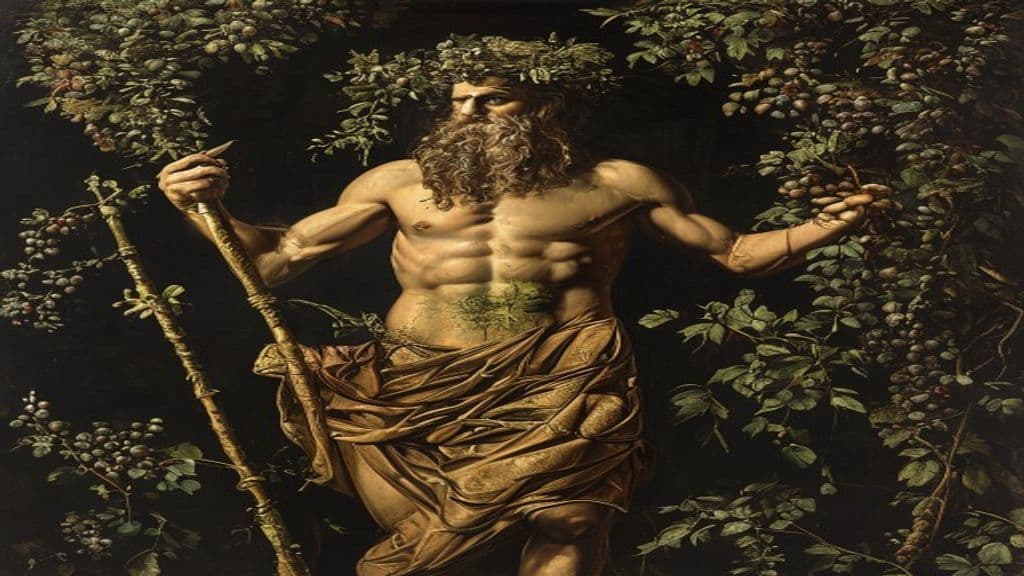
Dionysus
Dionysus (Ancient Greek: Διόνυσος) is a major ancient Greek deity associated with wine and winemaking, vegetation and fertility, festivity and theatre, ritual ecstasy and possession, and liminal links with death and the underworld. He is an epiphany-god who travels between worlds, whose cult includes ecstatic rites and mystery initiation.

Capitoline Triad
A state-centered collective cult in ancient Roman religion grouping three major deities — Jupiter, Juno (Iuno Regina) and Minerva — worshipped together in a shared temple (Capitolium) on Rome's Capitoline Hill. The Triad functioned as the chief focus of Roman public religion and was replicated as Capitolia in other cities of Italy and the provinces.
Abandinus
Abandinus is a locally attested Romano‑Celtic theonym known from a single inscribed bronze feather (votive object) dedicated at Godmanchester (the Roman fort Durovigutum) in Cambridgeshire. Scholars interpret him as a local god or male spirit tied to a specific place and possibly associated with a nearby spring or stream; this association is tentative and based on etymological readings of the name.
Abarbarea
Abarbarea is a name attested in classical Greek and Roman sources for freshwater nymphs (naiads). The name appears for at least two individual mythic figures — a naiad wife of Bucolion and a naiad counted among ancestors of the Tyrians — and Hesychius records plural forms that may indicate the name was also used as a class-name (Abarbareai / Abarbalaiai).
Abas
Abas (Ancient Greek: Ἄβας, gen.: Ἄβαντος) is not a single mythic being but a recurring personal name borne by multiple mortals and minor mythic figures in Greek epic and genealogical traditions — kings, founders, seers, warriors, attendants, a centaur, and a youth transformed by a goddess. The name is glossed in the sources as 'guileless' or 'good-hearted' and appears across Argive, Theban, Trojan, Euboean, and other local cycles.
Abellio
Abellio is a theonym attested in Roman‑period inscriptions from the Comminges area of the Pyrenees and reported as worshipped in the Garonne Valley of ancient Gallia Aquitania. Surviving evidence is limited to a small number of inscriptions; scholars have variously hypothesized solar or arboreal associations and compared the name to forms of Apollo or to Celtic Belenus, but the deity's precise role in local cosmology remains uncertain.
Abnoba
Abnoba is a Gaulish theonym and toponym attested in Roman-era sources and inscriptions: a localized deity associated with woods, springs and the sources of rivers (notably the Danube) and simultaneously the name applied to a mountain or mountain range in the Black Forest/Baar/Odenwald region. Roman altars equate her with Diana, reflecting syncretic cult practice in frontier provinces.
Aborigines (mythology)
A mytho-historical label used in Roman and general reference sources to denote the oldest inhabitants of a region (specifically central Italy in the cited Roman context). The term functions as an identity/category for original human populations rather than as a characterized supernatural being in the provided sources.
Abundantia
Abundantia is the Roman divine personification of abundance and material plenty, used primarily in imperial propaganda and public iconography to signify secure grain supplies, wealth, and the promise of a 'Golden Age' under the emperor. She also appears in later medieval European folklore as Domina Abundia / Dame Habonde, a household benefactor in accounts condemned by ecclesiastical writers.
Acamas
Acamas (Ancient Greek: Ἀκάμας) is a personal name recurrent in ancient Greek narrative traditions applied to multiple human characters (warriors, princes, suitors), once to a Cyclops, and once as a hound's name. Rather than a single supernatural entity, bearers of the name appear episodically across the Trojan War, Theseid, and Theban cycles as mortal actors whose deeds intersect with gods and fate.
Acantha
Acantha (Ancient Greek: Ἀκάνθα, 'thorn') is a late or secondary mythological figure known from modern retellings as a nymph transformed into the acanthus plant. The tale that she scratched Apollo and was changed into a spiny-leaved plant is not attested in surviving classical corpora and appears to be a modern compilation or invention rather than a firmly documented ancient myth.
Acerbas
Acerbas (also recorded as Sychaeus, Sycharbas, Zacherbas) is a figure in classical Greco‑Roman accounts of Phoenician/Tyrian tradition: a wealthy priest of Melqart (the Tyrian Hercules) whose concealed riches and murder by King Pygmalion precipitate Elissa/Dido's flight from Tyre and the foundation of Carthage. He is presented as a human priestly figure of high social rank rather than as a supernatural being.
Acestes
Acestes is a Roman/Greek founder-hero associated with the Sicilian city Segesta (Aegesta/Acesta). Presented as son of a Trojan woman and, in one tradition, the Sicilian river-god Crinisus (in animal form), he hospitably receives Aeneas and the Trojans, participates in the funeral games in Virgil's Aeneid (Book V), and functions as an eponymous culture-founder and local ruler.
Achaemenides
Achaemenides is a literary mortal figure introduced into Virgil's Aeneid as a marooned member of Odysseus' crew whom Aeneas rescues on Sicily. In Roman epic he functions as a chance survivor and eyewitness who helps link the Homeric tradition to the Trojan refugees and to illustrate Aeneas' magnanimity.
Community Record
- [1]Aventine Triad — Wikipedia. Wikipedia, 'Aventine Triad'.wiki
- [2]Wikidata entry: Aventine Triad. Wikidata Q790520.other
- [3]Liber — Wikipedia. Wikipedia, 'Liber'.wiki
- [4]Liber — NovaRoma. NovaRoma, 'Liber'.other
- [5]Lucus Antiquus blog posts on Roman triads. Lucus Antiquus, 'T is for Triads' (2012).other