
In tafsīr, ḥadīth, and Qisas al-Anbiya traditions Azazil is presented as the privileged celestial being who occupied a high station in heaven prior to his fall. Some accounts (notably those attributed to ibn Abbas and followed by later exegetes such as Ṭabarī and al-Suyūṭī) identify him as an inhabitant of paradise and leader of other angels, entrusted with authority over the lower heavens and sent to punish corrupt djinn. After his success he became arrogant and refused God's command to prostrate before the newly created human, claiming superiority; this act of pride led to his condemnation and subsequent identification as Iblis. Other exegetical strands (associated with al-Hasan al-Baṣrī and those who emphasize angelic infallibility) reject that Satan was ever an angel and read Qur'anic references to Iblis as indicating a jinn by nature. Scholarly commentary notes the name's resemblance to the Jewish figure Azazel and records competing etymologies—some proposing a borrowing from Jewish sources, others deriving the name from Arabic roots (e.g., ‘azala or azīz + il)—so the figure functions as a polyvalent explanatory persona for the origin of rebellion and pride in Islamic discourse.
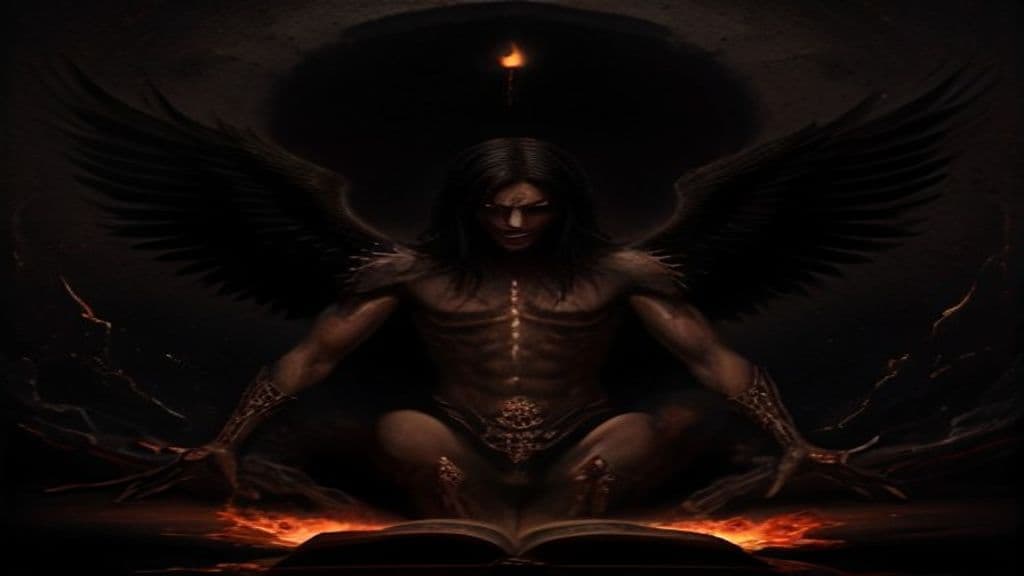
The surveyed sources do not supply a consistent anthropomorphic description. Exegetical and hadith material cited in the summaries emphasize elemental origin rather than visual detail: many accounts state that most angels are created from light (nūr), while Azazil and those with him are said in some traditions to be created from a 'poisonous fire' (nār as-samūm). This contrast—light for angels, fire for Azazil and his companions—is used interpretively to account for his capacity for rebellion and his ultimate destiny in fire, but the sources do not provide standardized corporeal features or a detailed physical likeness.
Before the fall, certain traditions describe Azazil as the master or chief among the heavenly beings, 'the strongest and most knowledgeable' of them, entrusted with ruling the lower heavens and authorized to lead an angelic force against corrupt djinn. He is credited with commanding angels to drive away errant djinn and administering punishment in the lower heavens. His defining behaviour that leads to downfall is prideful disobedience: when God commands prostration before the newly created human, Azazil refuses, asserting his superiority and thereby incurring divine condemnation. After his expulsion he is equated with Iblis and functions in Islamic theology and mysticism as the archetype of rebellion, temptation, and the consequences of pride; Sufi writers cite his example for moral and metaphysical lessons. The sources, however, also record contested views on his ontological status—angelic leader versus jinn—so accounts of his capacities and office vary with interpretive tradition.
Iblis
The primordial deceiver in Islamic theology; a jinn who refused God's command to bow before Adam and was expelled from heaven. The source of all temptation and whispered suggestion.

Djinn
The class of supernatural beings created from smokeless fire in Islamic cosmology — a parallel civilization to humanity, capable of belief or unbelief, with their own prophets, society, and judgment before God.
Ababil
Ababil (Arabic: أبابيل, romanized abābīl) are miraculous birds mentioned in the Qur'anic account of Surah Al‑Fil. In Islamic tradition they appear as a divinely sent avian host that defended the Kaaba by pelting an invading army with small clay stones; tradition places the event in the year traditionally given as 570 CE.
Abadir
Abadir is a polysemous name attested in distinct cultural contexts: a legendary founding saint and clan ancestor in eastern Ethiopia (Sheikh Abadir Umar Al‑Rida / Aw Abadir), a term applied to cone‑shaped cult stones in Phoenician religious description, and a personal name of a martyr (Abadir/Apater) in the Coptic Synaxarium. The attestations are independent usages of the same name rather than a single supernatural being.
Abdul Qadir Gilani
A historical 11th–12th century Hanbali jurist, preacher, and Sufi shaykh who became the eponym and principal early figure of the Qadiriyya tariqa; venerated in Sunni Sufi traditions as an Awliya (saint) and often given exalted hagiographical ranks such as Muḥi al‑Dīn and Ghawth.
Abel
Abel is the second son of Adam and Eve in the Genesis narrative, a shepherd whose accepted offering and subsequent murder by his brother Cain form the biblical account of the first death. Later interpretive traditions expand his role, treating him as an archetypal righteous victim, a postmortem avenging or adjudicating figure, and in some systems (notably Mandaean) identifying him with an angelic lightbeing.
Abraham (Ibrāhīm) in Islam
Ibrāhīm (Abraham) in Islam is a human prophet and messenger chosen by God, a paradigm of pure monotheism (hanīf), patriarchal ancestor to later peoples and prophets, and traditionally regarded as having helped establish the Kaʿbah with his son Ismāʿīl. He is called Khalīl Allāh ('Friend of God') and is central to rites commemorated in Hajj and Eid al‑Adha.
Abū Lahab
Abū Lahab (ʿAbd al-ʿUzzā ibn ʿAbd al-Muṭṭalib) is a historical Meccan figure — a paternal uncle of the Prophet Muḥammad and a Quraysh leader who opposed the Prophet; he is singled out and condemned in Qurʾān 111 (Sūrat al-Masad) and functions in Islamic textual memory as an exemplar of divine punishment for opposition.
Adam (ʾĀdam)
In Islamic theology Adam (Arabic: آدم, ʾĀdam) is presented as the first human being and the first prophet (nabī), created by God from earth/clay, granted life by God's spirit, placed in a paradisal Garden, taught knowledge (the "Names"), tested by divine command, tempted by Iblīs, and ultimately sent to live and die on Earth while remaining eligible for repentance and forgiveness.
Ahmed al-Badawī
Ahmed al-Badawī (Aḥmad al-Badawī, al-Sayyid al-Badawī) was a 13th-century Arab Sufi mystic and founder of the Badawiyyah order. Born in Fes to a Bedouin tribe and later settled in Tanta, Egypt, his tomb remains a major site of visitation and he is regarded as one of the most popular Sufi saints in Egypt (sources emphasize his historical sainthood and pilgrimage cult rather than detailed folkloric attributes).
Aicha Kandicha (Qandisa)
Aicha Kandicha (also romanized Qandisa/Qandisha) is a female mythological figure in Moroccan folklore described as a jinn-like seductress associated with water. She appears as a beautiful woman with hoofed lower limbs who dwells at rivers, springs, lakes and the sea and is said to use sexual allure to seduce men, sometimes driving them mad or killing them.
Aicha Qandicha
Aicha Qandicha is a female seductress spirit in northern Moroccan folklore, often associated with bodies of water and implicated in harmful encounters with men. She appears both as a wild liminal monster and as a named spirit incorporated into local ritual systems (Hamadsha, Zār, Buffi Sufi orders).
Al-Abyad
Al-Abyad (Arabic: al‑Abyad, "the White") appears in modern compilations and anecdotal references as a named jinn or epithet within Arabic/Islamic discourse on jinn. The corpus consists mainly of contemporary lists, forum posts, popular articles, and a polemical anecdote; no coherent classical origin myth or primary ritual tradition for Al-Abyad is attested in the supplied materials.
Al-Jānn
Al-Jānn (jann) is a pre-Adamite, ancestral category invoked in Arabic-Islamic exegetical, hadithic, mystical, and folkloric materials to designate an earlier class of sentient beings—progenitors of later jinn—said to be created of fire, to have once inhabited and sometimes ruled the earth, and to stand in a liminal ontological position between angels and humans.
Community Record
- [1]Azazil — Wikipedia. Wikipedia contributors, 'Azazil', Wikipedia, The Free Encyclopedia.wiki
- [2]Azazil — Wikidata. Wikidata entry Q3460708: Azazil.wiki
- [3]Sembunyi: Amukan Azazil — Wikipedia (film listing). Wikipedia contributors, 'Sembunyi: Amukan Azazil', film listing.wiki
- [4]Archive: Conspiracies of the Stars Part 3 (podcast listing). Archive.org listing referencing a podcast episode linked in research notes.other
- [5]'AZAZİL' Diye Cin Varmış ! Yalanı ⧸ Ebu Hanzala (Halis Hoca) — Archive. Archive.org upload referenced in research notes.other
- [6]Naqshbandi creation myth (Encyc entry). Encyc.org entry referenced in research notes (creation narratives related to Islamic mystical currents).other
- [7]The Sources of Islam — Tisdall (excerpts linked). Excerpts from Tisdall's compilation noted in research material.other