
In the sources Bai Baianai appears both as a cosmological figure and as a local guardian spirit. Some accounts present her as a daughter of the high creator Kayra (placing her within Turkic divine genealogy), while other descriptions treat her as an embodied woodland/fisheries patron present at specific natural sites. Her name is derived from Altaic‑Turkic roots glossed as 'wealth', 'richness', 'grandness' and 'divinity', and in ancient descriptions she is identified as a goddess of wildlife, wealth and fertility. These overlapping registers reflect a figure venerated across Altai and Sakha as a source of material abundance and lineage protection.
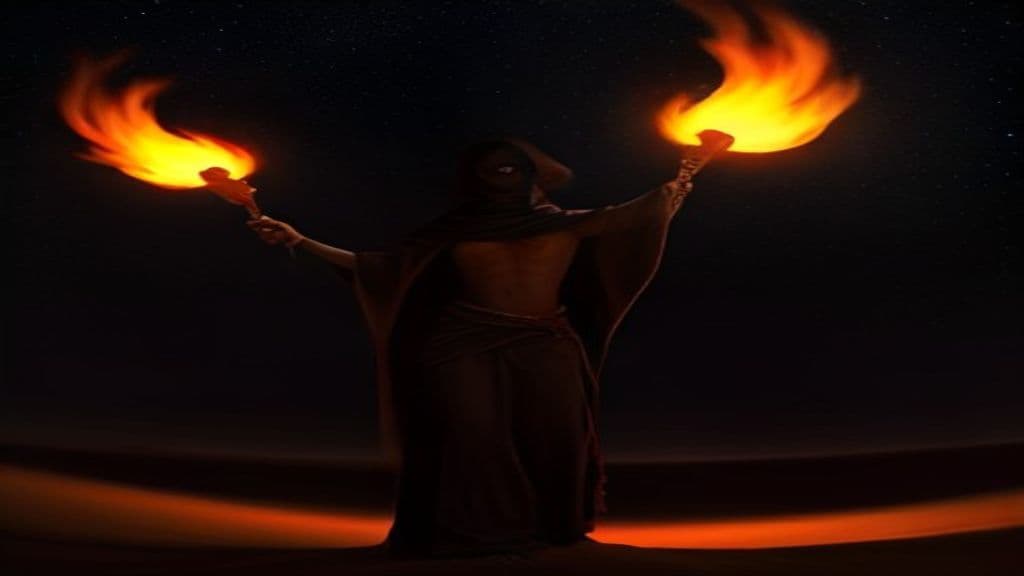
Reported depictions commonly portray Bai Baianai as an ethereal maiden: tall, slender, with long loose hair and wearing free‑flowing gowns often ornamented with feathers; some accounts add wings. Descriptions in the sources note pale, glowing skin and in some traditions a fair or blonde appearance. Several accounts emphasize transformative and fearsome manifestations: when angered she may assume the form of a monstrous bird and is described in some texts as able to fling fire at enemies.
Across the supplied material Bai Baianai functions as a protector and provider—patron of hunters, a bringer of fertility, game, fish and material wealth, and in certain traditions a guardian of children and family lineage. She is credited with controlling ecological and economic outcomes for human communities. Conversely, some sources report punitive powers: causing drought, burning crops or making cattle die of high fever when offended. The figure is seasonal in folk belief, said to come into the human world in spring and remain until autumn. Sources also distinguish functional forms (Bai Baianai for hunting, Tagh Baianai for forests, Ughu Baianai for fishery), suggesting local specialization within the Baianai cluster.
Weaknesses
- conditionseasonal absence (winter)
- otherabsence of explicit material weaknesses in sources — no attested aversions or substances recorded
Wards
- rituallighting fires and prayers by hunters
- ritualongoing cultic reverence (Altai and Sakha)

Jann
The weakest class of djinn in Islamic tradition, associated with desert winds and taking the form of snakes or whirlwinds, dwelling in empty wilderness and posing little threat to those who know the proper invocations.
Djinn
The class of supernatural beings created from smokeless fire in Islamic cosmology — a parallel civilization to humanity, capable of belief or unbelief, with their own prophets, society, and judgment before God.
Abzar İyesi
A Turkic iyesi (possessive/guardian spirit) of the courtyard, outbuildings, and farmstead grounds; ambivalent in nature, it protects its domain but may harm livestock and cause mischief, often appearing in animal forms.
Ak Ana
Ak Ana (also Ağ Ana, Ak Ene) is the primordial water-mother of Turkic and some Siberian (Khanty, Mansi) traditions: a holy maternal creator principle associated with the pre-earth expanse of water, fertility of the land, and the threshold to the spirit world.
Al (Alı)
No folkloric or ethnographic evidence for a supernatural entity named "Al" or "Alı" is present in the supplied source set. The available materials are modern biographical, political, linguistic, and religious texts that do not describe a Turkish spirit, demon, or other supernatural being by this name.
Alaz
Alaz is the Turkic god of fire associated with hearths, flame, and the Great Fire (Ulugh Od). He is described as a powerful fire-being who sends protector-spirits (İye) to household hearths and can cause destructive fires when angered; fire under his authority is also a purifying force.
Alp Er Tunga
Alp Er Tunga is a legendary heroic ruler of Turan in early Turkic tradition, remembered as an ideal warrior-king and ancestral figure invoked in medieval dynastic genealogies. He also appears in Iranian epic tradition under the cognate name Afrosiyab/Afrasiab, where the figure is framed differently.
Amazons
A society of women-warriors in ancient Greek myth and legend, depicted as skilled horsemen and archers who inhabit the periphery of the Greek world and act as recurring opponents and counterparts to Greek heroes. Treated by ancient authors as a past people and by modern scholars as a mythic construct possibly inspired by Eurasian female warrior burials.
Amrak
Amrak is not attested in the provided sources as a supernatural being. The lexical string "Amrak" appears across unrelated secular contexts — as a historical regnal name (Amrak Khagan / Ashina Anluo), a Turkish place-name (Çamrak / amrak), titles in modern Arabic-language music, an institutional name/acronym (AMRAK Institute), and as a modern brand/typeface/project name. No folkloric, ritual, or mythological descriptions of an entity called "Amrak" are present in the cited material.
Antimachus
Antimachus is attested in the provided sources primarily as a classical Greek personal name borne by historical figures (notably Antimachus of Colophon, a poet and grammarian ca. 400 BC, and Antimachus I Theos, a Greco-Bactrian king). The name is also reused in modern contexts (a Wikidata taxon entry and small-press fictional/divinatory pages). The sources do not present Antimachus as a supernatural or folkloric entity.
Apa Qaghan
Apa Qaghan (阿波可汗, Ābō Kèhán) is an historical Ashina prince and mid-6th century claimant to the Göktürk khaganate. Sources portray him as a political and military actor involved in the succession disputes after Taspar Qaghan's death, ruling contested steppe territories and engaging with both western Turkic allies and Sui China.
Aq Bars
Aq Bars (Tatar: Ак Барс, 'White Leopard') is an ancient Bulgar tribal totem and heraldic emblem historically used in Volga Bulgaria and the Khanate of Kazan and adopted in the modern era as the official symbol of the Republic of Tatarstan (formally since 7 February 1992). It functions as a dynastic/tribal mark of identity (derived from the Barsil tribe) and as a political-state emblem rather than a personal supernatural being.
Archura
Archura (Arçura) is a Turkic woodland chura — a shapeshifting forest spirit associated with particular woodland tracts and wild animals. Traditions portray Archura as a protector of wildlife and a trickster-like figure that can be dangerous to humans.
Asena
Asena is a mythic she-wolf who functions as the ancestress in the Göktürk foundation myth; she rescues an injured child after a battle, becomes pregnant by him according to the legend, flees across the Western Sea to a cave near the Qocho mountains, and gives birth to progenitors of the Ashina clan. The figure legitimizes the ruling lineage of early Turkic polities and has been revalorized in modern Turkish nationalist symbolism under the related label Bozkurt ('gray wolf').
Community Record
- [1]Bai Baianai — Wikipedia. Wikipedia contributors, 'Bai Baianai', Wikipedia, The Free Encyclopedia.wiki
- [2]Wikidata: Baj Bajania (Q3621530). Wikidata entry Q3621530 (Baj Bajania).wiki
- [3]Quagmire (Kuta) — IMFDB (ancillary mention). IMFDB entry referencing Yakut mythic names in popular culture (used as ancillary corroboration).other
- [4]August 2024 Horrorscopes: Vengeful Nature Deities! | The Horror Tree. Horrortree article referencing Bai Baianai in a popular context.other