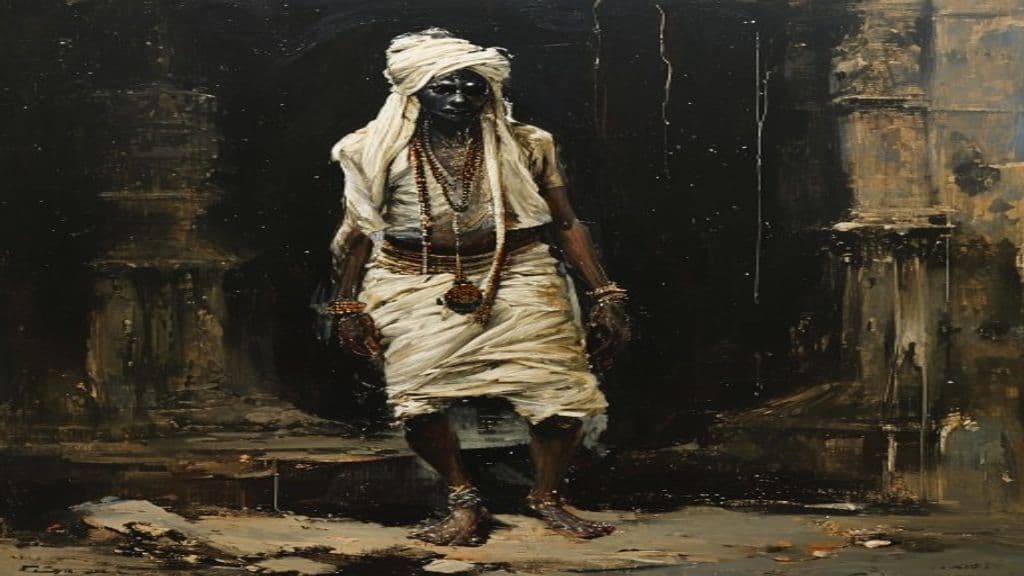
The provided source does not supply a specific mythic origin story for individual Būtas or a unified cosmogony. Instead, it situates Būtas/Daivas as local deities integral to the religious life of the Tulu-speaking population: beings venerated through the ritual-performance tradition called Būta Kōlā (also rendered Bhūta Kolam, Daiva Kōlā, Daiva Nēmā). The practice is presented as part of 'Bhootaradhane' or 'Daivaaradhane'—worship of local deities—indicating that these entities are embedded in an indigenous, community-centered religious order. The source furthermore places Būta Kōlā in a regional constellation of related performative-devotional forms, noting that Theyyam in North Malabar is an evolved form of Būta Kōla and that Būta Kōlā has influenced Yakshagana folk theatre.
The source emphasizes that Būta Kōlā is a highly stylised ritual-dance performance through which the local deities are venerated and enacted; it does not provide detailed descriptions of the spirits' inherent physical forms. From the material given, the primary visible manifestation of Būtas in the cultural context is the embodied performance by specialists—elaborate, stylised dance and theatrical enactment—rather than an independent iconographic description. The article notes the performative, theatrical character of the tradition and its relations to Theyyam and Yakshagana but does not list specific costumes, masks, or visual attributes in the cited text.
Reported powers and behaviours across sources include shape-shifting into various animal or human forms, luring and accompanying living people (often at night or on roads) and avoiding direct contact with the earth (manifested as floating). Narratives commonly describe bhootas seeking out milk and immersing themselves in it; consumption of bhoota-contaminated milk is presented as a typical route to possession. In stories a churel may seduce or obsess men and cause illness or death; more generally bhootas are associated with possession, sickness, obsession, or other harmful outcomes in folklore. In contrast, when ritually propitiated (for example in Tulu Nadu) the spirit-power of bhootas may be mediated through performance and become protective.
Weaknesses
- conditionproper funerary rites
- conditionavoidance of ingestion of bhoota-contaminated milk (preventive)
Wards
- ritualBhoota Kola (propitiatory performance)
- ritualmaintenance of Bhoota Staana (local shrine/installation of carved figures or stones)

Jinn
A class of supernatural beings from pre-Islamic Arabian religion later integrated into Islamic theology; jinn are created, morally accountable entities distinct from humans and angels, often unseen but capable of taking visible forms and interacting with people in varied ways.

Churel (Chudail)
A South Asian female revenant or vengeful ghost associated with women who die cruelly or unpurified; often said to target male relatives and sometimes described as latching onto trees, producing a tree‑attached tree‑spirit variant in local tales.
*Péh₂usōn (reconstructed)
Péh₂usōn is a hypothetical Proto‑Indo‑European pastoral guardian reconstructed by comparative scholars from parallels in Greek and Vedic traditions. Proposed as a Graeco‑Aryan ancestor‑figure, the reconstruction describes a protector of flocks, roads, and travellers rather than an attested historical cultic personality.
Ababil
Ababil (Arabic: أبابيل, romanized abābīl) are miraculous birds mentioned in the Qur'anic account of Surah Al‑Fil. In Islamic tradition they appear as a divinely sent avian host that defended the Kaaba by pelting an invading army with small clay stones; tradition places the event in the year traditionally given as 570 CE.
Abadir
Abadir is a polysemous name attested in distinct cultural contexts: a legendary founding saint and clan ancestor in eastern Ethiopia (Sheikh Abadir Umar Al‑Rida / Aw Abadir), a term applied to cone‑shaped cult stones in Phoenician religious description, and a personal name of a martyr (Abadir/Apater) in the Coptic Synaxarium. The attestations are independent usages of the same name rather than a single supernatural being.
Abdul Qadir Gilani
A historical 11th–12th century Hanbali jurist, preacher, and Sufi shaykh who became the eponym and principal early figure of the Qadiriyya tariqa; venerated in Sunni Sufi traditions as an Awliya (saint) and often given exalted hagiographical ranks such as Muḥi al‑Dīn and Ghawth.
Abel
Abel is the second son of Adam and Eve in the Genesis narrative, a shepherd whose accepted offering and subsequent murder by his brother Cain form the biblical account of the first death. Later interpretive traditions expand his role, treating him as an archetypal righteous victim, a postmortem avenging or adjudicating figure, and in some systems (notably Mandaean) identifying him with an angelic lightbeing.
Abhimanyu
Abhimanyu is a youthful Kuru/Pandava warrior-hero in the Sanskrit epic Mahābhārata. Son of Arjuna and Subhadra, he is famed for entering the Chakravyuha battle formation on the thirteenth day of the Kurukshetra War and dying at age sixteen; his posthumous son Parikshit continues the Kuru line.
Abraham (Ibrāhīm) in Islam
Ibrāhīm (Abraham) in Islam is a human prophet and messenger chosen by God, a paradigm of pure monotheism (hanīf), patriarchal ancestor to later peoples and prophets, and traditionally regarded as having helped establish the Kaʿbah with his son Ismāʿīl. He is called Khalīl Allāh ('Friend of God') and is central to rites commemorated in Hajj and Eid al‑Adha.
Abū Lahab
Abū Lahab (ʿAbd al-ʿUzzā ibn ʿAbd al-Muṭṭalib) is a historical Meccan figure — a paternal uncle of the Prophet Muḥammad and a Quraysh leader who opposed the Prophet; he is singled out and condemned in Qurʾān 111 (Sūrat al-Masad) and functions in Islamic textual memory as an exemplar of divine punishment for opposition.
Achyuta
Achyuta (Sanskrit: अच्युत, acyuta) is primarily an epithet/theonym in Vaishnava Hindu tradition applied to Vishnu and Krishna, signifying the divine quality of being 'not fallen' — immutable, infallible, and imperishable. It functions as a devotional name in scripture, liturgy, and Pancharatra lists of divine emanations rather than as an autonomous folkloric spirit.
Acintya
Acintya is an Indonesian Hindu theological-symbolic representation of the ineffable supreme divine principle. In Balinese and Javanese practice it functions as a way to make ultimate reality present in ritual and art—often aniconically as an empty throne (padmasana) or anthropomorphically as a naked, flame-surrounded figure—rather than as a narrative, intervening deity.
Adam (ʾĀdam)
In Islamic theology Adam (Arabic: آدم, ʾĀdam) is presented as the first human being and the first prophet (nabī), created by God from earth/clay, granted life by God's spirit, placed in a paradisal Garden, taught knowledge (the "Names"), tested by divine command, tempted by Iblīs, and ultimately sent to live and die on Earth while remaining eligible for repentance and forgiveness.
Adi (asura)
Adi is attested in modern reference works as the name of an Asura who 'appears in the Matsya Purāṇa.' Beyond this single-line citation in secondary sources, no descriptive material about the figure is provided in the supplied research notes.
Community Record
- [1]Bhoota (ghost) — Wikipedia. Wikipedia article 'Bhoota (ghost)' (selected excerpts provided in research notes)wiki
- [2]Wooden Bhoota Figures - Udupi, Karnataka — Archive. Archive description of Bhoota Staana, carved figures, Gudigar carvers and Bhoota Kola (selected excerpts provided in research notes)other
- [3]Buta Kola (Bhoota). Wikipedia: 'Būta Kōlā, also referred to as Bhūta Kolam, Daiva Kōlā or Daiva Nēmā, is a Hindu folk dance performance practised, believed and protected by the Tuluvas of Tulu Nadu and parts of Malenadu of Karnataka and Kasargod in northern Kerala, India.'wiki