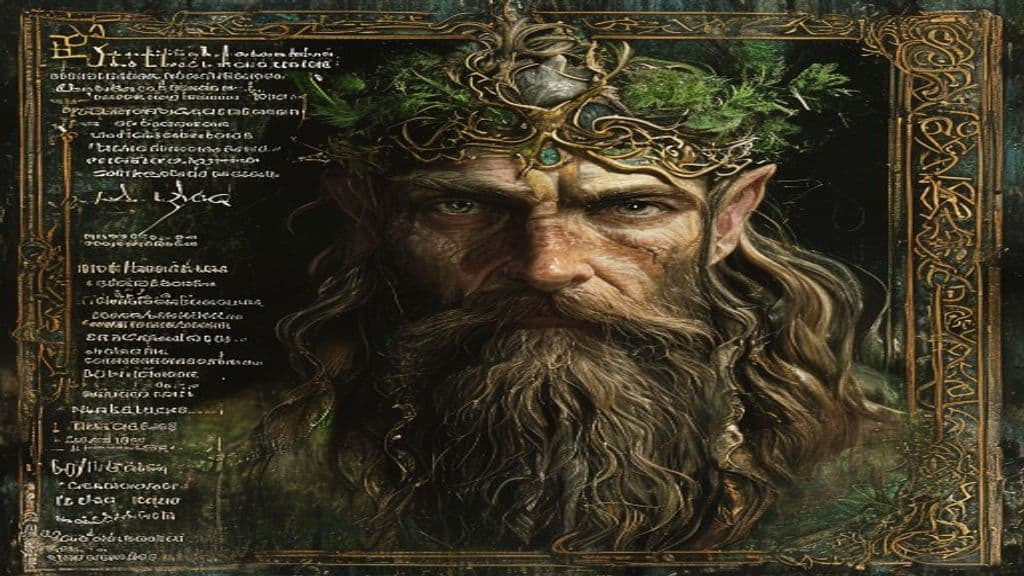
In the Lebor Gabála and Cath Maige Tuired accounts Bres is the son of a Fomorian (commonly named Elatha) and Ériu of the Tuatha Dé Danann, placing him at the liminal intersection of the two groups; alternative medieval variants (e.g., in The Fate of the Children of Tuirenn tradition) give Balor as his father. He becomes king of the Tuatha Dé for seven years, ruling in a manner that favours his Fomorian kin and provokes deposition and the restoration of Nuada, after which he returns to lead the Fomorians at the Second Battle of Magh Tuiredh (sources: Lebor Gabála, Cath Maige Tuired, The Fate of the Children of Tuirenn; dindsenchas poems).
Medieval texts (Lebor Gabála, Cath Maige Tuired) repeatedly describe Bres as physically beautiful; the scribal glosses record his name as meaning "beautiful," and dindsenchas poetry (Carn Hui Neit) lists numerous flattering epithets — "gifted with excellences," "ornament of the host," "with a visage never woeful." One summary tradition notes rapid childhood growth (reaching the size of a fourteen-year-old by seven). Despite attractive appearance, narrative depictions contrast that beauty with inhospitable behaviour (sources: Lebor Gabála, Cath Maige Tuired, Carn Hui Neit; Wikipedia summary of medieval material).
The tradition does not ascribe a catalogue of arcane powers to Bres; poetic sources credit him with attractiveness and even with being a "master of love-spells" (Carn Hui Neit). His narrative agency is political and practical: as king he levied tribute and labour from the Tuatha Dé (forcing figures like Ogma and the Dagda into menial tasks), and in one strand of the tradition he survives defeat to teach agriculture to the Tuatha Dé after promising Lugh that he will instruct them. Alternative accounts give his death by Lugh's trickery (the dindsenchas wooden cows filled with a lethal red liquid). Thus his role is chiefly that of a morally contested ruler whose actions produce social and political consequences rather than an explicitly magic-wielding supernatural antagonist (sources: Lebor Gabála, Cath Maige Tuired, Carn Hui Neit, dindsenchas; The Fate of the Children of Tuirenn variant noted).
Weaknesses
- conditionsusceptibility to poetic/satirical censure
- otherpolitical loss of legitimacy upon restoration of a whole king (Nuada's restoration)
- otherobligation of hospitality (exploited in dindsenchas account where it causes his death)
Wards
- ritualrestoration of rightful kingship (medical-restorative act by Miach and Airmed)
Abandinus
Abandinus is a locally attested Romano‑Celtic theonym known from a single inscribed bronze feather (votive object) dedicated at Godmanchester (the Roman fort Durovigutum) in Cambridgeshire. Scholars interpret him as a local god or male spirit tied to a specific place and possibly associated with a nearby spring or stream; this association is tentative and based on etymological readings of the name.
Abarta (Ábartach)
Abarta (also Ábartach) is a figure of Irish myth who, in surviving accounts, tricks Fionn mac Cumhaill's warriors by giving them a supernatural grey horse that bears them into the Otherworld. Sources variably identify him as a member of the Tuatha Dé Danann or as a Fomorian; after the incident he is compelled to release the captured warriors and is refused entry to the Fianna.
Abcán (Abhcán)
Abcán (modern spelling Abhcán) is a named dwarf poet and musician of the Tuatha Dé Danann in Irish myth. He appears in a small number of narratives as a musician whose art has soporific power and as the ferryman who brings the goddess Ruad from the Otherworld to the human world.
Abhean
Abhean is a named poet of the Tuatha Dé Danann in medieval Irish literature, described as a poet in particular of Lugh and recorded as having been killed by Óengus before Midir in a poem by Fland Mainistreach preserved in the Lebor Gabála Érenn.
Abnoba
Abnoba is a Gaulish theonym and toponym attested in Roman-era sources and inscriptions: a localized deity associated with woods, springs and the sources of rivers (notably the Danube) and simultaneously the name applied to a mountain or mountain range in the Black Forest/Baar/Odenwald region. Roman altars equate her with Diana, reflecting syncretic cult practice in frontier provinces.
Accolon
Accolon is a mortal knight of the Arthurian court, presented in the Post-Vulgate Merlin tradition and Malory's Le Morte d'Arthur as Morgan le Fay's paramour and instrument in a plot to supplant King Arthur; his tale centers on enchanted weapons (Excalibur and its scabbard), love-manipulation, and a tragic duel with Arthur.
Achall
Achall is an eponymous mortal woman in the Ulster Cycle of early Irish literature whose grief-induced death is given as the origin of the hill-name Achall (identified with the modern Hill of Skryne). She appears as a genealogical and etiological figure tied to Tara and later legendary events at the hill, rather than as a recurring supernatural agent.
Achtland
Achtland is a figure from Irish tradition who, according to the surviving account, was a mortal woman famed for rejecting mortal suitors who married a member of the Tuatha Dé Danann and crossed into the síde to become immortal as his wife.
Adar Llwch Gwin
Legendary large, intelligent birds from Welsh tradition said to understand human speech and obey their master's commands; best known for tearing their master Drudwas ap Tryffin to pieces when bound by a literal order in an Arthurian battle narrative. The term later came to be applied to raptors and metaphorically to brave men in medieval Welsh poetry.
Adar Rhiannon
Adar Rhiannon ('birds of Rhiannon') are a set of three magical birds in medieval Welsh narrative (the Mabinogi) whose song can 'wake the dead and lull the living to sleep.' They appear as otherworldly song‑beings tied to the figure Rhiannon and function within tales as providers of enchanted music that sustains and consoles characters.
Aderyn y Corff
Aderyn y Corff (literally 'bird of the corpse') is a bird-like death-porter in Welsh folklore said to call outside the door of a person about to die. Described as an avian portent that may lack feathers or wings and as existing on another plane when not manifesting, it is treated in Welsh ghost lore and sometimes naturalized as a screech owl in modern accounts.
Adhene
A class of Manx fairies (Cloan ny moyrn) described in Isle of Man tradition as a social people of beings said to be "fallen angels cast from heaven but too good for hell," who interact with human livelihoods and families, sometimes benevolent but often mischievous.
Community Record
- [1]Bres (Wikipedia entry). Wikipedia, entry 'Bres' summarizing Lebor Gabála, Cath Maige Tuired, dindsenchas, and related textswiki
- [2]Cath Maige Tuired (medieval text summaries). Cath Maige Tuired material summarized in sources cited by the Wikipedia entry and the supplied research notes (Lebor Gabála and manuscript glosses referenced there)literary
- [3]Carn Hui Neit (dindsenchas poem) – praise lines for Bres. Carn Hui Neit lines and dindsenchas material summarized in Story Archaeology and the supplied research notesliterary
- [4]Cairpre mac Edaine, 'Satire Upon Bres mac Eladain'. Text of the satire traditionally held to have been composed against Bres (noted in supplied sources as central to his deposition)literary
- [5]Story Archaeology — 'Bres – Kingship and Status' and 'Bres in Other Texts'. Summaries and discussion of variant portrayals and appearances of Bres across texts (used in supplied research notes)other