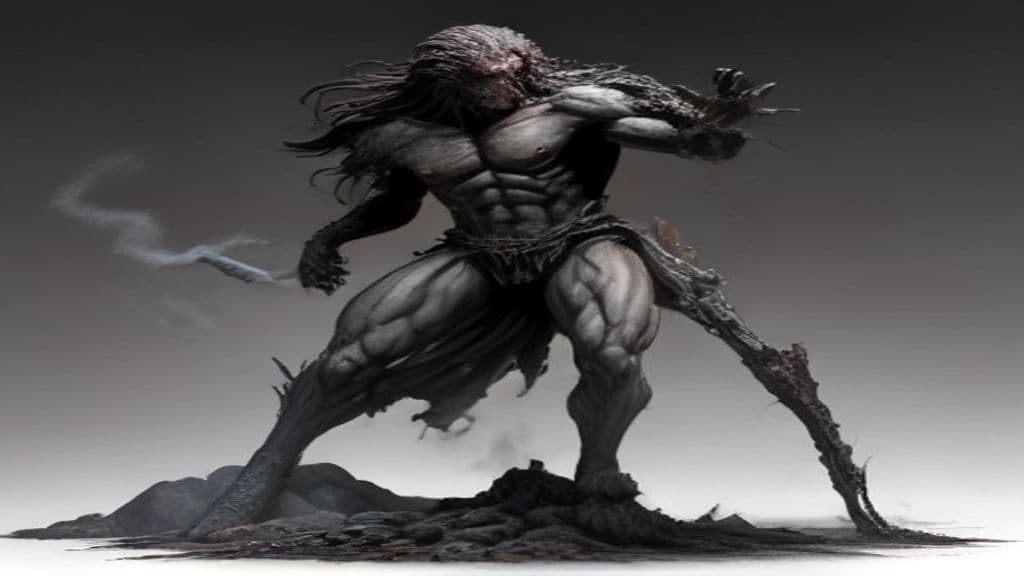
In Roman tradition Cacus is presented as a cave‑dwelling monstrous son of Vulcan (Plutarch calls him son of Hephaestus) who terrorized the area of the Aventine Hill before the founding of Rome. In Virgilic and later retellings he steals cattle belonging to the returning Heracles; when Heracles discovers the theft he pursues Cacus, enters the cave amid smoke and fire, and kills the creature. The episode functions etiologically to explain a local cult to Hercules and the erection of an altar (the Ara Maxima) at the Forum Boarium.
Classical sources and summaries describe Cacus as a large, physically monstrous, fire‑breathing giant associated with a cave; he is said to spew fire and smoke from his lair. Medieval and later literature (for example Dante's Inferno) reimagines him as a hybrid centaur figure with a fire‑breathing dragon on his shoulders and snakes upon his equine back, but that is a later literary transformation rather than a detail of the classical accounts.
Accounts describe Cacus as able to spew fire and smoke and possessing great physical strength/size sufficient to confront Hercules. He is depicted as a cunning thief: in Virgil/Evander variants he stole eight cattle (four bulls and four cows) and concealed the theft by dragging animals by their tails to mislead trackers or, in other variants, by making cattle leave false traces. Behaviorally he is presented as a predator on humans (reports say he 'lived on human flesh' and displayed macabre trophies such as nailing victims' heads to his cave door). He is ultimately overcome when Hercules enters the smoke‑filled cave and kills him.
Weaknesses
- othervulnerability to heroic force/tactic (Hercules' direct assault and killing)
Wards
- ritualAra Maxima (altar to Hercules)

3-D Man
3-D Man is a Marvel Comics superhero identity associated with a 1950s-era origin in which the body of Chuck Chandler can materialize in three-dimensional existence when activated by his brother Hal via a pair of glasses. The mantle was later assumed by Delroy Garrett (formerly Triathlon) in modern continuity.
5 Ronin
5 Ronin is a 2011 Marvel Comics five-issue limited series that reimagines five Marvel superhero archetypes as rōnin (masterless samurai) in a fictionalized post‑Sekigahara feudal Japan. The work places Wolverine, Hulk, Punisher, Psylocke, and Deadpool analogues into period roles to explore displacement, revenge, and identity in an era of political upheaval.
57 Mnemosyne
57 Mnemosyne is a large main-belt asteroid (S-type) discovered in 1859 and named after the Greek Titaness Mnemosyne. It is a non-sentient astronomical body studied for its orbital and rotational properties and has been used in dynamical measurements related to Jupiter.
A Elbereth Gilthoniel
An Elvish hymn in Sindarin addressed to Elbereth (Varda) from J. R. R. Tolkien's legendarium. Presented in The Lord of the Rings and later musical and dramatic adaptations, the hymn functions as devotional poetic language that evokes Elvish reverence for the star-kindler rather than an independent supernatural agent.
A.R.G.U.S.
A.R.G.U.S. is a fictional clandestine United States government agency in the DC Comics universe that investigates, contains, and manages superhuman, meta-human, and supernatural incidents and assets. Introduced in The New 52 continuity, it functions as an institutional actor providing intelligence, logistical support, covert task forces (notably Task Force X / the Suicide Squad), and a dedicated magic division across comics and media adaptations.
Aamon
Aamon (also Amon) is a named spirit in early modern Western grimoire tradition (Pseudomonarchia Daemonum; the Ars Goetia / Lesser Key of Solomon). He is presented as a high-ranking infernal officer (Marquis/Prince) who governs forty legions and is credited with knowledge of past and future and with affecting human relationships (reconciling or procuring feuds and favor).
Abandinus
Abandinus is a locally attested Romano‑Celtic theonym known from a single inscribed bronze feather (votive object) dedicated at Godmanchester (the Roman fort Durovigutum) in Cambridgeshire. Scholars interpret him as a local god or male spirit tied to a specific place and possibly associated with a nearby spring or stream; this association is tentative and based on etymological readings of the name.
Abarbarea
Abarbarea is a name attested in classical Greek and Roman sources for freshwater nymphs (naiads). The name appears for at least two individual mythic figures — a naiad wife of Bucolion and a naiad counted among ancestors of the Tyrians — and Hesychius records plural forms that may indicate the name was also used as a class-name (Abarbareai / Abarbalaiai).
Abas
Abas (Ancient Greek: Ἄβας, gen.: Ἄβαντος) is not a single mythic being but a recurring personal name borne by multiple mortals and minor mythic figures in Greek epic and genealogical traditions — kings, founders, seers, warriors, attendants, a centaur, and a youth transformed by a goddess. The name is glossed in the sources as 'guileless' or 'good-hearted' and appears across Argive, Theban, Trojan, Euboean, and other local cycles.
Abellio
Abellio is a theonym attested in Roman‑period inscriptions from the Comminges area of the Pyrenees and reported as worshipped in the Garonne Valley of ancient Gallia Aquitania. Surviving evidence is limited to a small number of inscriptions; scholars have variously hypothesized solar or arboreal associations and compared the name to forms of Apollo or to Celtic Belenus, but the deity's precise role in local cosmology remains uncertain.
Abin Sur
Abin Sur is a fictional extraterrestrial Green Lantern from the planet Ungara in DC Comics. A former history professor turned Green Lantern of Space Sector 2814, he discovered and investigated a prophecy tied to the "Blackest Night," died wounded on Earth and chose Hal Jordan as his ring-successor, and was later reanimated as a Black Lantern in the Blackest Night storyline.
Abnoba
Abnoba is a Gaulish theonym and toponym attested in Roman-era sources and inscriptions: a localized deity associated with woods, springs and the sources of rivers (notably the Danube) and simultaneously the name applied to a mountain or mountain range in the Black Forest/Baar/Odenwald region. Roman altars equate her with Diana, reflecting syncretic cult practice in frontier provinces.
Community Record
- [1]Cacus — Wikipedia. Wikipedia: 'In Roman mythology, Cacus ... was a fire‑breathing giant and the son of Vulcan ... He was killed by Hercules after terrorizing the Aventine Hill before the founding of Rome.' (summary and details on theft, fire, and Ara Maxima)wiki
- [2]Wikidata: Cacus. Wikidata entry summarizing classical identifiers and labels for Cacus.other
- [3]The Divine Comedy (Inferno) — recorded receptional depiction. Archive recording of Dante's Inferno; cited in the notes for Dante's later depiction of Cacus as a centaur‑like hybrid guarding thieves.literary
- [4]Africa's Desert Garden (archive). Included in supplied source list (archive collection referenced in materials).other
- [5]Catalogue of Japanese works of art (archive). Included in supplied source list (archive collection referenced in materials).other