
Accounts vary by textual and regional tradition. In passages of the Ganesha Purana Buddhi and Siddhi appear during Brahmā's worship (Ganesha causes them to appear so Brahmā can offer them back), while in another Ganesha Purana variant they are described as born from Brahmā's mind and given to Ganesha. The Śiva Purāṇa contains a marriage‑competition narrative in which the daughters of Prajāpati (identified with Siddhi and Buddhi or related figures) are involved in Ganesha's marital associations. Tantric sources (e.g., the Ajitāgama) describe forms of Ganapati flanked by two wives (dārā/dārāyugalam). These differing narratives reflect regional and sectarian variation in how Ganesha's attendant figures are configured.
Descriptions in the supplied sources are primarily iconographic and positional rather than detailed anthropomorphic accounts. Siddhi and Buddhi are frequently depicted standing to the right and left of the central Ganesha image in sanctums (for example, the Morgaon temple garbhagṛha). The Aṣṭa‑siddhi are represented in later iconography as a group of young women surrounding Ganesha (visual examples include Raja Ravi Varma's painting where attendants carry fans). The Ajitāgama describes a turmeric‑colored Haridra Ganapati flanked by two unnamed wives, using the Sanskrit term dārā/dārāyugalam; that text thus treats these two figures explicitly with the lexical category 'wives' while remaining within a tantric classificatory context.
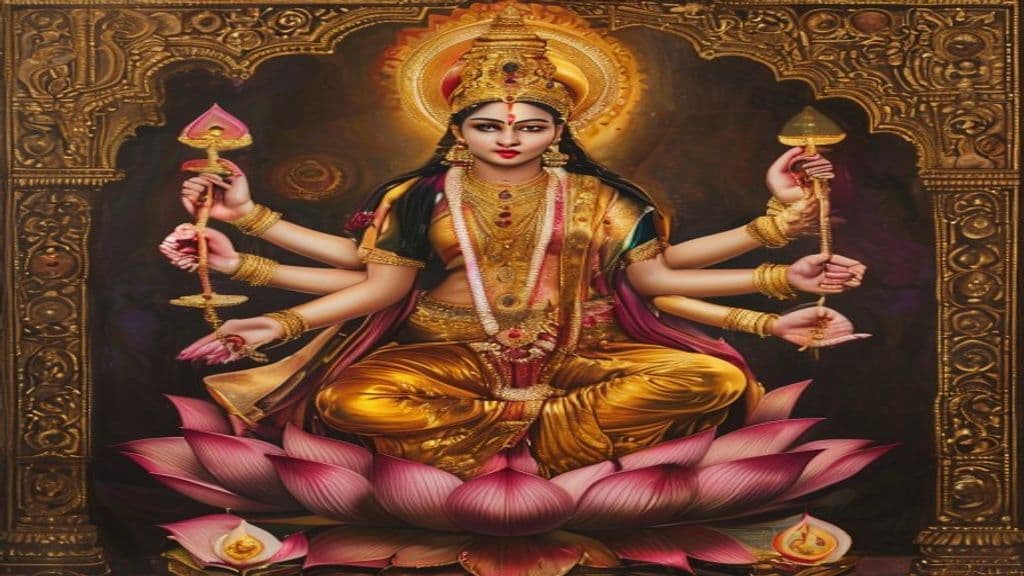
The consort‑figures function as personifications or emanations of qualities associated with Ganesha: Buddhi as intellect/wisdom, Siddhi as spiritual attainment/success, and Riddhi as prosperity/growth. Textual passages depict them as attendant powers that accompany or are produced by Ganesha (e.g., Ganesha causes Buddhi and Siddhi to appear in the Ganesha Purana). The Aṣṭa‑siddhi, when personified, can be employed by Ganesha as instruments in mythic action; the Ganesha Purana describes the personified Aṣṭa‑siddhi being used by Ganesha to attack the demon Devantaka. Scholarly commentary in the sources emphasizes that these women often function as shaktis—associate consciousness powers inseparable from the devatā—rather than as autonomous independent beings.
Weaknesses
- otherNo hostile weaknesses documented in provided sources
Wards
- otherNo warding or exorcistic rituals specifically targeted at Ganesha's consorts are documented in the provided sources
*Péh₂usōn (reconstructed)
Péh₂usōn is a hypothetical Proto‑Indo‑European pastoral guardian reconstructed by comparative scholars from parallels in Greek and Vedic traditions. Proposed as a Graeco‑Aryan ancestor‑figure, the reconstruction describes a protector of flocks, roads, and travellers rather than an attested historical cultic personality.
Abaddon
In Hebrew scripture Abaddon is primarily a noun meaning 'destruction' or a section/condition of the underworld paired with Sheol; in the New Testament Book of Revelation Abaddon is personified as an angelic figure (Greek Apollyon) described as the king of an army of locusts released from the abyss during the apocalypse.
Abadir
Abadir is a polysemous name attested in distinct cultural contexts: a legendary founding saint and clan ancestor in eastern Ethiopia (Sheikh Abadir Umar Al‑Rida / Aw Abadir), a term applied to cone‑shaped cult stones in Phoenician religious description, and a personal name of a martyr (Abadir/Apater) in the Coptic Synaxarium. The attestations are independent usages of the same name rather than a single supernatural being.
Abadiu of Antinoe
Abadiu of Antinoe was a fourth‑century bishop of Antinoe (Antinoopolis, in Roman Egypt) commemorated as a martyr and saint in the Coptic Orthodox Church, with a feast day on 26 December. Sources record that he was killed during a theological dispute with Arian opponents and reference him in collections of Egyptian martyrs.
Abagtha
Abagtha (Hebrew: אבגתא, ’Ǎḇaḡṯā) is a named human court official in the Hebrew Bible’s Book of Esther, listed among seven chamberlains who ministered before King Ahasuerus and were commanded to bring Queen Vashti before the king. He is attested only in Esther 1:10 and is presented as an institutional palace attendant rather than a supernatural being.
Abanoub
Abanoub is a 4th‑century Egyptian Christian child martyr venerated in the Coptic tradition. Remembered for his public confession of Christ, miraculous healings associated with his passion, and the translation and veneration of his relics, his feast is observed on July 31 (Epip 24) and his cult centers include Nehisa and Samanoud.
Abaskhiron the Soldier
A Coptic Orthodox martyr venerated for refusing imperial idolatry during the Diocletian persecution; reputedly healed by the Archangel Michael, preserved in monastery relics, and commemorated on 14 June (7 Paoni).
Abdel Messih El-Makari
Abdel Messih El-Makari (1892–1963) was a Coptic Orthodox monk and priest venerated as a 20th‑century Coptic saint. Associated with the Monastery of Saint Samuel the Confessor and the Monastery of Saint Macarius (Scetes/Wadi El‑Natrun), he is remembered for humility, asceticism, charity, and reported spiritual gifts such as prescience, discerning of spirits, and healing.
Abel
Abel is the second son of Adam and Eve in the Genesis narrative, a shepherd whose accepted offering and subsequent murder by his brother Cain form the biblical account of the first death. Later interpretive traditions expand his role, treating him as an archetypal righteous victim, a postmortem avenging or adjudicating figure, and in some systems (notably Mandaean) identifying him with an angelic lightbeing.
Abhimanyu
Abhimanyu is a youthful Kuru/Pandava warrior-hero in the Sanskrit epic Mahābhārata. Son of Arjuna and Subhadra, he is famed for entering the Chakravyuha battle formation on the thirteenth day of the Kurukshetra War and dying at age sixteen; his posthumous son Parikshit continues the Kuru line.
Abib and Apollo
Abib and Apollo are Christian ascetics and hagiographic saints of Akhmim (Upper Egypt) attested in Coptic sources and the Historia Monachorum. Remembered for extreme asceticism, monastic leadership, angelic encounters, and inclusion in the Coptic Synaxarion (feast day November 4).
Abiel
Abiel is attested in the supplied sources only as a male given name — borne by several historical American individuals and listed as two minor biblical figures. The provided materials contain no evidence presenting Abiel as a supernatural, mythological, or folkloric entity.
Community Record
- [1]Consorts of Ganesha (Wikipedia). Wikipedia, 'Consorts of Ganesha'.wiki
- [2]Vishnu with His Consorts, Lakshmi and Sarasvati (archive image and notes). Archive: Vishnu with His Consorts, Lakshmi and Sarasvati (museum/archive material cited in research notes).other
- [3]ERIC ED434851: India's Myths and Symbols through the Oral Tradition. Fulbright-Hays Summer Seminars Abroad, 1998 (India): 'India's Myths and Symbols through the Oral Tradition' (archive).other
- [4]Notre dernière création... Devatā (archive image/notes). Archive: Devatā sculpture notes (used for devatā/consort symbolism context).other