
Cyllarus is attested in Ovid's Metamorphoses (Book XII) within the narrative of the centaur–Lapith battle (the conflict erupting at Pirithous' wedding). The supplied sources present him as one of the centaurs who fought the Lapiths; no separate genealogy or founding origin for Cyllarus is provided in the cited materials. His story in the sources is a dramatic episode within the larger mythic confrontation rather than an independent origin myth.
Cyllarus is described in the supplied texts as a centaur — possessing the conventional composite form of human upper body and horse lower body — and explicitly characterized as "handsome and valiant" (summary of Ovid as reported in secondary sources). The available materials do not provide further iconographic details, measurements, coloration, or distinctive markings beyond the general centaur morphology and the attributes of handsomeness and valor.
In the cited accounts Cyllarus' demonstrated abilities are martial: he participated in the battle against the Lapiths and is portrayed as valorous in combat. He is also presented as deeply attached to his centaur wife Hylonome; his death and her reaction emphasize emotional devotion. The supplied sources do not record any supernatural powers, magical abilities, or cosmic functions for Cyllarus beyond his role as a mortal combatant among centaurs.
Weaknesses
- othersusceptibility to mortal weapons (fatally wounded by a spear)
- conditionmortality / vulnerability in battle
Wards
- othernone attested in sources

Hylonome
Hylonome (Ancient Greek: Ὑλονόμη) is a female centaur from Greek mythology known primarily from Ovid's Metamorphoses (Book 12) as one half of a pair of centaur lovers; after her husband Cyllarus is killed in the battle between the Centaurs and the Lapiths she kills herself from grief.
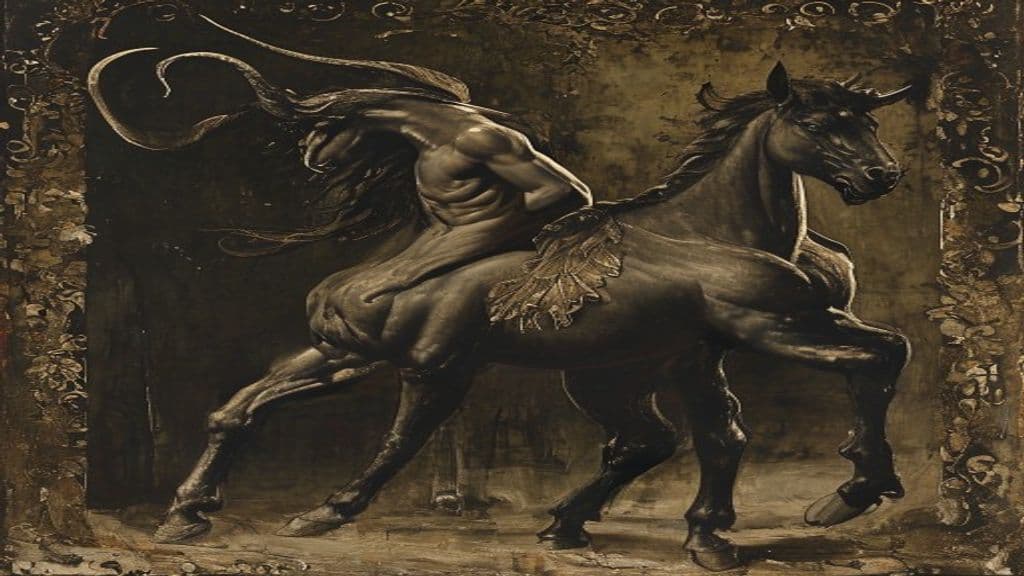
Centaur
A mythic hybrid from ancient Greek tradition with the upper body of a human and the lower body and legs of a horse. Centaurs appear as a tribal population associated with mountainous and wooded regions of Greece and embody tensions between human social order and untamed nature.
*Péh₂usōn (reconstructed)
Péh₂usōn is a hypothetical Proto‑Indo‑European pastoral guardian reconstructed by comparative scholars from parallels in Greek and Vedic traditions. Proposed as a Graeco‑Aryan ancestor‑figure, the reconstruction describes a protector of flocks, roads, and travellers rather than an attested historical cultic personality.
Aba (disambiguation / name-form)
Aba is a polyvalent name-form attested across many unrelated contexts (place names, personal names, animal names, and brief mythological listings). The provided sources do not support a single, coherent supernatural entity called "Aba" and offer no descriptive or ritual material for such a being.
Abandinus
Abandinus is a locally attested Romano‑Celtic theonym known from a single inscribed bronze feather (votive object) dedicated at Godmanchester (the Roman fort Durovigutum) in Cambridgeshire. Scholars interpret him as a local god or male spirit tied to a specific place and possibly associated with a nearby spring or stream; this association is tentative and based on etymological readings of the name.
Abarbarea
Abarbarea is a name attested in classical Greek and Roman sources for freshwater nymphs (naiads). The name appears for at least two individual mythic figures — a naiad wife of Bucolion and a naiad counted among ancestors of the Tyrians — and Hesychius records plural forms that may indicate the name was also used as a class-name (Abarbareai / Abarbalaiai).
Abas
Abas (Ancient Greek: Ἄβας, gen.: Ἄβαντος) is not a single mythic being but a recurring personal name borne by multiple mortals and minor mythic figures in Greek epic and genealogical traditions — kings, founders, seers, warriors, attendants, a centaur, and a youth transformed by a goddess. The name is glossed in the sources as 'guileless' or 'good-hearted' and appears across Argive, Theban, Trojan, Euboean, and other local cycles.
Abderus
Abderus (Ancient Greek: Ἄβδηρος, romanized Ábdēros) is a mortal heroic figure in Greek myth closely associated with Heracles, remembered as the youth left in charge of the Mares of Diomedes who was killed by them. He functions as an eponymous local/divine-hero ancestor for the city of Abdera and received funerary commemoration and athletic agones at his tomb.
Abellio
Abellio is a theonym attested in Roman‑period inscriptions from the Comminges area of the Pyrenees and reported as worshipped in the Garonne Valley of ancient Gallia Aquitania. Surviving evidence is limited to a small number of inscriptions; scholars have variously hypothesized solar or arboreal associations and compared the name to forms of Apollo or to Celtic Belenus, but the deity's precise role in local cosmology remains uncertain.
Abnoba
Abnoba is a Gaulish theonym and toponym attested in Roman-era sources and inscriptions: a localized deity associated with woods, springs and the sources of rivers (notably the Danube) and simultaneously the name applied to a mountain or mountain range in the Black Forest/Baar/Odenwald region. Roman altars equate her with Diana, reflecting syncretic cult practice in frontier provinces.
Abomination of Desolation
An apocalyptic prophetic phrase originating in the Book of Daniel designating a profaning thing or act that renders the Jerusalem Temple cult desolate; later reused in the Synoptic Gospels as an eschatological sign prompting urgent flight. The term denotes ritual/cultic impurity (Hebrew shiqquts) and is variously interpreted as pagan offerings or altar, a foreign cult statue, or (in some New Testament readings) an acting agent.
Aborigines (mythology)
A mytho-historical label used in Roman and general reference sources to denote the oldest inhabitants of a region (specifically central Italy in the cited Roman context). The term functions as an identity/category for original human populations rather than as a characterized supernatural being in the provided sources.
Absyrtus
Absyrtus (Ancient Greek: Ἄψυρτος) is a Colchian prince in the Greek Argonautic cycle, son of King Aeëtes and brother or half-brother of Medea. He appears in variant traditions either as a companion taken by Medea during her flight with Jason and murdered/dismembered to delay pursuit, or as a pursuer sent by Aeëtes who is overtaken and slain by Jason; his death functions as a key narrative device in the escape from Colchis.
Abundantia
Abundantia is the Roman divine personification of abundance and material plenty, used primarily in imperial propaganda and public iconography to signify secure grain supplies, wealth, and the promise of a 'Golden Age' under the emperor. She also appears in later medieval European folklore as Domina Abundia / Dame Habonde, a household benefactor in accounts condemned by ecclesiastical writers.
Community Record
- [1]Metamorphoses (Book XII) — Ovid. Ovid, Metamorphoses, Book XII (as available in The Internet Classics Archive)literary
- [2]Cyllarus — Wikipedia. Wikipedia entry 'Cyllarus' (summarizing Ovid)wiki
- [3]52975 Cyllarus (asteroid) — Wikipedia. Wikipedia entry for asteroid 52975 Cyllarus (notes naming after the centaur)wiki
- [4]Cyllarus — Wikidata. Wikidata entry for Cyllarusother
- [5]52975 Cyllarus — Mark Andrew Holmes. Asteroid naming notes referencing the centaur Cyllarusother