
In classical sources Diana is a member of the Roman pantheon, commonly described as the daughter of Latona (Leto) and the elder twin sister of Apollo. Some accounts summarized in the provided corpus say Latona gave birth to Diana without difficulty and then labored for Apollo (with variants describing nine nights and nine days of labor for Apollo), and other versions place Diana's birth at Ortygia; these variant birth-details appear across reception summaries. Later and modern esoteric or neo-pagan writings sometimes recast Diana in larger, primordial roles (e.g., “Diana Primigenia”), but those are post-classical reinterpretations distinct from her classical Roman parentage and twin relationship with Apollo.
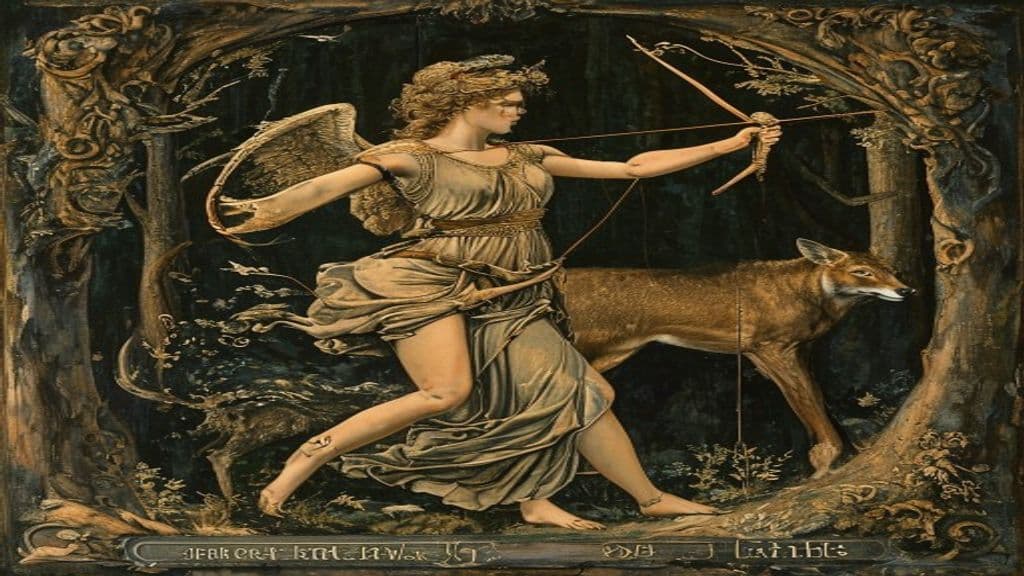
The supplied sources emphasize Diana's functional domains more than a single fixed iconographic description, but by assimilation with the Greek Artemis she is commonly imagined and depicted as a huntress: a young, chaste female figure bearing a bow and quiver and often accompanied in art and myth by wild animals such as stags or hunting dogs. Later artistic and literary reception also represents her with lunar imagery (for example a crescent) reflecting her association with the Moon and the night. The provided extracts do not supply a single canonical physical description from Roman ritual texts, instead presenting these visual traits through syncretism with Artemis and later portrayals.
Across the supplied sources Diana's powers and spheres of authority include guardianship of the countryside and nature, patronage of hunters and wildlife, protection in childbirth, oversight of crossroads, and association with the night and the Moon. Sources describe her as chaste and as a protector of children and the weak; reception summaries note myths (e.g., associations with Callisto) that reflect her independence and chastity. Some secondary summaries (e.g., popular-encyclopedic entries) attribute abilities such as rapport with animals as part of her huntress character; more speculative claims that recast her as a primordial creative principle appear in later esoteric/neo-pagan material and are distinct from the classical Roman portrayal.
*Péh₂usōn (reconstructed)
Péh₂usōn is a hypothetical Proto‑Indo‑European pastoral guardian reconstructed by comparative scholars from parallels in Greek and Vedic traditions. Proposed as a Graeco‑Aryan ancestor‑figure, the reconstruction describes a protector of flocks, roads, and travellers rather than an attested historical cultic personality.
3-D Man
3-D Man is a Marvel Comics superhero identity associated with a 1950s-era origin in which the body of Chuck Chandler can materialize in three-dimensional existence when activated by his brother Hal via a pair of glasses. The mantle was later assumed by Delroy Garrett (formerly Triathlon) in modern continuity.
5 Ronin
5 Ronin is a 2011 Marvel Comics five-issue limited series that reimagines five Marvel superhero archetypes as rōnin (masterless samurai) in a fictionalized post‑Sekigahara feudal Japan. The work places Wolverine, Hulk, Punisher, Psylocke, and Deadpool analogues into period roles to explore displacement, revenge, and identity in an era of political upheaval.
58 Concordia
58 Concordia is a fairly large main-belt asteroid orbiting the Sun, discovered in 1860 and named after the Roman goddess Concordia. Astronomical sources classify it as a C-type (carbonaceous) body with a multi-year orbital period and measurable rotation and pole orientations.
9MOTHER9HORSE9EYES9
An anonymous Reddit screen name and online persona used by the author of the Interface series, a multipart speculative-horror narrative posted in short installments across Reddit in 2016. The name functions as the signature of an authorial identity and as a focal label for a fandom that created archives, a subreddit, and a wiki documenting the story and its fictional phenomena (notably entities called "flesh interfaces").
A.R.G.U.S.
A.R.G.U.S. is a fictional clandestine United States government agency in the DC Comics universe that investigates, contains, and manages superhuman, meta-human, and supernatural incidents and assets. Introduced in The New 52 continuity, it functions as an institutional actor providing intelligence, logistical support, covert task forces (notably Task Force X / the Suicide Squad), and a dedicated magic division across comics and media adaptations.
Aba (disambiguation / name-form)
Aba is a polyvalent name-form attested across many unrelated contexts (place names, personal names, animal names, and brief mythological listings). The provided sources do not support a single, coherent supernatural entity called "Aba" and offer no descriptive or ritual material for such a being.
Abandinus
Abandinus is a locally attested Romano‑Celtic theonym known from a single inscribed bronze feather (votive object) dedicated at Godmanchester (the Roman fort Durovigutum) in Cambridgeshire. Scholars interpret him as a local god or male spirit tied to a specific place and possibly associated with a nearby spring or stream; this association is tentative and based on etymological readings of the name.
Abarbarea
Abarbarea is a name attested in classical Greek and Roman sources for freshwater nymphs (naiads). The name appears for at least two individual mythic figures — a naiad wife of Bucolion and a naiad counted among ancestors of the Tyrians — and Hesychius records plural forms that may indicate the name was also used as a class-name (Abarbareai / Abarbalaiai).
Abas
Abas (Ancient Greek: Ἄβας, gen.: Ἄβαντος) is not a single mythic being but a recurring personal name borne by multiple mortals and minor mythic figures in Greek epic and genealogical traditions — kings, founders, seers, warriors, attendants, a centaur, and a youth transformed by a goddess. The name is glossed in the sources as 'guileless' or 'good-hearted' and appears across Argive, Theban, Trojan, Euboean, and other local cycles.
Abderus
Abderus (Ancient Greek: Ἄβδηρος, romanized Ábdēros) is a mortal heroic figure in Greek myth closely associated with Heracles, remembered as the youth left in charge of the Mares of Diomedes who was killed by them. He functions as an eponymous local/divine-hero ancestor for the city of Abdera and received funerary commemoration and athletic agones at his tomb.
Abellio
Abellio is a theonym attested in Roman‑period inscriptions from the Comminges area of the Pyrenees and reported as worshipped in the Garonne Valley of ancient Gallia Aquitania. Surviving evidence is limited to a small number of inscriptions; scholars have variously hypothesized solar or arboreal associations and compared the name to forms of Apollo or to Celtic Belenus, but the deity's precise role in local cosmology remains uncertain.
Community Record
- [1]Diana (mythology) — Wikipedia (excerpt). Wikipedia: 'Diana is a goddess in Roman religion, primarily considered a patroness of the countryside and nature, hunters, wildlife, childbirth, crossroads, the night, and the Moon. She is equated with the Greek goddess Artemis, and absorbed much of Artemis' mythology.'wiki
- [2]Diana (mythology) — Alchetron (summary). Alchetron summary: describes Diana as a figure of the hunt, the moon, and nature and notes assimilation with Artemis.other
- [3]Diana (mythology) — New World Encyclopedia (excerpt). New World Encyclopedia: summarizes birth narratives (Latona/Leto as mother; twin of Apollo) and variant accounts noting Ortygia and differing labor lengths.other
- [4]Callisto (mythology) — Wikipedia (entry referenced). Callisto entry referenced among supplied materials as a figure associated with Artemis/Diana traditions.wiki
- [5]Mulholland-drive: Roman Mythology (summary). Mulholland-drive summary noting Diana's roles as nurturer of children and protector of the weak and commentary on her chastity and relations with men.other
- [6]Dianic Mythology — Jesterbear (reception/neo-pagan material). Jesterbear: later/alternative interpretations presenting 'Diana Primigenia' and noting Leland's 19th-century reception of Diana in Italian folklore collections; used here as evidence of post-classical reinterpretation rather than classical cult practice.folk