
Literary tradition links the cult at Nemi to a Tauric origin story brought to Italy in mythic time (associations with Orestes and Iphigenia appear in ancient narrative), while archaeological and votive evidence date the sanctuary's cult-image and dedicatory activity into the classical period (attested from the fourth century BC onward). The sanctuary remained a locally distinct center—outside Rome's pomerium—and its foundation and ritual identity combine indigenous Italic practice with later Hellenising conflation with Artemis and associations with Hekate/Trivia.
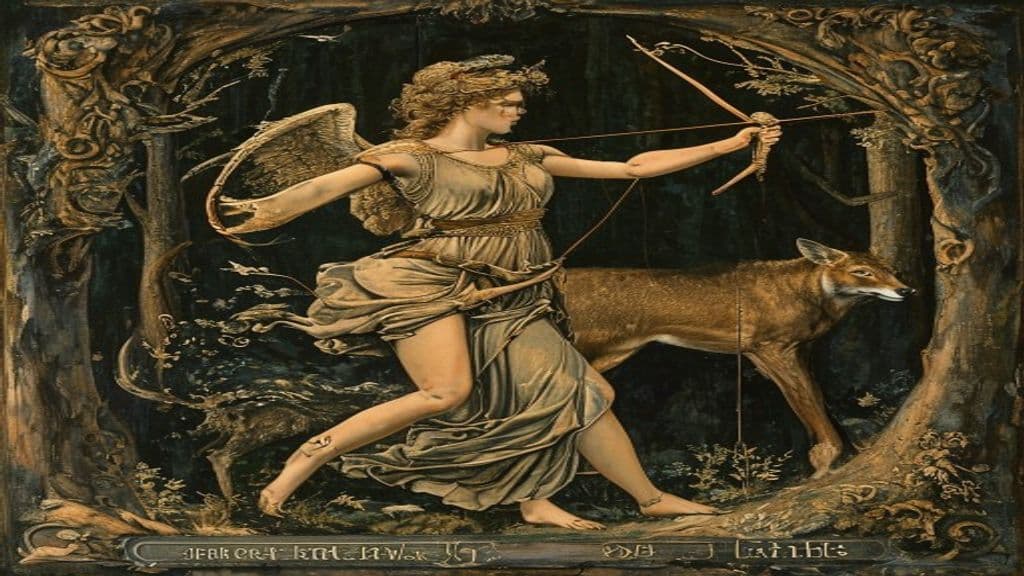
Ancient sources and numismatic reconstructions indicate a triform mode of representation: coin imagery and later scholarship reconstruct three female figures standing before a wood, joined by a horizontal element at the necks, with the central figure touching the others (a reconstruction associated with Alföldi). Votive material and literary testimony portray her in huntress garb and with fertility/childbearing associations. The grove itself contained a prominently guarded central tree that formed a focal point of the sanctuary.
As documented in literary and votive evidence, Diana Nemorensis functioned as protector of woods and mountains, a local huntress and lunar figure (the 'triform' goddess combining huntress, moon, and chthonic aspects), and as a recipient of votive petitions for fertility and safe childbirth. The sanctuary also institutionalized and sanctioned a distinctive priestly-political role—the Rex Nemorensis—whose succession ritual involved breaking a bough and ritualized mortal combat, preserving memories of more severe sacrificial customs in mythic narrative.
Weaknesses
- conditionsanctuary taboos/limits (no breaking of boughs except by a permitted challenger)
Wards
- ritualphysical guarding of the grove
- conditiontaboo prohibiting breaking branches of the sacred tree
Abandinus
Abandinus is a locally attested Romano‑Celtic theonym known from a single inscribed bronze feather (votive object) dedicated at Godmanchester (the Roman fort Durovigutum) in Cambridgeshire. Scholars interpret him as a local god or male spirit tied to a specific place and possibly associated with a nearby spring or stream; this association is tentative and based on etymological readings of the name.
Abarbarea
Abarbarea is a name attested in classical Greek and Roman sources for freshwater nymphs (naiads). The name appears for at least two individual mythic figures — a naiad wife of Bucolion and a naiad counted among ancestors of the Tyrians — and Hesychius records plural forms that may indicate the name was also used as a class-name (Abarbareai / Abarbalaiai).
Abas
Abas (Ancient Greek: Ἄβας, gen.: Ἄβαντος) is not a single mythic being but a recurring personal name borne by multiple mortals and minor mythic figures in Greek epic and genealogical traditions — kings, founders, seers, warriors, attendants, a centaur, and a youth transformed by a goddess. The name is glossed in the sources as 'guileless' or 'good-hearted' and appears across Argive, Theban, Trojan, Euboean, and other local cycles.
Abellio
Abellio is a theonym attested in Roman‑period inscriptions from the Comminges area of the Pyrenees and reported as worshipped in the Garonne Valley of ancient Gallia Aquitania. Surviving evidence is limited to a small number of inscriptions; scholars have variously hypothesized solar or arboreal associations and compared the name to forms of Apollo or to Celtic Belenus, but the deity's precise role in local cosmology remains uncertain.
Abnoba
Abnoba is a Gaulish theonym and toponym attested in Roman-era sources and inscriptions: a localized deity associated with woods, springs and the sources of rivers (notably the Danube) and simultaneously the name applied to a mountain or mountain range in the Black Forest/Baar/Odenwald region. Roman altars equate her with Diana, reflecting syncretic cult practice in frontier provinces.
Aborigines (mythology)
A mytho-historical label used in Roman and general reference sources to denote the oldest inhabitants of a region (specifically central Italy in the cited Roman context). The term functions as an identity/category for original human populations rather than as a characterized supernatural being in the provided sources.
Abundantia
Abundantia is the Roman divine personification of abundance and material plenty, used primarily in imperial propaganda and public iconography to signify secure grain supplies, wealth, and the promise of a 'Golden Age' under the emperor. She also appears in later medieval European folklore as Domina Abundia / Dame Habonde, a household benefactor in accounts condemned by ecclesiastical writers.
Acamas
Acamas (Ancient Greek: Ἀκάμας) is a personal name recurrent in ancient Greek narrative traditions applied to multiple human characters (warriors, princes, suitors), once to a Cyclops, and once as a hound's name. Rather than a single supernatural entity, bearers of the name appear episodically across the Trojan War, Theseid, and Theban cycles as mortal actors whose deeds intersect with gods and fate.
Acantha
Acantha (Ancient Greek: Ἀκάνθα, 'thorn') is a late or secondary mythological figure known from modern retellings as a nymph transformed into the acanthus plant. The tale that she scratched Apollo and was changed into a spiny-leaved plant is not attested in surviving classical corpora and appears to be a modern compilation or invention rather than a firmly documented ancient myth.
Acerbas
Acerbas (also recorded as Sychaeus, Sycharbas, Zacherbas) is a figure in classical Greco‑Roman accounts of Phoenician/Tyrian tradition: a wealthy priest of Melqart (the Tyrian Hercules) whose concealed riches and murder by King Pygmalion precipitate Elissa/Dido's flight from Tyre and the foundation of Carthage. He is presented as a human priestly figure of high social rank rather than as a supernatural being.
Acestes
Acestes is a Roman/Greek founder-hero associated with the Sicilian city Segesta (Aegesta/Acesta). Presented as son of a Trojan woman and, in one tradition, the Sicilian river-god Crinisus (in animal form), he hospitably receives Aeneas and the Trojans, participates in the funeral games in Virgil's Aeneid (Book V), and functions as an eponymous culture-founder and local ruler.
Achaemenides
Achaemenides is a literary mortal figure introduced into Virgil's Aeneid as a marooned member of Odysseus' crew whom Aeneas rescues on Sicily. In Roman epic he functions as a chance survivor and eyewitness who helps link the Homeric tradition to the Trojan refugees and to illustrate Aeneas' magnanimity.
Community Record
- [1]Diana Nemorensis. Wikipedia: 'Diana Nemorensis' article (accessed via research notes)wiki
- [2]Temple of Diana (Nemi). Wikipedia: 'Temple of Diana (Nemi)' (accessed via research notes)wiki
- [3]Nemorensis (place resource). Pleiades place resource for Nemus/Nemi (as cited in research notes)other
- [4]Writings and numismatic reconstruction (summary in research notes). Wikidata entry for Diana Nemorensis and numismatic description summarized in research notes (Alföldi reconstruction referenced in secondary literature cited in notes)other
- [5]Archive material and secondary commentary (contextual references). Archive.org item referenced in research notes for contextual discussion of cult violence and ritual (not primary liturgy)other