Divine Twins is a deity in Hindu folklore, from South Asia. A recurring Indo‑European mytheme of youthful equestrian twin youths associated with the sky and dawn who act as rescuers, healers, and protectors of travelers and oaths. They appear across multiple traditions (e.g., Vedic Aśvins, Lithuanian Ašvieniai, Greek Dioskouroi) as a functional paired figure rather than a single cultic entity.
Comparative Indo‑European scholarship reconstructs the Divine Twins as semi‑divine youths linked to the Sky‑God (*Dyēus) and to the dawn/sun family (*H₂éwsōs). They are typically presented as the offspring or descendants of the Sky‑God (epithets reconstructed as forms meaning "sons/descendants of Dyēus" in some proposals) and function as mobile divine horsemen who accompany or draw solar vehicles and intervene to rescue the solar/dawn figure from watery peril. This reconstruction is inferred from multiple descendant traditions—not a single preserved Proto‑Indo‑European text—and some proposed linguistic forms (e.g., a name derived from the PIE word for "horse" *h1éḱwos) are treated as plausible but not certain by scholars.
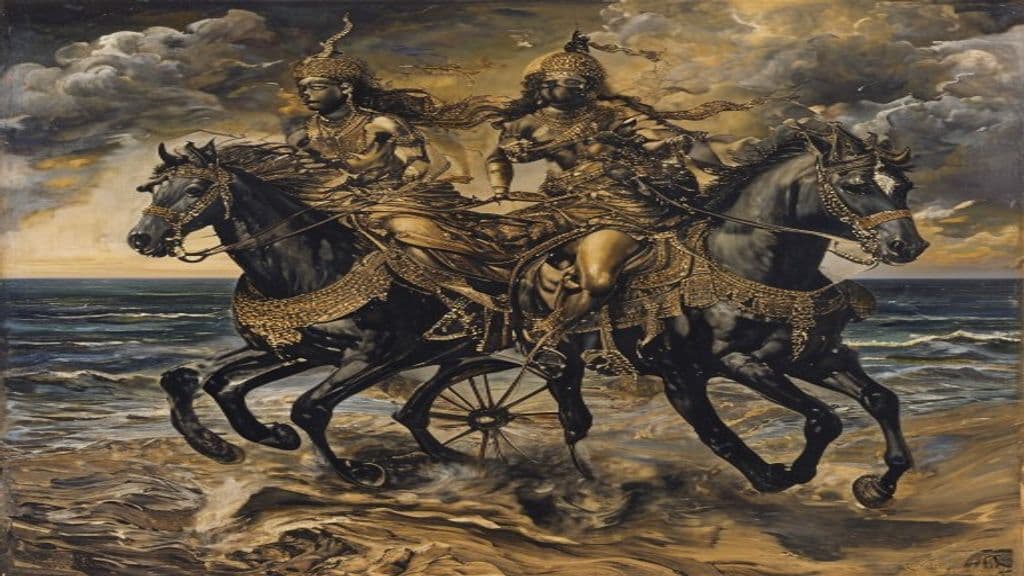
Across traditions the twins are represented as youthful horsemen or as horses themselves. Attestations include paired young men driving or flanking horses on reliefs and monuments (e.g., iconography attested for the Dioskouroi and continental dedications) and literary depictions like the Vedic Aśvins as divine horsemen. They may appear as charioteers, as riders drawing the sun's chariot, or as figures associated with maritime imagery (golden boats) in comparative motifs.
Comparative sources attribute to the twins rescuing and healing functions: saviors at sea, rescuers on the battlefield, and magic healers. Cosmologically they are linked to the solar/dawn cycle in common motifs—riding steeds that pull or accompany solar vehicles, rescuing the dawn or the sun's daughter from watery danger, and returning in a golden boat at night to bring the sun back in the morning. They are also protectors of oaths and providers of divine aid in battle, often portrayed as a complementary pair with one twin more martial and the other more healing or domestic. Many of these features are reconstructed as a recurring mytheme rather than attested as a single narrative across all traditions.
Weaknesses
- othernone attested
Wards
- othernone attested
*Péh₂usōn (reconstructed)
Péh₂usōn is a hypothetical Proto‑Indo‑European pastoral guardian reconstructed by comparative scholars from parallels in Greek and Vedic traditions. Proposed as a Graeco‑Aryan ancestor‑figure, the reconstruction describes a protector of flocks, roads, and travellers rather than an attested historical cultic personality.
Aba (disambiguation / name-form)
Aba is a polyvalent name-form attested across many unrelated contexts (place names, personal names, animal names, and brief mythological listings). The provided sources do not support a single, coherent supernatural entity called "Aba" and offer no descriptive or ritual material for such a being.
Abarbarea
Abarbarea is a name attested in classical Greek and Roman sources for freshwater nymphs (naiads). The name appears for at least two individual mythic figures — a naiad wife of Bucolion and a naiad counted among ancestors of the Tyrians — and Hesychius records plural forms that may indicate the name was also used as a class-name (Abarbareai / Abarbalaiai).
Abaris the Hyperborean
Abaris the Hyperborean is a semi-legendary Hyperborean sage, healer, seer, and priestly envoy of Apollo in Greek tradition, famed for traveling with a magical arrow/dart, expelling pestilence, and transmitting ritual and prophetic knowledge to Greece.
Abas
Abas (Ancient Greek: Ἄβας, gen.: Ἄβαντος) is not a single mythic being but a recurring personal name borne by multiple mortals and minor mythic figures in Greek epic and genealogical traditions — kings, founders, seers, warriors, attendants, a centaur, and a youth transformed by a goddess. The name is glossed in the sources as 'guileless' or 'good-hearted' and appears across Argive, Theban, Trojan, Euboean, and other local cycles.
Abderus
Abderus (Ancient Greek: Ἄβδηρος, romanized Ábdēros) is a mortal heroic figure in Greek myth closely associated with Heracles, remembered as the youth left in charge of the Mares of Diomedes who was killed by them. He functions as an eponymous local/divine-hero ancestor for the city of Abdera and received funerary commemoration and athletic agones at his tomb.
Abhimanyu
Abhimanyu is a youthful Kuru/Pandava warrior-hero in the Sanskrit epic Mahābhārata. Son of Arjuna and Subhadra, he is famed for entering the Chakravyuha battle formation on the thirteenth day of the Kurukshetra War and dying at age sixteen; his posthumous son Parikshit continues the Kuru line.
Abomination of Desolation
An apocalyptic prophetic phrase originating in the Book of Daniel designating a profaning thing or act that renders the Jerusalem Temple cult desolate; later reused in the Synoptic Gospels as an eschatological sign prompting urgent flight. The term denotes ritual/cultic impurity (Hebrew shiqquts) and is variously interpreted as pagan offerings or altar, a foreign cult statue, or (in some New Testament readings) an acting agent.
Absyrtus
Absyrtus (Ancient Greek: Ἄψυρτος) is a Colchian prince in the Greek Argonautic cycle, son of King Aeëtes and brother or half-brother of Medea. He appears in variant traditions either as a companion taken by Medea during her flight with Jason and murdered/dismembered to delay pursuit, or as a pursuer sent by Aeëtes who is overtaken and slain by Jason; his death functions as a key narrative device in the escape from Colchis.
Acacallis
Acacallis (Ancient Greek: Ἀκακαλλίς; also Acalle) is a mythological princess of Crete in Greek tradition, daughter of King Minos and Pasiphae. She functions primarily as a dynastic and etiological figure: in varying accounts she is mother, by gods such as Hermes (Mercury) or Apollo, of eponymous or founder-figures like Cydon (founder of Cydonia), Miletus, or Lydon/ Lydus.
Acacus
Acacus (Ancient Greek: Ἄκακος) is, in Arcadian Greek tradition, a mortal eponymous founder-king of Acacesium and is remembered as the foster-father who reared the infant Hermes (Mercury) in that local tradition. He is presented in genealogies as a son of Lycaon and functions as a local ancestral/onomastic figure rather than a supernatural spirit.
Academus
Academus (Greek: Akádemos / Hekádemos) is an Attic hero-eponym tied to a sacred grove (Akademeia) on the Cephissus near Athens. In myth he revealed where Helen was hidden to the Dioskouroi, an act said to have saved the city, and the place bearing his name became a long-lived sacred precinct, later the site of Plato's Academy.
Community Record
- [1]Divine twins. Wikipedia contributors. "Divine twins." Wikipedia, The Free Encyclopedia.wiki
- [2]Wikidata: Divine Twins. Wikidata entry Q135046739.other
- [3]Gaulish Divine Twins – Druid Hearth. Cunolugus. "The Gaulish Divine Twins." Druid Hearth blog post.other
- [4]Gaulish Divine Twins (Part 2) – Druid Hearth. Cunolugus. "Gaulish Divine Twins (Part 2)." Druid Hearth blog post.other
- [5]Taema and Tilafaiga : The Divine Twins - Mythlok. Mythlok. "Taema and Tilafaiga: The Divine Twins."other