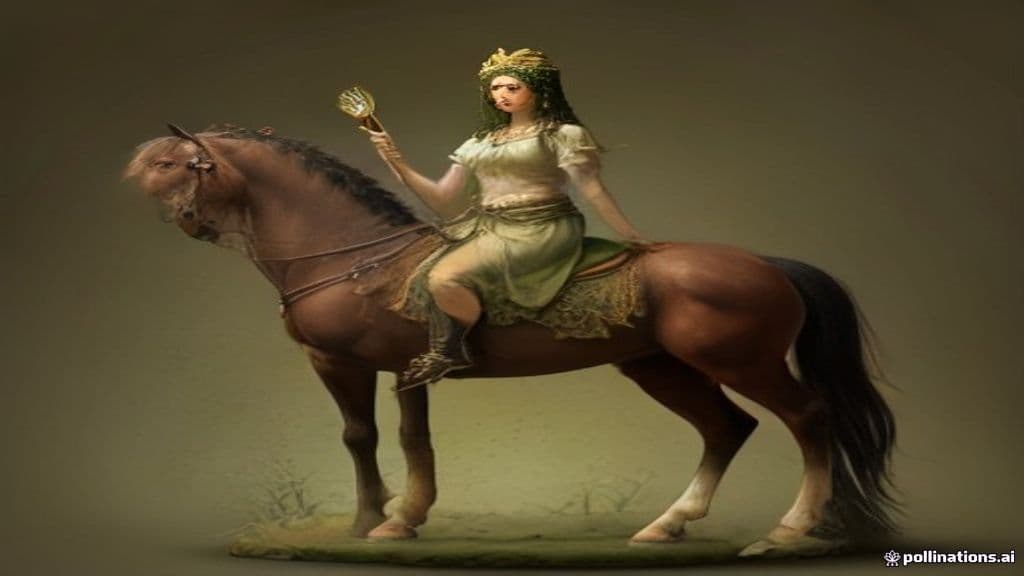
The attested name Epona (inscribed as Epona / Eponae in Latin contexts) derives from Gaulish epos 'horse', ultimately from Proto‑Indo‑European *éḱwos → Proto‑Celtic *ekʷos; the -on/-a element is a theonymic/augmentative suffix frequently glossed in modern sources as producing the sense 'Great Mare'. Some scholars have proposed an alternate reading of the suffix (‑ona/‑ana) as referencing sacred water or springs, but that reading is presented in the sources as a scholarly suggestion rather than settled fact. Classical retellings (e.g., a euhemeristic tale recorded in later sources) connect mare imagery to birth of a figure named Epona, but such tales are treated in the sources as interpretative or later parallels rather than definitive origin myths from indigenous practice.
Iconography commonly shows Epona mounted on a horse (often sidesaddle), seated on a throne with foals, or standing beside one or more foals. Typical attributes in depictions include a patera (libation dish), cornucopia, fruit, bread, or grain—emblems of fertility and abundance. Sculptural reliefs and votive images frequently pair her with foals; material culture places her images in stables and on altars. Her cult imagery was widespread enough to be attested across the Roman Empire and even within Rome, making her unusual among Celtic deities for this broad Roman presence.
Sources present Epona as a protector and patron tied specifically to horses (including donkeys and mules), the welfare of stables, and professions connected to equines (breeding, grooms, riders). She protects travellers and those whose livelihoods depend on equine transport. She embodies domesticated horse‑related fertility and abundance. Some scholars, based on select votive objects and iconographic motifs, have proposed a speculative funerary or psychopomp role—that she and her horses might have been regarded in some contexts as escorting souls to the afterlife—but this funerary aspect is presented in the sources as interpretive and not universally attested. Under Roman influence Epona was also widely venerated as patroness of cavalry units in the 1st–3rd centuries CE, an adoption described as secondary to her original domestic and fertility functions.

Rusalka
Water spirits in Slavic folklore — the spirits of young women who died by drowning or suicide, bound to rivers and lakes. Beautiful and dangerous, they can bewitch men to their deaths.
Rusalka
Water spirits in Slavic folklore — the spirits of young women who died by drowning or suicide, bound to rivers and lakes. Beautiful and dangerous, they can bewitch men to their deaths.
Abandinus
Abandinus is a locally attested Romano‑Celtic theonym known from a single inscribed bronze feather (votive object) dedicated at Godmanchester (the Roman fort Durovigutum) in Cambridgeshire. Scholars interpret him as a local god or male spirit tied to a specific place and possibly associated with a nearby spring or stream; this association is tentative and based on etymological readings of the name.
Abarbarea
Abarbarea is a name attested in classical Greek and Roman sources for freshwater nymphs (naiads). The name appears for at least two individual mythic figures — a naiad wife of Bucolion and a naiad counted among ancestors of the Tyrians — and Hesychius records plural forms that may indicate the name was also used as a class-name (Abarbareai / Abarbalaiai).
Abarta (Ábartach)
Abarta (also Ábartach) is a figure of Irish myth who, in surviving accounts, tricks Fionn mac Cumhaill's warriors by giving them a supernatural grey horse that bears them into the Otherworld. Sources variably identify him as a member of the Tuatha Dé Danann or as a Fomorian; after the incident he is compelled to release the captured warriors and is refused entry to the Fianna.
Abas
Abas (Ancient Greek: Ἄβας, gen.: Ἄβαντος) is not a single mythic being but a recurring personal name borne by multiple mortals and minor mythic figures in Greek epic and genealogical traditions — kings, founders, seers, warriors, attendants, a centaur, and a youth transformed by a goddess. The name is glossed in the sources as 'guileless' or 'good-hearted' and appears across Argive, Theban, Trojan, Euboean, and other local cycles.
Abcán (Abhcán)
Abcán (modern spelling Abhcán) is a named dwarf poet and musician of the Tuatha Dé Danann in Irish myth. He appears in a small number of narratives as a musician whose art has soporific power and as the ferryman who brings the goddess Ruad from the Otherworld to the human world.
Abellio
Abellio is a theonym attested in Roman‑period inscriptions from the Comminges area of the Pyrenees and reported as worshipped in the Garonne Valley of ancient Gallia Aquitania. Surviving evidence is limited to a small number of inscriptions; scholars have variously hypothesized solar or arboreal associations and compared the name to forms of Apollo or to Celtic Belenus, but the deity's precise role in local cosmology remains uncertain.
Abhean
Abhean is a named poet of the Tuatha Dé Danann in medieval Irish literature, described as a poet in particular of Lugh and recorded as having been killed by Óengus before Midir in a poem by Fland Mainistreach preserved in the Lebor Gabála Érenn.
Abnoba
Abnoba is a Gaulish theonym and toponym attested in Roman-era sources and inscriptions: a localized deity associated with woods, springs and the sources of rivers (notably the Danube) and simultaneously the name applied to a mountain or mountain range in the Black Forest/Baar/Odenwald region. Roman altars equate her with Diana, reflecting syncretic cult practice in frontier provinces.
Aborigines (mythology)
A mytho-historical label used in Roman and general reference sources to denote the oldest inhabitants of a region (specifically central Italy in the cited Roman context). The term functions as an identity/category for original human populations rather than as a characterized supernatural being in the provided sources.
Abundantia
Abundantia is the Roman divine personification of abundance and material plenty, used primarily in imperial propaganda and public iconography to signify secure grain supplies, wealth, and the promise of a 'Golden Age' under the emperor. She also appears in later medieval European folklore as Domina Abundia / Dame Habonde, a household benefactor in accounts condemned by ecclesiastical writers.
Acamas
Acamas (Ancient Greek: Ἀκάμας) is a personal name recurrent in ancient Greek narrative traditions applied to multiple human characters (warriors, princes, suitors), once to a Cyclops, and once as a hound's name. Rather than a single supernatural entity, bearers of the name appear episodically across the Trojan War, Theseid, and Theban cycles as mortal actors whose deeds intersect with gods and fate.
Acantha
Acantha (Ancient Greek: Ἀκάνθα, 'thorn') is a late or secondary mythological figure known from modern retellings as a nymph transformed into the acanthus plant. The tale that she scratched Apollo and was changed into a spiny-leaved plant is not attested in surviving classical corpora and appears to be a modern compilation or invention rather than a firmly documented ancient myth.
Community Record
- [1]Epona — Wikipedia. Wikipedia: Epona — summary of functions, iconography, etymology, and cultic attestations (Apuleius, Roman military adoption, funerary speculation).wiki
- [2]Wikidata: Epona. Wikidata entry for Epona — identifier and basic data.other
- [3]To Epona — Deo Mercurio (cult summary and image descriptions). Deo Mercurio: 'To Epona' — descriptions of iconography (Epona riding sidesaddle, carrying basket of fruits) and cult contexts.other