Accounts vary across Turkic and Mongolic traditions. In several creation narratives Erlik functions as the challenger, cast-out, or rival to heavenly creators (Ülgen, Kayra/Tengri) — in some versions he claimed divinity and was expelled, in others he slew a messenger-god (Maidere/Maydere) and became the teacher of sin. One variant records that a figure named Erlik becomes associated with the first human after being cast from the heavens for retaining earth from the primordial sea. Other tales hold that people summoned Erlik to introduce mortality when the world became overpopulated; after Erlik entered the world, death appeared. These variants show Erlik occupying a consistent role as the origin-agent of death, evil spirits, and underworld rulership rather than a single canonical origin myth.
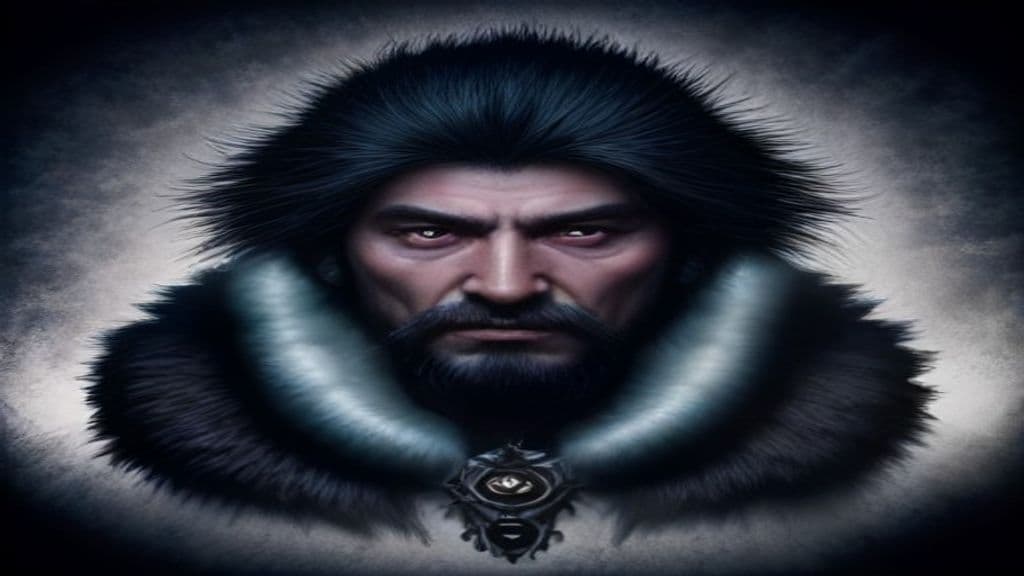
Shamanic prayers describe Erlik as monstrous: in those prayers he is depicted with a pig-like face and teeth combined with a human body, otherwise as an old but well-built man with black eyes, eyebrows and mustache. Certain legends associate him with totemic imagery (for example, a bear representation in some tales). Traditions such as the Khakas place him in a cosmically visualized residence—a copper palace with gold furniture—emphasizing his chthonic royal status rather than a single universal corporeal form.
Erlik brings death and plague into the world, creates or commands evil spirits (İye) that cause misfortune, sickness and death, and receives and judges souls in his lower realm. He sends agents called kormos to seize souls at death; simultaneously a heaven-sent spirit may try to carry the soul upward, and which side wins depends on the soul's alignment. Erlik demands sacrifices — failure to propitiate him is said to allow him to seize dead bodies and make them slaves. He is also said to have produced nine sons (the Karaoğlanlar) and nine daughters (Karakızlar) who assist his work, each son holding portfolios such as darkness, chaos, iron/mining, disaster, informants and discord.
Weaknesses
- conditionsoul alignment with heaven
Wards
- ritualanimal sacrifice / propitiation
- conditionliving in alignment with upper-world norms (moral/religious conduct)
Abzar İyesi
A Turkic iyesi (possessive/guardian spirit) of the courtyard, outbuildings, and farmstead grounds; ambivalent in nature, it protects its domain but may harm livestock and cause mischief, often appearing in animal forms.
Ak Ana
Ak Ana (also Ağ Ana, Ak Ene) is the primordial water-mother of Turkic and some Siberian (Khanty, Mansi) traditions: a holy maternal creator principle associated with the pre-earth expanse of water, fertility of the land, and the threshold to the spirit world.
Al (Alı)
No folkloric or ethnographic evidence for a supernatural entity named "Al" or "Alı" is present in the supplied source set. The available materials are modern biographical, political, linguistic, and religious texts that do not describe a Turkish spirit, demon, or other supernatural being by this name.
Alaz
Alaz is the Turkic god of fire associated with hearths, flame, and the Great Fire (Ulugh Od). He is described as a powerful fire-being who sends protector-spirits (İye) to household hearths and can cause destructive fires when angered; fire under his authority is also a purifying force.
Almas
Almas is presented in the provided source as a Mongolian 'wildman' reported in folklore and modern anecdote and treated within the modern subculture of cryptozoology as a disputed cryptid. The source frames Almas not as an established element of Mongolian cosmology but as an entity whose existence is unsubstantiated by mainstream science and discussed primarily in anecdotal and folkloric terms.
Alp Er Tunga
Alp Er Tunga is a legendary heroic ruler of Turan in early Turkic tradition, remembered as an ideal warrior-king and ancestral figure invoked in medieval dynastic genealogies. He also appears in Iranian epic tradition under the cognate name Afrosiyab/Afrasiab, where the figure is framed differently.
Amazons
A society of women-warriors in ancient Greek myth and legend, depicted as skilled horsemen and archers who inhabit the periphery of the Greek world and act as recurring opponents and counterparts to Greek heroes. Treated by ancient authors as a past people and by modern scholars as a mythic construct possibly inspired by Eurasian female warrior burials.
Amrak
Amrak is not attested in the provided sources as a supernatural being. The lexical string "Amrak" appears across unrelated secular contexts — as a historical regnal name (Amrak Khagan / Ashina Anluo), a Turkish place-name (Çamrak / amrak), titles in modern Arabic-language music, an institutional name/acronym (AMRAK Institute), and as a modern brand/typeface/project name. No folkloric, ritual, or mythological descriptions of an entity called "Amrak" are present in the cited material.
Antimachus
Antimachus is attested in the provided sources primarily as a classical Greek personal name borne by historical figures (notably Antimachus of Colophon, a poet and grammarian ca. 400 BC, and Antimachus I Theos, a Greco-Bactrian king). The name is also reused in modern contexts (a Wikidata taxon entry and small-press fictional/divinatory pages). The sources do not present Antimachus as a supernatural or folkloric entity.
Apa Qaghan
Apa Qaghan (阿波可汗, Ābō Kèhán) is an historical Ashina prince and mid-6th century claimant to the Göktürk khaganate. Sources portray him as a political and military actor involved in the succession disputes after Taspar Qaghan's death, ruling contested steppe territories and engaging with both western Turkic allies and Sui China.
Aq Bars
Aq Bars (Tatar: Ак Барс, 'White Leopard') is an ancient Bulgar tribal totem and heraldic emblem historically used in Volga Bulgaria and the Khanate of Kazan and adopted in the modern era as the official symbol of the Republic of Tatarstan (formally since 7 February 1992). It functions as a dynastic/tribal mark of identity (derived from the Barsil tribe) and as a political-state emblem rather than a personal supernatural being.
Archura
Archura (Arçura) is a Turkic woodland chura — a shapeshifting forest spirit associated with particular woodland tracts and wild animals. Traditions portray Archura as a protector of wildlife and a trickster-like figure that can be dangerous to humans.
Community Record
- [1]Erlik (Wikipedia). Wikipedia contributors, 'Erlik,' Wikipedia, The Free Encyclopedia.wiki
- [2]Erlik (Wikidata). Wikidata entry Q2366098, 'Erlik'wiki
- [3]The Daughter of Erlik Khan (and related popular-culture mentions). Wikipedia contributors, 'The Daughter of Erlik Khan', Wikipedia, references to literary adaptations.other
- [4]Selections and listings of modern adaptations and references (archives and fan pages). Archive.org listing for Howard's works and later usages of the Erlik name.other