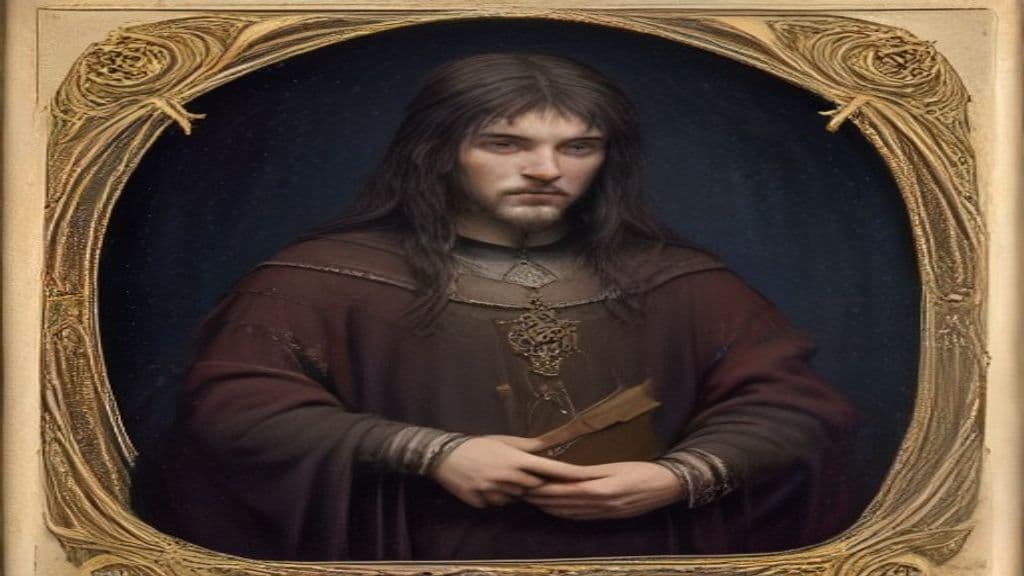
Euroswydd appears in medieval Welsh textual sources rather than as a fully developed deity: he is named in genealogical material connected to the Second Branch of the Mabinogi (Branwen ferch Llŷr) as the father of Nisien and Efnysien by Penarddun (daughter of Beli Mawr). The Second Branch records Penarddun's marriage to Llŷr and the children of Llŷr (Brân, Branwen, Manawydan) but does not describe the circumstances of Nisien and Efnysien's conception. Separately, a Welsh Triad (preserved in the Hergest Triads tradition) lists Euroswydd among those who held Llŷr captive as one of the "Three Exalted Prisoners of the Island of Britain." These attestations derive from medieval Welsh manuscripts that preserve the Mabinogi tales and the triadic mnemonic lists; surviving references to Euroswydd in those texts are sparse and primarily functional (name, parentage, and a role in an episode of captivity).
The supplied medieval sources give no physical description of Euroswydd. He is treated as a named human actor in genealogical and triadic material rather than as a character described in physical detail; this absence of appearance information is common for minor genealogical figures in the Mabinogi and Triads, which emphasize relationships and notable actions over portraiture.
No supernatural powers or magical faculties are ascribed to Euroswydd in the primary texts cited. His recorded role is narrative, genealogical, and political: he is identified as the father of Nisien and Efnysien (uterine half-brothers to Brân, Branwen, and Manawydan) and, according to a Welsh Triad, as a figure who participated in holding Llŷr captive. The Triadic record implies agency in interpersonal and political conflict (the detention of an important mythic figure), but the sources do not attribute extraordinary abilities such as sorcery, prophecy, or divine authority to him.

Efnisien
Efnisien (also spelled Efnysien or Efnissien) is a human royal figure in the medieval Welsh Second Branch of the Mabinogi (Branwen ferch Llŷr). Presented as an explosively violent and disruptive kin whose cruelty precipitates international war, he ends the tale by sacrificing himself to destroy a magical cauldron used by the Irish to revive the dead.

Branwen
Major character in Welsh mythology and daughter of Llŷr, a sea god. (Note: - Power tier should be Primordial (as she is a sea god's daughter and a central figure in a major mythological narrative). - Appearance: Add note that physical description is not provided. - Abilities)
Abandinus
Abandinus is a locally attested Romano‑Celtic theonym known from a single inscribed bronze feather (votive object) dedicated at Godmanchester (the Roman fort Durovigutum) in Cambridgeshire. Scholars interpret him as a local god or male spirit tied to a specific place and possibly associated with a nearby spring or stream; this association is tentative and based on etymological readings of the name.
Abarta (Ábartach)
Abarta (also Ábartach) is a figure of Irish myth who, in surviving accounts, tricks Fionn mac Cumhaill's warriors by giving them a supernatural grey horse that bears them into the Otherworld. Sources variably identify him as a member of the Tuatha Dé Danann or as a Fomorian; after the incident he is compelled to release the captured warriors and is refused entry to the Fianna.
Abcán (Abhcán)
Abcán (modern spelling Abhcán) is a named dwarf poet and musician of the Tuatha Dé Danann in Irish myth. He appears in a small number of narratives as a musician whose art has soporific power and as the ferryman who brings the goddess Ruad from the Otherworld to the human world.
Abhean
Abhean is a named poet of the Tuatha Dé Danann in medieval Irish literature, described as a poet in particular of Lugh and recorded as having been killed by Óengus before Midir in a poem by Fland Mainistreach preserved in the Lebor Gabála Érenn.
Abnoba
Abnoba is a Gaulish theonym and toponym attested in Roman-era sources and inscriptions: a localized deity associated with woods, springs and the sources of rivers (notably the Danube) and simultaneously the name applied to a mountain or mountain range in the Black Forest/Baar/Odenwald region. Roman altars equate her with Diana, reflecting syncretic cult practice in frontier provinces.
Accolon
Accolon is a mortal knight of the Arthurian court, presented in the Post-Vulgate Merlin tradition and Malory's Le Morte d'Arthur as Morgan le Fay's paramour and instrument in a plot to supplant King Arthur; his tale centers on enchanted weapons (Excalibur and its scabbard), love-manipulation, and a tragic duel with Arthur.
Achall
Achall is an eponymous mortal woman in the Ulster Cycle of early Irish literature whose grief-induced death is given as the origin of the hill-name Achall (identified with the modern Hill of Skryne). She appears as a genealogical and etiological figure tied to Tara and later legendary events at the hill, rather than as a recurring supernatural agent.
Achtland
Achtland is a figure from Irish tradition who, according to the surviving account, was a mortal woman famed for rejecting mortal suitors who married a member of the Tuatha Dé Danann and crossed into the síde to become immortal as his wife.
Adar Llwch Gwin
Legendary large, intelligent birds from Welsh tradition said to understand human speech and obey their master's commands; best known for tearing their master Drudwas ap Tryffin to pieces when bound by a literal order in an Arthurian battle narrative. The term later came to be applied to raptors and metaphorically to brave men in medieval Welsh poetry.
Adar Rhiannon
Adar Rhiannon ('birds of Rhiannon') are a set of three magical birds in medieval Welsh narrative (the Mabinogi) whose song can 'wake the dead and lull the living to sleep.' They appear as otherworldly song‑beings tied to the figure Rhiannon and function within tales as providers of enchanted music that sustains and consoles characters.
Aderyn y Corff
Aderyn y Corff (literally 'bird of the corpse') is a bird-like death-porter in Welsh folklore said to call outside the door of a person about to die. Described as an avian portent that may lack feathers or wings and as existing on another plane when not manifesting, it is treated in Welsh ghost lore and sometimes naturalized as a screech owl in modern accounts.
Adhene
A class of Manx fairies (Cloan ny moyrn) described in Isle of Man tradition as a social people of beings said to be "fallen angels cast from heaven but too good for hell," who interact with human livelihoods and families, sometimes benevolent but often mischievous.
Community Record
- [1]Euroswydd — Wikipedia. "Euroswydd" (Wikipedia entry), summarizing material from the Mabinogi and Welsh Triads.wiki
- [2]Branwen ferch Llŷr (The Second Branch of the Mabinogi). Second Branch of the Mabinogi (Branwen ferch Llŷr), which records Penarddun's marriage to Llŷr and the children of Llŷr; notes that the circumstances of Nisien and Efnysien's conception are not described.literary
- [3]The Hergest Triads (Welsh Triads). Hergest Triads (Welsh Triads) listing Euroswydd among those who held Llŷr captive as one of the 'Three Exalted Prisoners of the Island of Britain.'literary
- [4]Llŷr — Wikipedia. Entry on Llŷr, used for contextual information on Llŷr's position in the Mabinogi family network.wiki
- [5]Branwen summary — Mabinogion.info. Summary and notes on the Second Branch providing contextual commentary on characters including Nisien and Efnysien.literary