
The term appears in Old English poetry as fyrdraca (attested in Beowulf) where it names a dragon-like monster; in later centuries the same compound vocabulary continued in English as "firedrake" and was applied both to dragons in poetic usage and to observed fiery aerial phenomena. Renaissance writers such as William Fulke (1563) record popular sightings treated as either supernatural (the Devil in dragon form) or explain them as natural vapors and meteors, showing the term's survival from medieval dragon-poetry into early modern attempts at meteorological explanation.
In the sky firedrakes are described as sparking streaks or shafts of fire, a golden stripe that sweeps across the evening sky, a flaming broom or sheaf, a fiery steelyard balance, or a glowing ball of blue fire releasing sparks. Swedish accounts emphasize a wingless 'worm-dragon' with no visible limbs; East Slavic descriptions include a long flaming shaft (Russian коромысло, 'fiery carrying pole') or a flaming broom. In Slavic narratives the same being may also appear on the ground in human shape and is said in some stories to enter houses through chimneys.
As aerial phenomena they display flight as streaks, brooms, shafts or balls of fire emitting sparks (often read as meteors or ignes fatui). In Slavic traditions the firedrake is agentive: it can shapeshift (air-serpent in flight; human guise on the ground), enter homes through chimneys, visit and seduce women at night—sometimes taking the form of a dead or absent husband—bring ephemeral gifts (reported to turn to horse manure at sunrise), inseminate women leading in stories to abnormal pregnancies and monstrous births, and cause wasting illness, mental disturbance, hallucination, and death. In Swedish and English contexts the phenomenon is more often ambiguous or interpreted as omen-like (devil or sign of Last Judgment) rather than consistently anthropophagous or vampiric.
Weaknesses
- othernone recorded in sources
Wards
- otherno traditional wards recorded

Nuckelavee
The most terrifying creature of Orcadian folklore — a skinless, horse-headed demon of the sea whose breath spreads plague and whose presence causes crops to wither. It cannot cross fresh water.

Dragon (Long)
Long (龍, "dragon") is a pervasive cultural and artistic motif that appears in Taoist sacred-geographical contexts, Chinese literature, and modern exhibitions; the provided sources treat it as part of the broader mythic imagery present around Taoist sites and ritual scenes rather than as a single, consistently described doctrinal entity.
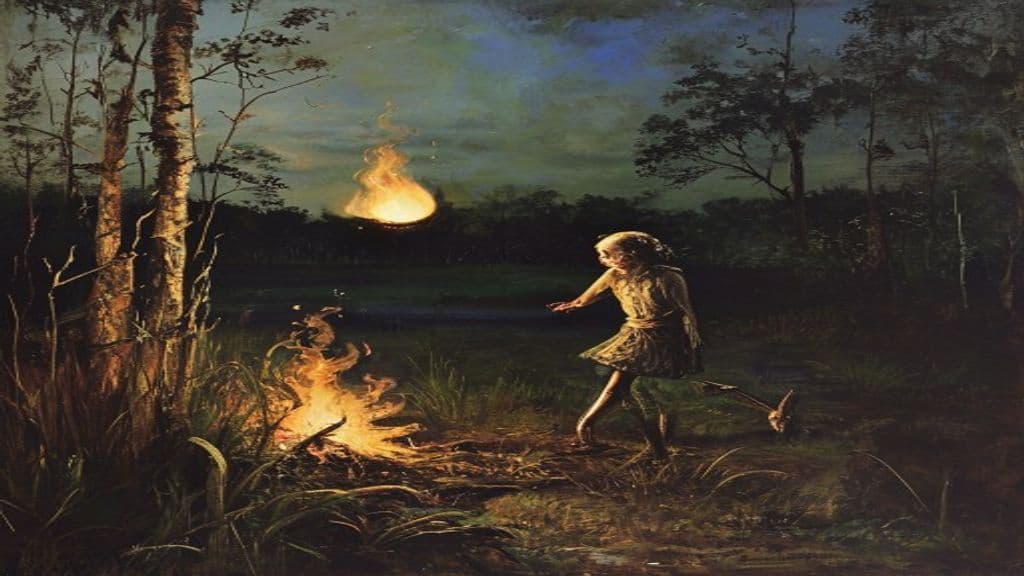
Will-o'-the-wisp
An atmospheric 'ghost light' — a small, mobile, lamp-like light seen at night over marshes, bogs, wet ground, or graveyards. In many cultures the phenomenon is interpreted as a supernatural being or manifestation (wandering nature-spirit, soul of the dead, transformed witch, or treasure-indicator); modern science offers chemiluminescent explanations for some occurrences.
Abdiel
Abdiel (Hebrew עֲבְדִּיאֵל) is primarily a theophoric Hebrew personal name meaning "servant of El/servant of God," attested once in the Hebrew Bible (1 Chronicles 5:15). In later literature—most notably John Milton's Paradise Lost—Abdiel is reimagined as a faithful seraph who opposes Satan's revolt. The provided sources do not treat Abdiel as an autonomous folkloric spirit type or record rituals or wards associated with the name.
Abiel
Abiel is attested in the supplied sources only as a male given name — borne by several historical American individuals and listed as two minor biblical figures. The provided materials contain no evidence presenting Abiel as a supernatural, mythological, or folkloric entity.
Abigail
Abigail is a female figure in the Hebrew Bible portrayed in 1 Samuel 25 as the intelligent and beautiful wife of Nabal who intervenes to prevent David from committing violence; later tradition regards her as one of the Tanakh's seven female prophets and as a model of beauty and wisdom.
Accolon
Accolon is a mortal knight of the Arthurian court, presented in the Post-Vulgate Merlin tradition and Malory's Le Morte d'Arthur as Morgan le Fay's paramour and instrument in a plot to supplant King Arthur; his tale centers on enchanted weapons (Excalibur and its scabbard), love-manipulation, and a tragic duel with Arthur.
Adils
Adils (Old Norse Aðils; also Eadgils, Adillus, Athisl, Adhel) is a semi‑legendary sixth‑century Swedish king attested in Old Norse saga material and later medieval traditions. He appears in saga episodes as a storied royal figure involved in warfare, court acts, and marriage suits rather than as a supernatural being.
Adsullata
Adsullata is attested as a Continental Celtic river goddess associated with the River Savus (modern Sava) in the Roman province of Noricum. Later traditions record her presence in Brittany as a goddess of hot springs and present her as an antecedent or origin-form of the Anglo‑Celtic sun goddess Sul.
Adže / Adze
No folkloric entity named 'Adže' is documented in the provided sources. The string appears in heterogeneous, non-folkloric contexts (a Bosnian village name, an English woodworking tool entry, a performer pen name, a CIA document fragment) and one modern podcast episode list that mentions 'the Adze' among other vampire-like beings; none of these supply an ethnographic description of a supernatural being called 'Adže'.
Afaon fab Taliesin
Afaon fab Taliesin is a medieval Welsh warrior-counsellor, named as a son of the bard Taliesin and recorded among Arthur’s retinue in Welsh tradition. He appears in the Welsh Triads and in the tale Breuddwyd Rhonabwy (The Dream of Rhonabwy) as a notable martial figure and proverb-speaker rather than as a supernatural being.
Agilaz (Egil)
Agilaz (reconstructed Proto-Germanic) — commonly recorded in medieval sources as Egil or Ægil — is a legendary archer attested in Germanic heroic tradition. He appears as the brother of Völund (Wayland/Weland) in the Old Norse poem Völundarkviða and in the Thidreks saga, and his name is also inscribed on early medieval objects (Franks Casket, Pforzen buckle). The attested material presents him as a named heroic human archer within saga and inscriptional contexts rather than as a recurrent supernatural species.
Aglovale
Aglovale (also Agloval, Aglovan, Aglovaus, Acglavael) is a human knight of Arthurian romance, presented as the eldest legitimate son of King Pellinore and a Knight of the Round Table in the Vulgate/Post‑Vulgate cycles, Malory, and later adaptations. He brings his long‑lost brother Perceval to Camelot, takes part in military actions (including slaying Agrippa in one account), and his death is related in varying ways across traditions (accidental at Gawain's hand, deliberate murder by Orkney kin, or killed during Lancelot's rescue of Guinevere).
Agnarr Geirröðsson
Agnarr Geirröðsson is a mortal prince attested only in the Poetic Edda poem Grímnismál; he aids Odin (disguised as Grímnir) during Geirröðr's torture and, after Odin reveals himself and King Geirröðr dies, Agnarr succeeds as king.
Agne
Agne (also attested Agni, Hogne, Agni Skjálfarbondi) is a semi-legendary king of Sweden in Old Norse saga tradition, preserved in the Ynglingatal corpus and prose expansions such as Snorri Sturluson's Ynglinga saga. He is portrayed as a mighty and famous warrior-king whose campaign in Finland, marriage to Skjalf, and death by hanging form a remembered episode connected to local place-names and a burial mound.
Community Record
- [1]Firedrakes in English folklore. Wikipedia, "Firedrakes in English folklore"wiki
- [2]PS238 (comic strip referencing firedrake term usage). PS238 webcomic (2015-08-05)other
- [3]Orlando Innamorato in English | Page 12 (examples of literary dragon-language usage). Rossignol Books, Orlando Innamorato in English (reference to dragon vocabulary)literary
- [4]18 Types of Dragons You've Probably Encountered - Facts.net. Facts.net, "18 Types of Dragons" (contextualizing firedrake as a literary/folk dragon type)other
- [5]Dragons: A History | Gresham College. Gresham College lecture, "Dragons: A History" (context on dragon terminology and historic usage)other
- [6]Miscellaneous web references (contextual/echoing usages). dxld1421.txt (online text containing references to firedrake usage)other
- [7]Firedrake (folklore) — Wikipedia. Wikipedia contributors, 'Firedrake (folklore)', Wikipedia, The Free Encyclopedia.wiki
- [8]Demons & Dragons (catalog / reference copy). Demons & Dragons (catalog reference), Archive.org entry.other
- [9]Demons & Dragons (alternate archive). Demons & Dragons (alternate archive), Archive.org entry.other
- [10]Save vs. Worm blog: Firedrake entries (popular commentary). Save vs. Worm blog, 'Goin' Through the Fiend Folio Part 6'.other