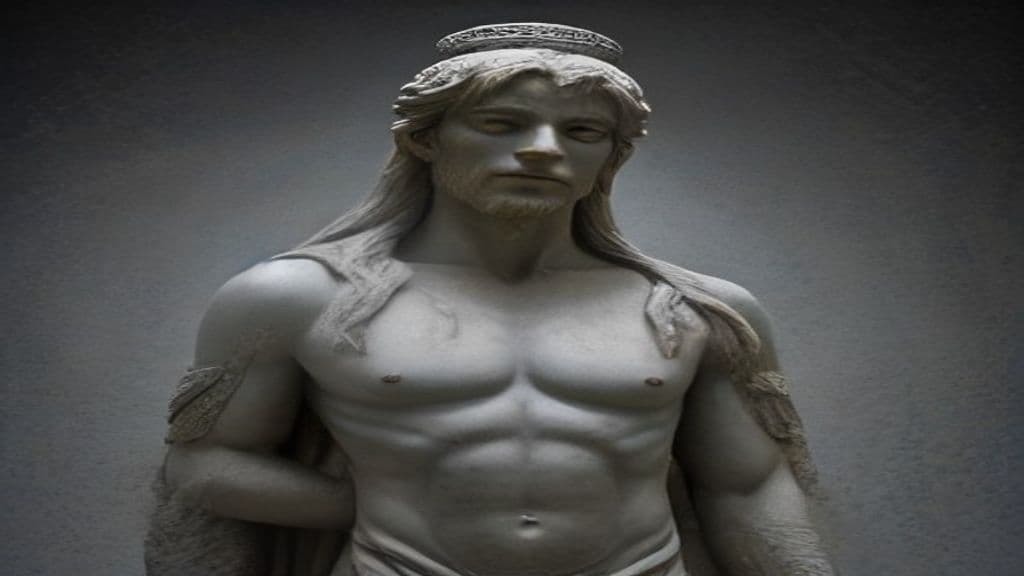
Freyr is a son of the Vanir god Njörðr and his sister-wife and is twin brother to Freyja; in mythic accounts he receives Álfheimr as a teething present and is linked to the Swedish Yngling royal lineage (epithet Yngvi-Freyr). Literary sources portray him as a central Vanir figure whose cultic association with Sweden (including an image at Uppsala reported by Adam of Bremen) and ties to kingship and fertility make him both a divine ancestor figure and a guarantor of agrarian and political well-being.
Surviving sources do not provide a single, detailed anthropomorphic portrait; instead they attest cult images and characteristic attributes. Adam of Bremen reports a phallic statue of the deity (Latinized as Fricco) in the Temple at Uppsala. Snorri's accounts emphasize Freyr's possessions— the dwarf-made ship Skíðblaðnir (which always has a favorable breeze and can be folded and carried in a pouch) and the boar Gullinbursti (whose mane glows to illuminate the way)—rather than fixed bodily description. Overall the literary record preserves symbolic and cultic representations (phallic imagery in Adam; named artifacts and attendants in Snorri) but no unified, detailed physical description.
Freyr's principal functions, ascribed in the Prose/Poetic Edda and in Adam of Bremen, are rulership, fertility, peace, prosperity, fair weather, and good harvest; he is a beneficent intermediary whose favor is sought in marriage and seasonal fertility rites (Adam records libations to his image at marriage). He possesses magical artifacts (Skíðblaðnir, Gullinbursti) that aid travel and illumination. Mythic narratives show him capable in combat—he slays the jötunn Beli with an antler after having given away his sword—but his prior gift of a self-fighting sword has decisive consequences: without it he is prophesied to fall to the fire jötunn Surtr at Ragnarök.
Weaknesses
- conditionabsence of the self-fighting sword (given away to win Gerðr)
Wards
- otherNo recorded wards or protective rites against Freyr in the supplied sources (literary and historical accounts record veneration and libation rather than warding)

Freyja
Freyja is a major Vanir goddess in Norse mythology associated with love, beauty, fertility, gold, war, and the seiðr form of magic. She rules the field Fólkvangr and the hall Sessrúmnir, where she receives half of those slain in battle, and is attested across the Poetic Edda, the Prose Edda, skaldic poetry, and later Scandinavian folklore.

Surtr
Surtr is a foremost fire-associated jötunn in Old Norse myth who stands at the frontier of Múspell (Muspelheim). In eschatological sources he leads the sons of Múspell from the south at Ragnarök, bears a bright flaming sword from which light shines more brightly than the sun, and flings fire that burns the world.
Abaddon
In Hebrew scripture Abaddon is primarily a noun meaning 'destruction' or a section/condition of the underworld paired with Sheol; in the New Testament Book of Revelation Abaddon is personified as an angelic figure (Greek Apollyon) described as the king of an army of locusts released from the abyss during the apocalypse.
Abadir
Abadir is a polysemous name attested in distinct cultural contexts: a legendary founding saint and clan ancestor in eastern Ethiopia (Sheikh Abadir Umar Al‑Rida / Aw Abadir), a term applied to cone‑shaped cult stones in Phoenician religious description, and a personal name of a martyr (Abadir/Apater) in the Coptic Synaxarium. The attestations are independent usages of the same name rather than a single supernatural being.
Abadiu of Antinoe
Abadiu of Antinoe was a fourth‑century bishop of Antinoe (Antinoopolis, in Roman Egypt) commemorated as a martyr and saint in the Coptic Orthodox Church, with a feast day on 26 December. Sources record that he was killed during a theological dispute with Arian opponents and reference him in collections of Egyptian martyrs.
Abagtha
Abagtha (Hebrew: אבגתא, ’Ǎḇaḡṯā) is a named human court official in the Hebrew Bible’s Book of Esther, listed among seven chamberlains who ministered before King Ahasuerus and were commanded to bring Queen Vashti before the king. He is attested only in Esther 1:10 and is presented as an institutional palace attendant rather than a supernatural being.
Abanoub
Abanoub is a 4th‑century Egyptian Christian child martyr venerated in the Coptic tradition. Remembered for his public confession of Christ, miraculous healings associated with his passion, and the translation and veneration of his relics, his feast is observed on July 31 (Epip 24) and his cult centers include Nehisa and Samanoud.
Abaskhiron the Soldier
A Coptic Orthodox martyr venerated for refusing imperial idolatry during the Diocletian persecution; reputedly healed by the Archangel Michael, preserved in monastery relics, and commemorated on 14 June (7 Paoni).
Abdel Messih El-Makari
Abdel Messih El-Makari (1892–1963) was a Coptic Orthodox monk and priest venerated as a 20th‑century Coptic saint. Associated with the Monastery of Saint Samuel the Confessor and the Monastery of Saint Macarius (Scetes/Wadi El‑Natrun), he is remembered for humility, asceticism, charity, and reported spiritual gifts such as prescience, discerning of spirits, and healing.
Abel
Abel is the second son of Adam and Eve in the Genesis narrative, a shepherd whose accepted offering and subsequent murder by his brother Cain form the biblical account of the first death. Later interpretive traditions expand his role, treating him as an archetypal righteous victim, a postmortem avenging or adjudicating figure, and in some systems (notably Mandaean) identifying him with an angelic lightbeing.
Abib and Apollo
Abib and Apollo are Christian ascetics and hagiographic saints of Akhmim (Upper Egypt) attested in Coptic sources and the Historia Monachorum. Remembered for extreme asceticism, monastic leadership, angelic encounters, and inclusion in the Coptic Synaxarion (feast day November 4).
Abiel
Abiel is attested in the supplied sources only as a male given name — borne by several historical American individuals and listed as two minor biblical figures. The provided materials contain no evidence presenting Abiel as a supernatural, mythological, or folkloric entity.
Abijah of Judah
Abijah (also Abijam or Abiah) is presented in the biblical and later interpretive traditions as a short-reigning human king of Judah from the Davidic line. He is portrayed as a dynastic successor whose military actions (notably the battle at Mount Zemaraim) and moral evaluation in rabbinic literature are interpreted theologically in relation to the Davidic covenant.
Abimelech
Abimelech is a Hebrew personal name and occasionally a regnal title attested in the Hebrew Bible and later traditions. It appears as the name/title of Philistine rulers in the patriarchal narratives (the "king of Gerar" who interacts with Abraham and Isaac) and as the personal name of Abimelech son of Jerubbaal (Gideon) in Judges, a dynastic usurper whose brief rule ends in violent death.
Community Record
- [1]Freyr - Wikipedia. Wikipedia contributors. "Freyr." Wikipedia, The Free Encyclopedia.wiki
- [2]Freyr - Wikidata. Wikidata: Q16424289other
- [3]Adam of Bremen (reported material as summarized in secondary sources). Adam of Bremen, as summarized in modern sources: report of a phallic statue at Uppsala and libations to 'Fricco' at marriages (see Freyr, Wikipedia entry).literary
- [4]Prose Edda / Snorri Sturluson (as summarized in secondary sources). Snorri Sturluson, Prose Edda: accounts of Skíðblaðnir, Gullinbursti, Skírnir's errand, giving away the sword and death at Ragnarök (summarized in modern sources).literary