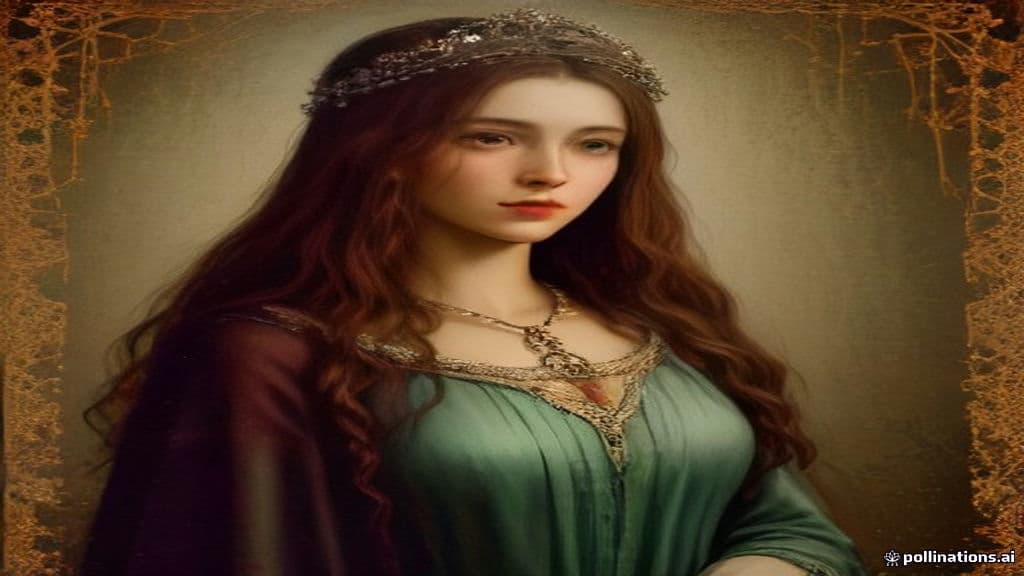
Genoveva (Genevieve of Brabant) is a legendary heroine in Germanic folklore, from Brabant (Low Countries). Genoveva is a legendary/hagiographic medieval heroine known from the Genevieve of Brabant cycle and later 19th‑century German Romantic adaptations (notably Schumann's opera Genoveva). Sources treat her as a mortal woman whose story of chastity, false accusation, exile/imprisonment, and eventual vindication circulated in literature, music, and local place‑legend, and whose name persists as a female given name and toponym.
The figure known as Genoveva (Genevieve of Brabant) appears in medieval legend as the daughter of the Duke of Brabant and wife of Siegfried (the Palatine of Trier) and is set around the 8th century (sources place her life around 750 AD). In the narrative strand preserved in opera and drama (the sources cited for Schumann's Genoveva draw on Tieck and Hebbel), Genoveva resists the sexual advances of a servant named Golo; she is subsequently accused of adultery by treacherous parties, imprisoned or exiled, and endures suffering in isolation. Over time the truth is revealed (in some adaptations by discovery of evidence or contrition from false accusers), her honor is restored and she is vindicated. The legend was adapted in the 19th century into dramatic and musical forms—most prominently Robert Schumann's four‑act opera Genoveva (Op. 81), premiered 25 June 1850 in Leipzig—which shaped modern reception and attached local topography (caves called Genoveva/Genovevahöhle) to the story.
Primary textual sources and summaries provide no consistent contemporaneous physical description of Genoveva; she is presented as a mortal woman rather than as a supernatural form. Artistic traditions, however, supply recurrent visual motifs: 19th‑century illustrations (for example works referenced by the Genoveva Caves site, such as Adrian Ludwig Richter's 'Genoveva in der Waldeinsamkeit') depict her in woodland solitude or in scenes of exile. Place‑name associations (Genoveva Caves / Genovevahöhle) further anchor pictorial imaginations of her in natural, wooded landscapes, but the sources do not give a standard iconography or bodily description originating in medieval texts.
Sources attribute no supernatural powers to Genoveva; she functions as a human protagonist characterized by moral qualities emphasized in the legend and its adaptations—steadfastness, chastity, endurance under false accusation, and eventual vindication. Narrative elements in dramatic adaptations may include heightened or supernaturalized events (for instance, the opera's libretto and staging introduce dramatic phenomena such as apparitions or symbolic occurrences), but these are not described in the provided sources as innate abilities of Genoveva herself.
3-D Man
3-D Man is a Marvel Comics superhero identity associated with a 1950s-era origin in which the body of Chuck Chandler can materialize in three-dimensional existence when activated by his brother Hal via a pair of glasses. The mantle was later assumed by Delroy Garrett (formerly Triathlon) in modern continuity.
5 Ronin
5 Ronin is a 2011 Marvel Comics five-issue limited series that reimagines five Marvel superhero archetypes as rōnin (masterless samurai) in a fictionalized post‑Sekigahara feudal Japan. The work places Wolverine, Hulk, Punisher, Psylocke, and Deadpool analogues into period roles to explore displacement, revenge, and identity in an era of political upheaval.
A Elbereth Gilthoniel
An Elvish hymn in Sindarin addressed to Elbereth (Varda) from J. R. R. Tolkien's legendarium. Presented in The Lord of the Rings and later musical and dramatic adaptations, the hymn functions as devotional poetic language that evokes Elvish reverence for the star-kindler rather than an independent supernatural agent.
A.R.G.U.S.
A.R.G.U.S. is a fictional clandestine United States government agency in the DC Comics universe that investigates, contains, and manages superhuman, meta-human, and supernatural incidents and assets. Introduced in The New 52 continuity, it functions as an institutional actor providing intelligence, logistical support, covert task forces (notably Task Force X / the Suicide Squad), and a dedicated magic division across comics and media adaptations.
Abaddon
In Hebrew scripture Abaddon is primarily a noun meaning 'destruction' or a section/condition of the underworld paired with Sheol; in the New Testament Book of Revelation Abaddon is personified as an angelic figure (Greek Apollyon) described as the king of an army of locusts released from the abyss during the apocalypse.
Abadir
Abadir is a polysemous name attested in distinct cultural contexts: a legendary founding saint and clan ancestor in eastern Ethiopia (Sheikh Abadir Umar Al‑Rida / Aw Abadir), a term applied to cone‑shaped cult stones in Phoenician religious description, and a personal name of a martyr (Abadir/Apater) in the Coptic Synaxarium. The attestations are independent usages of the same name rather than a single supernatural being.
Abadiu of Antinoe
Abadiu of Antinoe was a fourth‑century bishop of Antinoe (Antinoopolis, in Roman Egypt) commemorated as a martyr and saint in the Coptic Orthodox Church, with a feast day on 26 December. Sources record that he was killed during a theological dispute with Arian opponents and reference him in collections of Egyptian martyrs.
Abagtha
Abagtha (Hebrew: אבגתא, ’Ǎḇaḡṯā) is a named human court official in the Hebrew Bible’s Book of Esther, listed among seven chamberlains who ministered before King Ahasuerus and were commanded to bring Queen Vashti before the king. He is attested only in Esther 1:10 and is presented as an institutional palace attendant rather than a supernatural being.
Abanoub
Abanoub is a 4th‑century Egyptian Christian child martyr venerated in the Coptic tradition. Remembered for his public confession of Christ, miraculous healings associated with his passion, and the translation and veneration of his relics, his feast is observed on July 31 (Epip 24) and his cult centers include Nehisa and Samanoud.
Abaskhiron the Soldier
A Coptic Orthodox martyr venerated for refusing imperial idolatry during the Diocletian persecution; reputedly healed by the Archangel Michael, preserved in monastery relics, and commemorated on 14 June (7 Paoni).
Abdel Messih El-Makari
Abdel Messih El-Makari (1892–1963) was a Coptic Orthodox monk and priest venerated as a 20th‑century Coptic saint. Associated with the Monastery of Saint Samuel the Confessor and the Monastery of Saint Macarius (Scetes/Wadi El‑Natrun), he is remembered for humility, asceticism, charity, and reported spiritual gifts such as prescience, discerning of spirits, and healing.
Abel
Abel is the second son of Adam and Eve in the Genesis narrative, a shepherd whose accepted offering and subsequent murder by his brother Cain form the biblical account of the first death. Later interpretive traditions expand his role, treating him as an archetypal righteous victim, a postmortem avenging or adjudicating figure, and in some systems (notably Mandaean) identifying him with an angelic lightbeing.
Community Record
- [1]Genoveva (Wikipedia). Wikipedia, 'Genoveva' (opera and legend summary, synopsis, and cultural background).wiki
- [2]Genoveva Caves / Genovevahöhle (ShowCaves). ShowCaves site, 'Genovevahöhle' (links legend to local cave topo‑history; notes on dating and place‑legend).other
- [3]Genoveva topic page (ShowCaves). ShowCaves, 'Genoveva' (discussion of legend and cultural references including illustrations).other
- [4]Wikidata: Genoveva (female given name). Wikidata entry identifying 'Genoveva' as a female given name and its usage.wiki
- [5]Genoveva Caves / GenovevaKordel (ShowCaves local page). ShowCaves 'Genovevahöhle' (place‑name and legend association; dating Genoveva to ca. 750 AD and association with Siegfried of Trier).other
- [6]Genoveva Matute's 105th Birthday (Google Doodle). Google Doodle entry (example of modern personal name bearer 'Genoveva').other
- [7]DBLP: Genoveva Vargas-Solar. DBLP entry (modern individual bearing the name Genoveva).other
- [8]Archive: María Genoveva Ermilio Favorites. Archive item demonstrating modern onomastic use of the name Genoveva.other
- [9]Ogyris genoveva / Junonia genoveva (biological name coincidence). Wikipedia pages cited in research notes showing use of 'genoveva' in species names (not related to the legend).wiki