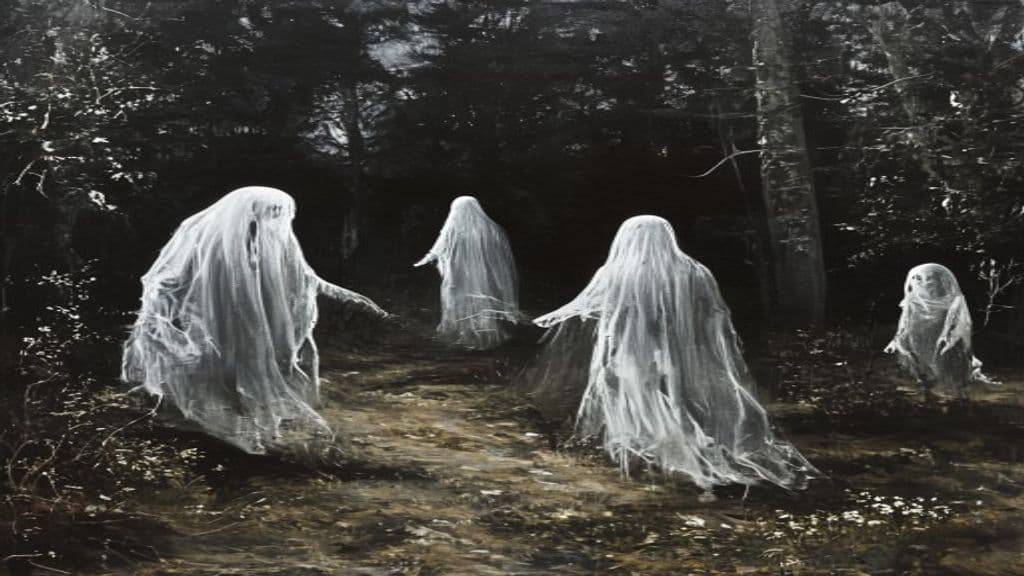
The English term 'ghost' derives from Old English gāst ('breath, spirit, soul, ghost'), tracing to Proto-Germanic *gaistaz and a reconstructed Indo-European root; historically the term covered senses from life-breath and divine spirit to the souls of the dead. Folkloric belief in ghosts is widespread and ancient, often placed by scholars as continuous with animism and ancestor-worship practices in pre-literate societies. Across cultures the ghost concept functions as the continued presence or agency of a formerly living being, connected to social practices (for example, funeral rites) that manage the transition of the dead.
Descriptions vary widely: ghosts may be experienced as an unseen presence, as translucent or wispy shapes, or as realistic, lifelike apparitions resembling the deceased human or animal. Most accounts describe solitary, humanlike essences, though traditions also include animal ghosts and larger phenomena such as spectral groups; related terminology (for example, 'poltergeist'—literally 'noisy ghost' in German) marks behavioral or appearance subtypes rather than a single fixed image.
Folkloric attributions include the ability to appear to the living and to haunt locations, objects, or people associated with them in life; some traditions describe interaction with the physical environment (the poltergeist type is associated with unexplained movement or disturbance of objects). Cultural practices such as necromancy or spiritist séances are named as deliberate techniques for contacting such spirits. Modern scientific sources emphasize that there is no proof of ghosts and often explain reported experiences by alternative causes (neurological disease, certain drugs, or environmental toxins such as carbon monoxide), presenting a competing interpretive frame to folkloric claims.
Weaknesses
- ritualfuneral rites
- ritualexorcism
- ritualritual magic and spiritist practices intended to rest or manage spirits
Wards
- ritualproper funeral rites (culturally specific)
- ritualexorcism (tradition-dependent)
- ritualcontrolled spirit contact (séance / spiritism) as management

Poltergeist
A poltergeist is a German-derived ghostlore label for an unseen agent associated chiefly with noisy, kinetic, and disruptive physical phenomena in domestic settings. Modern summaries and case literature emphasize episodic outbreaks of object movement, loud noises, and occasional assaults or electrical/foul-smell disturbances, with competing explanations ranging from spirit activity to hoax, psychogenic projection, or natural physical causes.
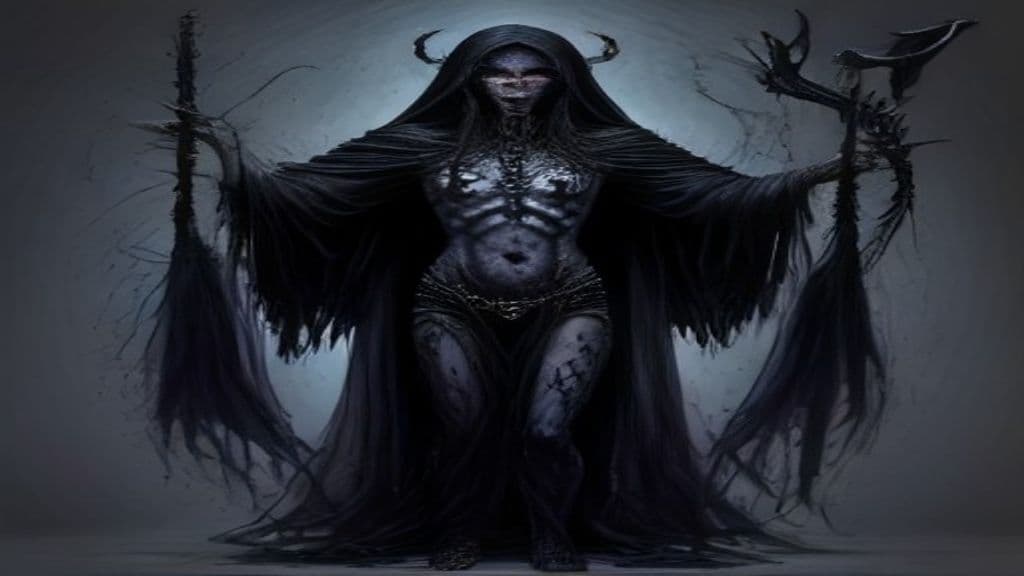
Ghoul
A ghoul is a demon-like or monstrous humanoid originating in pre-Islamic Arabian religion, traditionally associated with graveyards and the consumption of human flesh. The concept later entered broader folklore and has been widely reused and transformed in modern fiction and popular culture.
*Perkʷūnos
*Perkʷūnos is the reconstructed Proto-Indo-European thunder‑god hypothesized by comparative linguistics and mythology. Scholarly reconstructions portray him as a storm or thunder figure associated with fructifying rain and as the combatant who fights a multi‑headed water‑serpent to release life‑giving waters; no direct attestations from the Proto‑Indo‑European period survive and the figure is inferred from later Indo‑European traditions.
*Péh₂usōn (reconstructed)
Péh₂usōn is a hypothetical Proto‑Indo‑European pastoral guardian reconstructed by comparative scholars from parallels in Greek and Vedic traditions. Proposed as a Graeco‑Aryan ancestor‑figure, the reconstruction describes a protector of flocks, roads, and travellers rather than an attested historical cultic personality.
57 Mnemosyne
57 Mnemosyne is a large main-belt asteroid (S-type) discovered in 1859 and named after the Greek Titaness Mnemosyne. It is a non-sentient astronomical body studied for its orbital and rotational properties and has been used in dynamical measurements related to Jupiter.
Aamon
Aamon (also Amon) is a named spirit in early modern Western grimoire tradition (Pseudomonarchia Daemonum; the Ars Goetia / Lesser Key of Solomon). He is presented as a high-ranking infernal officer (Marquis/Prince) who governs forty legions and is credited with knowledge of past and future and with affecting human relationships (reconciling or procuring feuds and favor).
Abaddon
In Hebrew scripture Abaddon is primarily a noun meaning 'destruction' or a section/condition of the underworld paired with Sheol; in the New Testament Book of Revelation Abaddon is personified as an angelic figure (Greek Apollyon) described as the king of an army of locusts released from the abyss during the apocalypse.
Aban Yasht
The Aban Yasht is a hymn from the Persian tradition that praises Anahita, a goddess associated with water, fertility, and wisdom. It consists of 132 stanzas and is part of the 21 Yashts collection. (Note: - Power tier should be "Primordial" or possibly "Cosmic", given that it's a hymn of great spiritual significance and associated with a goddess. - The article incorrectly states that Anahita is associa)
Abath
No corroborated folkloric entity named "Abath" is documented in the provided sources. The string appears in the supplied material only as a surname/personal name in Aruban/Dutch-Caribbean archival records and as an unrelated taxonomic or encyclopedic hit; no mythic attributes, origin stories, rituals, or apotropaic practices for an entity called Abath are present in the documents reviewed.
Abatur
Abatur is an uthra (celestial emanation) in Mandaeism described as the 'father of the Uthras' and called the Ancient (ʿattīqā). He resides on the boundary between the World of Light and lower regions, functions as a judge who weighs souls (Abatur Muzania), and supplies instructions and materials to the demiurgic uthra Ptahil in accounts from the Diwan (Scroll) of Abatur.
Abatwa (Twa / Batwa)
Abatwa (also recorded as Twa, Batwa, Mutwa; singular forms Barhwa or Murhwa in some transcriptions) are indigenous hunter‑gatherer peoples of the Great Lakes region of Central Africa, historically identified as some of the earliest inhabitants of the area. The available sources treat them as human ethnic groups whose livelihoods, lands, and populations have been severely affected by conservation policies and modern violence.
Abellio
Abellio is a theonym attested in Roman‑period inscriptions from the Comminges area of the Pyrenees and reported as worshipped in the Garonne Valley of ancient Gallia Aquitania. Surviving evidence is limited to a small number of inscriptions; scholars have variously hypothesized solar or arboreal associations and compared the name to forms of Apollo or to Celtic Belenus, but the deity's precise role in local cosmology remains uncertain.
Abraham
Abraham (originally Abram) is the foundational patriarchal ancestor in the Hebrew Bible whose life establishes a covenantal relationship between his family/people and God. He functions as an exemplar of faith, the progenitor of promised descendants, and a narrative anchor for claims of land, blessing, and communal identity in later religious traditions.
Abrahel
Abrahel is a demonological entity attested in early modern sources (notably Nicholas Rémy's Demonolatria as summarized in modern reference) portrayed as a female sexual spirit who seduced a man in 1581, induced him to kill his son, then restored the child to life in exchange for worship; the revival produced a diminished, foul-smelling corpse that later died again.
Community Record
- [1]Ghost — Wikipedia. Wikipedia contributors. "Ghost." Wikipedia, The Free Encyclopedia.wiki
- [2]ghost — Wikidata. Wikidata entry Q45529, 'ghost'.wiki