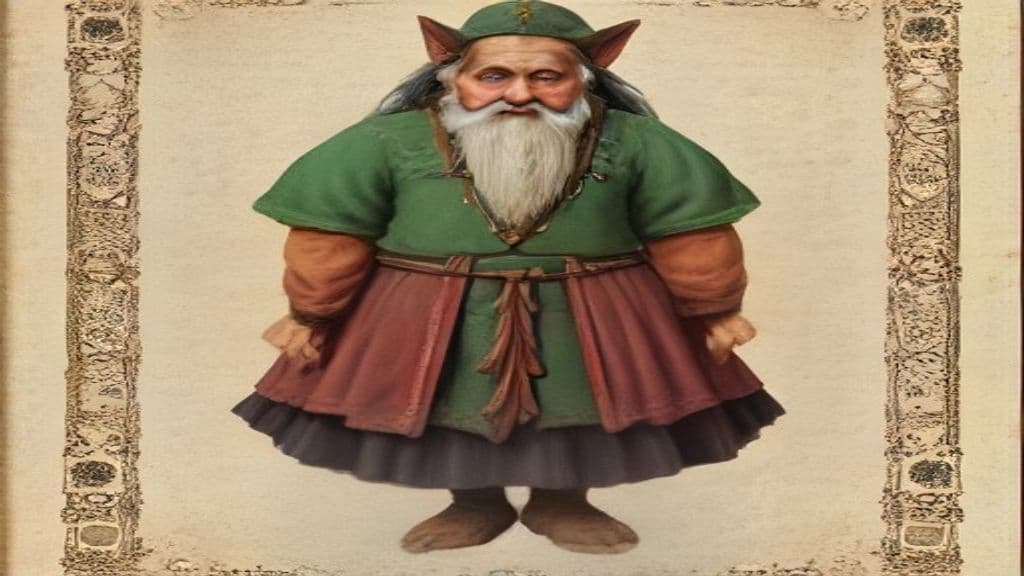
In Paracelsian natural-philosophy the gnomi are classified as earth elementals — beings ontologically tied to the element Earth and locally embodied within the earth-substance. Paracelsus presents them as a category distinct from incorporeal spirits because they eat, drink and speak, yet they move through earth as humans move through air. Early-modern German miners' tradition, recorded by observers such as Georg Agricola, treats comparable beings (Bergmännlein / Berggeist / daemon metallicus) as part of miners' explanatory lore: animate subterranean entities whose existence accounts for unpredictable underground phenomena (helpful leads of ore, prankish acts, and hazardous occurrences). The taxonomy and miners' vocabulary intersect in early-modern attempts to integrate local occupational beliefs with a systematic elemental ontology.
Primary historical descriptions depict gnomi / Bergmännlein as diminutive humanoid 'manikins.' Paracelsus describes gnomi as two spans tall (two spans ≈ 18 inches). Agricola and related mine lore record comparable subterranean creatures at three spans (three spans ≈ 27 inches). Across sources the consistent image is of small, manlike mountain-people (the German Bergmännlein literally 'mountain manikin') rather than formless incorporeal entities; discrepancies in exact measured stature are noted between authors.
Sources ascribe to gnomi the capacity to move through solid earth 'as easily as humans move through air' (Paracelsus), making subterranean mobility a defining trait tied to their elemental nature. Paracelsus also emphasizes their humanlike activities — they eat, drink and talk — distinguishing them from purely incorporeal spirits. Agricola's miners' legends attribute a range of behaviors: prankish mischief (miming, laughing, throwing pebbles at miners) and occasionally beneficial actions such as leading miners to rich veins of ore. Terminology linked to kobel/kobelt associates certain mine-spirits with troublesome or noxious ores (the miners' term that later influenced the element name cobalt). Agricola notes variation in temperament and danger among subterranean beings rather than a single uniform disposition.

Kobold
The German household and mine spirit — a mischievous but potentially helpful small being who attaches to a household, bringing luck or disaster depending on how it is treated.

Yaksha
Nature spirits of Hindu, Buddhist, and Jain cosmology — guardians of forests, treasures, and wilderness. Ambivalent beings, capable of great benevolence to the respectful and terrible harm to the greedy.
57 Mnemosyne
57 Mnemosyne is a large main-belt asteroid (S-type) discovered in 1859 and named after the Greek Titaness Mnemosyne. It is a non-sentient astronomical body studied for its orbital and rotational properties and has been used in dynamical measurements related to Jupiter.
Aamon
Aamon (also Amon) is a named spirit in early modern Western grimoire tradition (Pseudomonarchia Daemonum; the Ars Goetia / Lesser Key of Solomon). He is presented as a high-ranking infernal officer (Marquis/Prince) who governs forty legions and is credited with knowledge of past and future and with affecting human relationships (reconciling or procuring feuds and favor).
Abrahel
Abrahel is a demonological entity attested in early modern sources (notably Nicholas Rémy's Demonolatria as summarized in modern reference) portrayed as a female sexual spirit who seduced a man in 1581, induced him to kill his son, then restored the child to life in exchange for worship; the revival produced a diminished, foul-smelling corpse that later died again.
Abraun
Abraun is an attested name in German-language plant-legend scholarship (Der abraun, ein beitrag zur pflanzensagenkunde, 1916) and a short database entry (Wikidata) labels it as a spirit from German mythology. Surviving accessible documentation is extremely limited: the principal academic treatment is a 1916 contribution to pflanzensagenkunde (plant-saga studies), but the excerpts available here contain only bibliographic metadata and do not record tales, descriptions, or rituals.
Abraxas
Abraxas (Abrasax) is a late‑antique Gnostic and magical name attested as a high-ranking cosmic power in heresiological summaries and as a potent name engraved on amulets (so-called Abraxas stones) in the Greco‑Roman magical milieu. Heresiologists associate Abraxas with rulership of 365 heavens and note the name's numerological value, while archaeological and papyrological contexts show its use as an amuletic formula.
Achamōth
Achamōth is a feminine emanational figure in certain Gnostic systems, attested as a daughter or subordinate aspect of the divine Wisdom, Sophia. She appears in ophitic/Naassene mythic genealogies where she is named as motherly/filial to lower, problematic figures such as Ilda‑Baoth; beyond this genealogical role the supplied sources record little concrete description or ritual material specific to her.
Adam Kadmon
Adam Kadmon (Hebrew: אָדָם קַדְמוֹן) is the Kabbalistic Primordial Man: a supra‑human, archetypal pattern or persona projected at the first stage of creation after God's contraction (tzimtzum). It is a metaphysical template corresponding to the highest aspect of divine intention and the sefirotic structure rather than a historical, corporeal individual.
Adils
Adils (Old Norse Aðils; also Eadgils, Adillus, Athisl, Adhel) is a semi‑legendary sixth‑century Swedish king attested in Old Norse saga material and later medieval traditions. He appears in saga episodes as a storied royal figure involved in warfare, court acts, and marriage suits rather than as a supernatural being.
Aedesia
Aedesia is a proper name attested in the supplied sources with three distinct referents: a fifth‑century Neoplatonic woman philosopher of Alexandria, a modern botanical genus (Aedesia O.Hoffm.) native to parts of West and Central Tropical Africa, and a reused toponym/moon name in a speculative fiction setting. None of the provided materials portray Aedesia as a supernatural being or attribute spiritlike powers to the name.
Aeon (Gnosticism)
In Gnostic religious systems an Aeon is a divine emanation or hypostasis that issues from the supreme divine source and together with other Aeons composes the Pleroma, the realm or fullness of divine reality. Aeons function as personified principles or powers (e.g., Nous, Sophia) that mediate between the ultimate One and lower levels of existence; their names, numbers, and relationships vary across Gnostic schools (Valentinian, Basilidian, Sethian, etc.).
Agaliarept
A named high-ranking spirit from post-medieval grimoire tradition, presented in the Grimoirium Verum and the Grand Grimoire as a commanding officer in a hierarchical host of spirits; credited with revealing secrets and commanding a legion, and cited in later printed occult imprints and modern fiction.
Agares
Agares is a named, ranked spirit in the European grimoire tradition. Frequently presented as an elderly man associated with the eastern quarter, he is credited in multiple grimoires with teaching languages, stopping or retrieving runaway persons, causing earthquakes, and granting noble titles, and is invoked in evocations and object-binding experiments.
Community Record
- [1]Gnome — Wikipedia (summary of Paracelsus, Agricola and later commentary). Wikipedia: 'Gnome' article summarizing Paracelsus' classification of gnomi and Agricola's account of Bergmännlein.wiki
- [2]Wikidata: Gnome. Wikidata entry for 'Gnome' referenced in research notes.other