
In the mythic genealogy related to the foundation of Korea, a heavenly figure named Hwanin (literally 'Heavenly King' and closely related to the Haneunim concept) is presented as the ancestor of Dangun. Hwanin's son Hwanung requests and receives permission to govern the human world; Hwanung is sent to Earth bearing 'three Heavenly Seals' and accompanied by three thousand followers, arriving beneath the sindansu (신단수; 神檀樹; 'Holy Tree of Sandalwood') on a holy mountain where he founds a holy city. Sources present Haneunim/Hananim as the supreme sky-lord occupying the highest place in older Korean cosmology and later identified with analogous supreme deities in adjacent religious systems.
The supplied sources do not record a fixed anthropomorphic iconography for Haneunim. Rather than a consistent visual form, Haneunim is described as the supreme sky deity and is in various traditions identified with other high deities (for example Indra/Śakra in Buddhist contexts or Okhwang Sangje, the Jade Emperor, in Taoist-influenced contexts). No specific, consistent physical description is provided in the cited materials.
Source material characterizes Haneunim chiefly by role and status: as the Lord of Sky and supreme heavenly authority in Korean cosmology. In the Dangun narrative the heavenly king bestows authority to his son (Hwanung) to govern Earth, sending him with three Heavenly Seals and followers — an act of conferral of rule. Syncretic identifications with Indra, the Jade Emperor, and other pan-Asian sky-high deities imply functions typical of apex deities (rule over heaven, legitimization of earthly authority) as reported by the sources, but the provided materials do not enumerate a list of specific supernatural powers or miracle stories beyond these roles and identifications.
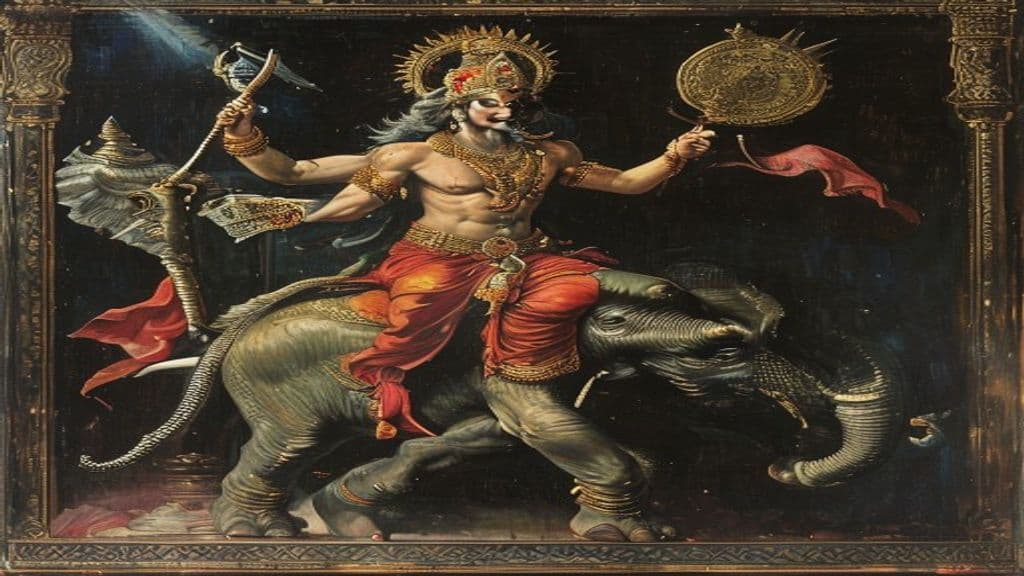
Indra
Indra is a major Vedic deity, king of the devas and lord of Svarga (heaven), associated primarily with the sky, storms, lightning, rain, rivers and martial heroism; he is central in the Rigveda and later appears across Hindu, Buddhist and Jain cosmologies with varying status.

Marid
The most powerful class of jinn in Islamic tradition — beings of the sea, associated with the deep ocean, storms, and the granting of wishes at terrible cost. The classic genie of the Arabian Nights.

Jann
The weakest class of djinn in Islamic tradition, associated with desert winds and taking the form of snakes or whirlwinds, dwelling in empty wilderness and posing little threat to those who know the proper invocations.
Jann
The weakest class of djinn in Islamic tradition, associated with desert winds and taking the form of snakes or whirlwinds, dwelling in empty wilderness and posing little threat to those who know the proper invocations.
A'ra
No reliable sources in the supplied material establish A'ra as a distinct supernatural entity. The token "A'ra" appears in the dataset as (a) part of general references to pre-Islamic Arabian deities, (b) a modern Korean female given name (A-ra/아라), and (c) an Arabic toponym (A'ra, one village merged into Ar'ara).
Abaddon
In Hebrew scripture Abaddon is primarily a noun meaning 'destruction' or a section/condition of the underworld paired with Sheol; in the New Testament Book of Revelation Abaddon is personified as an angelic figure (Greek Apollyon) described as the king of an army of locusts released from the abyss during the apocalypse.
Abadir
Abadir is a polysemous name attested in distinct cultural contexts: a legendary founding saint and clan ancestor in eastern Ethiopia (Sheikh Abadir Umar Al‑Rida / Aw Abadir), a term applied to cone‑shaped cult stones in Phoenician religious description, and a personal name of a martyr (Abadir/Apater) in the Coptic Synaxarium. The attestations are independent usages of the same name rather than a single supernatural being.
Abadiu of Antinoe
Abadiu of Antinoe was a fourth‑century bishop of Antinoe (Antinoopolis, in Roman Egypt) commemorated as a martyr and saint in the Coptic Orthodox Church, with a feast day on 26 December. Sources record that he was killed during a theological dispute with Arian opponents and reference him in collections of Egyptian martyrs.
Abagtha
Abagtha (Hebrew: אבגתא, ’Ǎḇaḡṯā) is a named human court official in the Hebrew Bible’s Book of Esther, listed among seven chamberlains who ministered before King Ahasuerus and were commanded to bring Queen Vashti before the king. He is attested only in Esther 1:10 and is presented as an institutional palace attendant rather than a supernatural being.
Abanoub
Abanoub is a 4th‑century Egyptian Christian child martyr venerated in the Coptic tradition. Remembered for his public confession of Christ, miraculous healings associated with his passion, and the translation and veneration of his relics, his feast is observed on July 31 (Epip 24) and his cult centers include Nehisa and Samanoud.
Abaskhiron the Soldier
A Coptic Orthodox martyr venerated for refusing imperial idolatry during the Diocletian persecution; reputedly healed by the Archangel Michael, preserved in monastery relics, and commemorated on 14 June (7 Paoni).
Abdel Messih El-Makari
Abdel Messih El-Makari (1892–1963) was a Coptic Orthodox monk and priest venerated as a 20th‑century Coptic saint. Associated with the Monastery of Saint Samuel the Confessor and the Monastery of Saint Macarius (Scetes/Wadi El‑Natrun), he is remembered for humility, asceticism, charity, and reported spiritual gifts such as prescience, discerning of spirits, and healing.
Abel
Abel is the second son of Adam and Eve in the Genesis narrative, a shepherd whose accepted offering and subsequent murder by his brother Cain form the biblical account of the first death. Later interpretive traditions expand his role, treating him as an archetypal righteous victim, a postmortem avenging or adjudicating figure, and in some systems (notably Mandaean) identifying him with an angelic lightbeing.
Abib and Apollo
Abib and Apollo are Christian ascetics and hagiographic saints of Akhmim (Upper Egypt) attested in Coptic sources and the Historia Monachorum. Remembered for extreme asceticism, monastic leadership, angelic encounters, and inclusion in the Coptic Synaxarion (feast day November 4).
Abiel
Abiel is attested in the supplied sources only as a male given name — borne by several historical American individuals and listed as two minor biblical figures. The provided materials contain no evidence presenting Abiel as a supernatural, mythological, or folkloric entity.
Abijah of Judah
Abijah (also Abijam or Abiah) is presented in the biblical and later interpretive traditions as a short-reigning human king of Judah from the Davidic line. He is portrayed as a dynastic successor whose military actions (notably the battle at Mount Zemaraim) and moral evaluation in rabbinic literature are interpreted theologically in relation to the Davidic covenant.
Community Record
- [1]Haneunim. Wikipedia: 'Haneunim (Korean: 하느님; lit. "Lord of Sky") or Hananim (Korean: 하나님) is the sky god in Korean mythology.'; Dangun section: description of Hwanung sent bearing three Heavenly Seals and arriving under the sindansu.wiki
- [2]Haneullim (Wikidata entry). Wikidata: 'Sky god of Cheondoism and Jeungsanism.'other
- [3]Korean Studies mailing-list posts: 'Again, Haneunim (and the Trinity)'. Discussion noting linguistic/confessional variation and usage of Haneunim/Hananim in Christian contexts (forum/mailing-list commentary).folk
- [4]GypsyScholar blog: Rhie Won-bok on Christian 'Misuse' of 'Allah' (includes discussion of name-usage). Blog commentary noting debates over term usage and noting Haneunim/Hananim in modern religious-language contexts (blog/forum source).other