
Jophiel appears in Jewish pseudepigraphal and mystical corpora and later in Christian and occult angelologies rather than in a single narrative origin myth. The Revelation of Moses (pseudepigraphal) names Jophiel (also called Dina) as an angel of the seventh heaven, a guardian of the Torah and wisdom who taught seventy languages to souls at the dawn of creation. The Zohar, produced in the milieu of medieval Kabbalah, lists Jophiel as a Great Angel Chief who commands legions and supervises Torah-reading on the Sabbath. Early modern ceremonial and magical texts (for example, listings in works cited by the Calendarium Naturale Magicum Perpetuum and variants of the Key of Solomon) adapt Jophiel into correspondential systems (notably associated with the Sephira Binah) and into planetary/zodiacal attributions in the writings of authors such as Agrippa, Paracelsus, and Rudd.
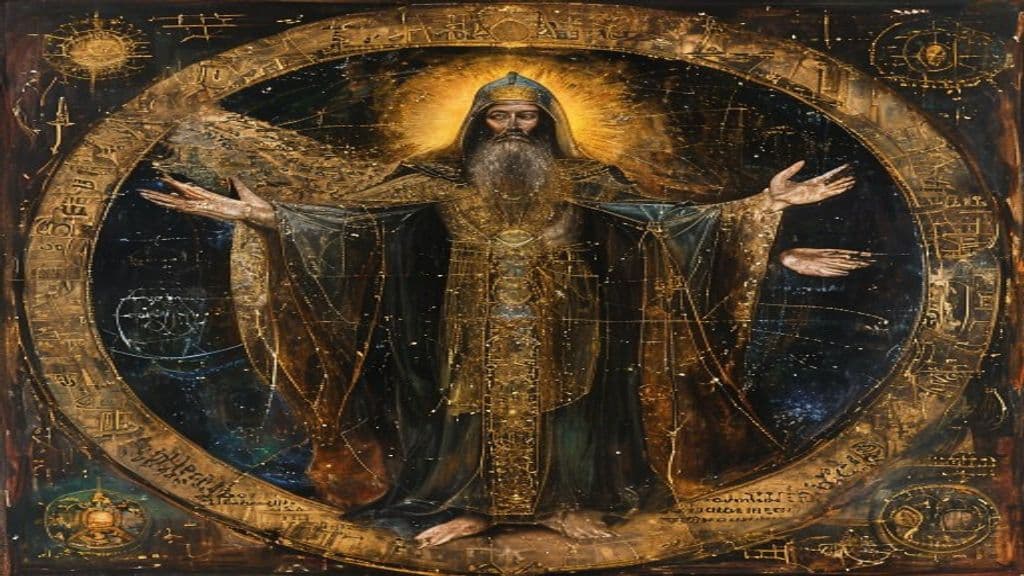
Canonical textual sources provide little consistent literal description; instead iconography and literature shape Jophiel’s visual image. Medieval and later Christian church windows and murals commonly depict Jophiel as an angelic figure often holding a flaming sword (examples cited in stained glass at St Michael's Church, Brighton; St Peter and St John's Church, Kirkley; Holy Trinity Church, Coventry; and a mural at St. John's Episcopal Church, Memphis). John Milton’s Paradise Lost characterizes the archangel as 'the cherubim with the swiftest wings,' reflecting literary imaginings of great swiftness and beauty. General angelological conventions (humanlike beauty, wings, halo, radiance) are applied to Jophiel in artistic contexts, but no single canonical anthropomorphic description is provided in the mystical or pseudepigraphal texts cited.
Across the cited sources Jophiel functions as a high celestial officer with pedagogic, custodial, and supervisory powers. The Revelation of Moses credits Jophiel/Dina with teaching seventy languages to souls and guarding the Torah and wisdom. The Zohar assigns Jophiel command over many legions (the Zohar names eighty-three or, as summarized, fifty-three legions in various listings) and the role of superintendence over Torah-readings on the Sabbath. Later occult and Kabbalistic systems place Jophiel in correspondence with the Sephira Binah and various planetary/zodiacal attributions (Agrippa assigns Saturn; Paracelsus assigns Jupiter; Rudd links Jophiel with the Zodiac), which integrates the angel into ritual and astrological frameworks where the name functions as an operative power to be invoked or stationed by practitioners. Artistic depictions of Jophiel with a flaming sword indicate a guardian or martial aspect in devotional imagery, though the supplied texts do not elaborate combative powers beyond iconographic signaling.
Metatron
An exalted heavenly figure in postbiblical Jewish literature, often identified with the transformed patriarch Enoch in later mystical texts and portrayed as a celestial scribe and high court official in merkabah and Kabbalistic writings.

Raziel
Raziel is an angelic revealer in Jewish mystical literature, called the 'Angel of Secrets' and credited with transmitting esoteric books (notably Sefer Raziel) to prime ancestors; the name is also reused in modern fiction for characters and artifacts that evoke revelation or hidden knowledge.
57 Mnemosyne
57 Mnemosyne is a large main-belt asteroid (S-type) discovered in 1859 and named after the Greek Titaness Mnemosyne. It is a non-sentient astronomical body studied for its orbital and rotational properties and has been used in dynamical measurements related to Jupiter.
Aamon
Aamon (also Amon) is a named spirit in early modern Western grimoire tradition (Pseudomonarchia Daemonum; the Ars Goetia / Lesser Key of Solomon). He is presented as a high-ranking infernal officer (Marquis/Prince) who governs forty legions and is credited with knowledge of past and future and with affecting human relationships (reconciling or procuring feuds and favor).
Aaron
Aaron is a central human figure in Israelite sacred literature: the elder brother of Moses, the first high priest (progenitor of the Aaronide priesthood), and a spokesman/prophet who mediates between Israel and God in Exodus–Deuteronomy narratives. His role in the texts establishes hereditary priestly authority, ritual functions (sacrifices, blessing, use of Urim and Thummim), and institutional norms for Israelite cultic life.
Abaddon
In Hebrew scripture Abaddon is primarily a noun meaning 'destruction' or a section/condition of the underworld paired with Sheol; in the New Testament Book of Revelation Abaddon is personified as an angelic figure (Greek Apollyon) described as the king of an army of locusts released from the abyss during the apocalypse.
Abadir
Abadir is a polysemous name attested in distinct cultural contexts: a legendary founding saint and clan ancestor in eastern Ethiopia (Sheikh Abadir Umar Al‑Rida / Aw Abadir), a term applied to cone‑shaped cult stones in Phoenician religious description, and a personal name of a martyr (Abadir/Apater) in the Coptic Synaxarium. The attestations are independent usages of the same name rather than a single supernatural being.
Abadiu of Antinoe
Abadiu of Antinoe was a fourth‑century bishop of Antinoe (Antinoopolis, in Roman Egypt) commemorated as a martyr and saint in the Coptic Orthodox Church, with a feast day on 26 December. Sources record that he was killed during a theological dispute with Arian opponents and reference him in collections of Egyptian martyrs.
Abagtha
Abagtha (Hebrew: אבגתא, ’Ǎḇaḡṯā) is a named human court official in the Hebrew Bible’s Book of Esther, listed among seven chamberlains who ministered before King Ahasuerus and were commanded to bring Queen Vashti before the king. He is attested only in Esther 1:10 and is presented as an institutional palace attendant rather than a supernatural being.
Abanoub
Abanoub is a 4th‑century Egyptian Christian child martyr venerated in the Coptic tradition. Remembered for his public confession of Christ, miraculous healings associated with his passion, and the translation and veneration of his relics, his feast is observed on July 31 (Epip 24) and his cult centers include Nehisa and Samanoud.
Abaskhiron the Soldier
A Coptic Orthodox martyr venerated for refusing imperial idolatry during the Diocletian persecution; reputedly healed by the Archangel Michael, preserved in monastery relics, and commemorated on 14 June (7 Paoni).
Abdel Messih El-Makari
Abdel Messih El-Makari (1892–1963) was a Coptic Orthodox monk and priest venerated as a 20th‑century Coptic saint. Associated with the Monastery of Saint Samuel the Confessor and the Monastery of Saint Macarius (Scetes/Wadi El‑Natrun), he is remembered for humility, asceticism, charity, and reported spiritual gifts such as prescience, discerning of spirits, and healing.
Abdiel
Abdiel (Hebrew עֲבְדִּיאֵל) is primarily a theophoric Hebrew personal name meaning "servant of El/servant of God," attested once in the Hebrew Bible (1 Chronicles 5:15). In later literature—most notably John Milton's Paradise Lost—Abdiel is reimagined as a faithful seraph who opposes Satan's revolt. The provided sources do not treat Abdiel as an autonomous folkloric spirit type or record rituals or wards associated with the name.
Abel
Abel is the second son of Adam and Eve in the Genesis narrative, a shepherd whose accepted offering and subsequent murder by his brother Cain form the biblical account of the first death. Later interpretive traditions expand his role, treating him as an archetypal righteous victim, a postmortem avenging or adjudicating figure, and in some systems (notably Mandaean) identifying him with an angelic lightbeing.
Community Record
- [1]Jophiel — Wikipedia. Wikipedia article 'Jophiel' — summary of appearances in Revelation of Moses, Zohar, artistic depictions, and occult correspondences.wiki
- [2]Wikidata entry Q592818 (Jophiel). Wikidata entry for Jophiel, cross-referencing authority data and aliases.other
- [3]Revelation of Moses (summarized in secondary sources). Summary in Wikipedia noting Revelation of Moses description of Jophiel/Dina as an angel of the seventh heaven who guarded the Torah and taught 70 languages.other
- [4]Zohar (summary in secondary sources). Summary in Wikipedia noting the Zohar lists Jophiel as a Great Angel Chief in charge of legions who superintend Torah-readings on the Sabbath.other
- [5]Iconographic examples and literary depiction (summarized). Wikipedia summary noting stained glass/mural examples and John Milton's depiction in Paradise Lost as 'the cherubim with the swiftest wings.'literary
- [6]Calendarium Naturale Magicum Perpetuum; Veritable Clavicles of Solomon; Sixth and Seventh Books of Moses (summary). Wikipedia summary reporting that these magical/Kabbalistic works list Jophiel as the angel of the Sephira Binah and that occult authors (Agrippa, Paracelsus, Rudd) assign planetary/zodiacal correspondences.other