
Sources name Maymun as the last of the seven kings of the jinn and place him within a hierarchical supernatural order: manuscripts report he acts under the supervision of the angel Kasfa'il and is in the service of a minister called Dikianos (the latter associated in the sources with Iblis and plagues). The supplied materials do not provide a creation myth or full origin narrative for Maymun.
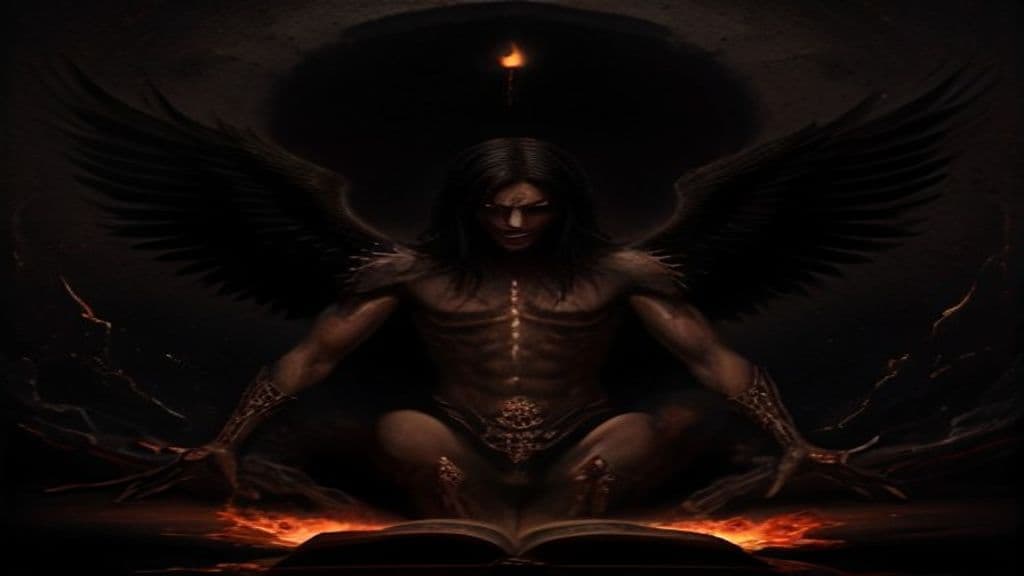
Manuscript descriptions attributed to al‑Buni and the Book of Wonders depict Maymun as a winged, monkey‑faced jinn with cow horns, goat ears, fangs, green eyes, and large outstretched wings with gold and red feathers; a muscular torso likened to the Zawba'a jinn and a lower body enveloped in red flames. He is shown descending among oriental‑style clouds, sometimes carrying the half‑naked body of a sleeping person. In Moroccan folk variants the figure is feminized (Lalla Mimuna) and presented as wearing a white or white‑and‑green gown with a gem‑adorned crown and large wings, a very charming appearance distinct from the manuscript feral iconography.
Within the occult/manuscript tradition Maymun is described as leader of wind jinns (implying authority over wind/directional jinn), possessing physical strength unmatched by other jinn and displaying ruthlessness in battle. The iconography of him bearing sleeping humans indicates an attributed power to abduct sleeping or unaware persons. Through his service relationships (Dikianos and links to Iblis) sources also connect his presence to causes of anxiety, sadness, and melancholy. In North African vernacular practice the reworked Lalla Mimuna is credited with miracle‑working, exorcism, protection of lovers, and local resistance narratives.
Ababil
Ababil (Arabic: أبابيل, romanized abābīl) are miraculous birds mentioned in the Qur'anic account of Surah Al‑Fil. In Islamic tradition they appear as a divinely sent avian host that defended the Kaaba by pelting an invading army with small clay stones; tradition places the event in the year traditionally given as 570 CE.
Abadir
Abadir is a polysemous name attested in distinct cultural contexts: a legendary founding saint and clan ancestor in eastern Ethiopia (Sheikh Abadir Umar Al‑Rida / Aw Abadir), a term applied to cone‑shaped cult stones in Phoenician religious description, and a personal name of a martyr (Abadir/Apater) in the Coptic Synaxarium. The attestations are independent usages of the same name rather than a single supernatural being.
Abdul Qadir Gilani
A historical 11th–12th century Hanbali jurist, preacher, and Sufi shaykh who became the eponym and principal early figure of the Qadiriyya tariqa; venerated in Sunni Sufi traditions as an Awliya (saint) and often given exalted hagiographical ranks such as Muḥi al‑Dīn and Ghawth.
Abel
Abel is the second son of Adam and Eve in the Genesis narrative, a shepherd whose accepted offering and subsequent murder by his brother Cain form the biblical account of the first death. Later interpretive traditions expand his role, treating him as an archetypal righteous victim, a postmortem avenging or adjudicating figure, and in some systems (notably Mandaean) identifying him with an angelic lightbeing.
Abraham (Ibrāhīm) in Islam
Ibrāhīm (Abraham) in Islam is a human prophet and messenger chosen by God, a paradigm of pure monotheism (hanīf), patriarchal ancestor to later peoples and prophets, and traditionally regarded as having helped establish the Kaʿbah with his son Ismāʿīl. He is called Khalīl Allāh ('Friend of God') and is central to rites commemorated in Hajj and Eid al‑Adha.
Abāmūn of Ṭoukh
Abāmūn of Ṭoukh is a Coptic Christian martyr attested in the Synaxarion of Mikhail of Atrib, commemorated with a feast day on 20 July (13 Abib). He is said to have been visited by the archangel Michael, traveled to Ansena where he was tortured and beheaded, was credited with working miracles, and whose body was wrapped by Julius of Aqfahs and returned to Toukh.
Abū Lahab
Abū Lahab (ʿAbd al-ʿUzzā ibn ʿAbd al-Muṭṭalib) is a historical Meccan figure — a paternal uncle of the Prophet Muḥammad and a Quraysh leader who opposed the Prophet; he is singled out and condemned in Qurʾān 111 (Sūrat al-Masad) and functions in Islamic textual memory as an exemplar of divine punishment for opposition.
Adam (ʾĀdam)
In Islamic theology Adam (Arabic: آدم, ʾĀdam) is presented as the first human being and the first prophet (nabī), created by God from earth/clay, granted life by God's spirit, placed in a paradisal Garden, taught knowledge (the "Names"), tested by divine command, tempted by Iblīs, and ultimately sent to live and die on Earth while remaining eligible for repentance and forgiveness.
Ahmed al-Badawī
Ahmed al-Badawī (Aḥmad al-Badawī, al-Sayyid al-Badawī) was a 13th-century Arab Sufi mystic and founder of the Badawiyyah order. Born in Fes to a Bedouin tribe and later settled in Tanta, Egypt, his tomb remains a major site of visitation and he is regarded as one of the most popular Sufi saints in Egypt (sources emphasize his historical sainthood and pilgrimage cult rather than detailed folkloric attributes).
Aicha Kandicha (Qandisa)
Aicha Kandicha (also romanized Qandisa/Qandisha) is a female mythological figure in Moroccan folklore described as a jinn-like seductress associated with water. She appears as a beautiful woman with hoofed lower limbs who dwells at rivers, springs, lakes and the sea and is said to use sexual allure to seduce men, sometimes driving them mad or killing them.
Aicha Qandicha
Aicha Qandicha is a female seductress spirit in northern Moroccan folklore, often associated with bodies of water and implicated in harmful encounters with men. She appears both as a wild liminal monster and as a named spirit incorporated into local ritual systems (Hamadsha, Zār, Buffi Sufi orders).
Al-Abyad
Al-Abyad (Arabic: al‑Abyad, "the White") appears in modern compilations and anecdotal references as a named jinn or epithet within Arabic/Islamic discourse on jinn. The corpus consists mainly of contemporary lists, forum posts, popular articles, and a polemical anecdote; no coherent classical origin myth or primary ritual tradition for Al-Abyad is attested in the supplied materials.
Community Record
- [1]Maymun (Wikipedia). Wikipedia article 'Maymun', accessed via provided research noteswiki
- [2]Summary notes citing al‑Buni and the Book of Wonders. Research notes summarizing manuscript descriptions attributed to al‑Buni and the Book of Wonders (provided in the assignment materials)other
- [3]North African variants (Sidi Mimun / Lalla Mimuna) — research notes. Research notes summarizing Moroccan folk adaptations and cultic roles (provided in the assignment materials)folk