
The Mothman label arose from newspaper coverage of November 1966 reports near Point Pleasant, West Virginia, where several witnesses reported encountering a large winged, man‑sized creature. The coinage 'Mothman' and the iconic image of a red‑eyed winged humanoid were shaped by press headlines and later popular writers (e.g., Gray Barker, John Keel). Folklorists treat the episode as a case of modern legend formation driven by local reporting, subsequent national media attention, and later books and film; some commentators connected the sightings narratively to the 1967 Silver Bridge collapse, though that linkage is a feature of later retellings rather than part of the original newspaper accounts.
Eyewitness descriptions from the 1966–67 cluster vary: early press quoted a 'man‑sized bird' with eyes that 'glowed red'; Linda Scarberry described what she called a 'slender, muscular man' about seven feet tall with white wings and said she could not discern the face because of the effect of its eyes; volunteer firemen described a 'large bird with red eyes.' Investigators and biologists later proposed prosaic comparators — sandhill crane, great blue heron, barred or snowy owls — and emphasized that eyeshine and poor viewing conditions plausibly account for reports of 'glowing red eyes.' Later pop‑culture images and the Mothman name consolidated divergent descriptions into a single iconic figure.
Contemporary sources report witness claims of behaviors during the Point Pleasant cluster: standing alongside roads, flying after or pursuing vehicles, producing a loud screeching sound, and in some accounts appearing to impede clear observation of facial features. Folklorists record anecdotal motifs associated with the tale complex (e.g., stories of creatures attacking roofs of parked cars). These reported behaviors are presented in sources as witness reports or folkloric elements; investigators have offered mundane explanations (misidentified birds, eyeshine, hoaxes such as flashlights tied to balloons) rather than confirmed supernatural powers. Some later authors and paranormal commentators linked the sightings to other anomalous events (UFOs, the Silver Bridge collapse), a retrospective interpretive layer in the legend.
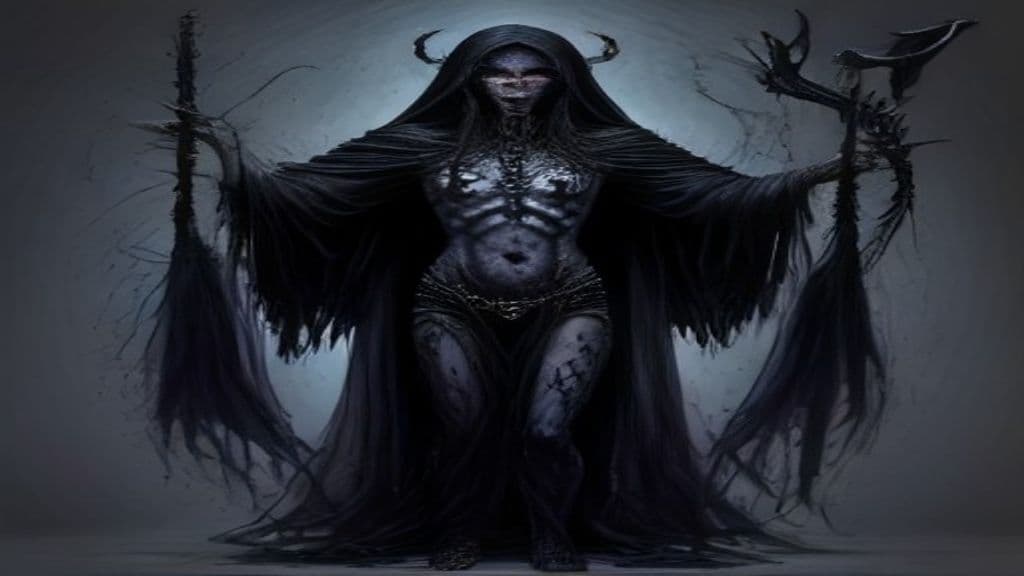
Ghoul
A ghoul is a demon-like or monstrous humanoid originating in pre-Islamic Arabian religion, traditionally associated with graveyards and the consumption of human flesh. The concept later entered broader folklore and has been widely reused and transformed in modern fiction and popular culture.

Bhoot (bhoota)
A bhoot (also bhoota, bhoot, bhut) is the culturally specific term across parts of the Indian subcontinent for a perturbed, restless spirit generally understood to be the ghost of a deceased person. Sources describe bhoots as arising when a person's death or post-death circumstances prevent them from moving on — for example violent death, unresolved affairs, or failures in funerary rites — and the term appears frequently in modern South Asian media and discussions.
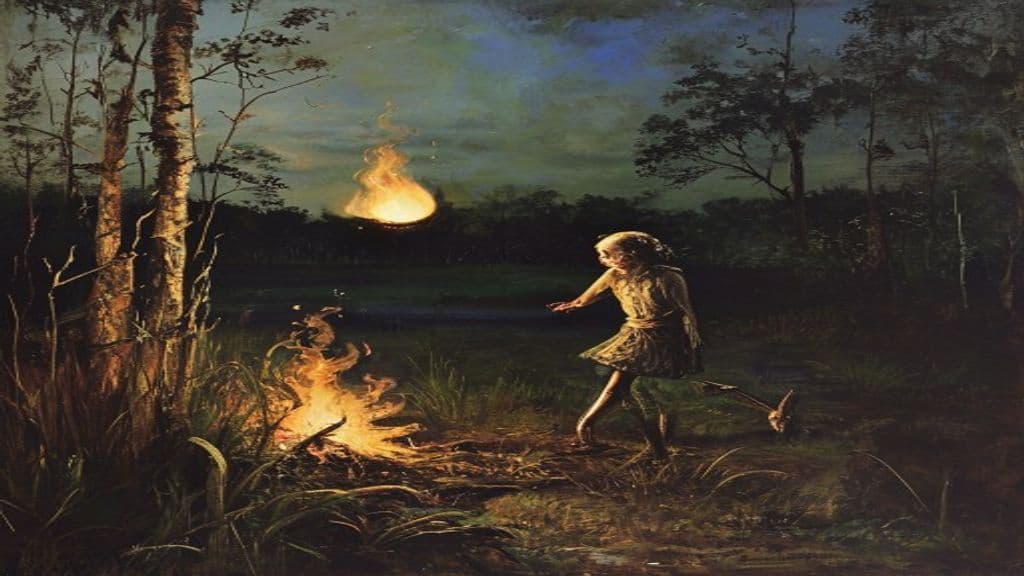
Will-o'-the-wisp
An atmospheric 'ghost light' — a small, mobile, lamp-like light seen at night over marshes, bogs, wet ground, or graveyards. In many cultures the phenomenon is interpreted as a supernatural being or manifestation (wandering nature-spirit, soul of the dead, transformed witch, or treasure-indicator); modern science offers chemiluminescent explanations for some occurrences.
3-D Man
3-D Man is a Marvel Comics superhero identity associated with a 1950s-era origin in which the body of Chuck Chandler can materialize in three-dimensional existence when activated by his brother Hal via a pair of glasses. The mantle was later assumed by Delroy Garrett (formerly Triathlon) in modern continuity.
5 Ronin
5 Ronin is a 2011 Marvel Comics five-issue limited series that reimagines five Marvel superhero archetypes as rōnin (masterless samurai) in a fictionalized post‑Sekigahara feudal Japan. The work places Wolverine, Hulk, Punisher, Psylocke, and Deadpool analogues into period roles to explore displacement, revenge, and identity in an era of political upheaval.
58 Concordia
58 Concordia is a fairly large main-belt asteroid orbiting the Sun, discovered in 1860 and named after the Roman goddess Concordia. Astronomical sources classify it as a C-type (carbonaceous) body with a multi-year orbital period and measurable rotation and pole orientations.
9MOTHER9HORSE9EYES9
An anonymous Reddit screen name and online persona used by the author of the Interface series, a multipart speculative-horror narrative posted in short installments across Reddit in 2016. The name functions as the signature of an authorial identity and as a focal label for a fandom that created archives, a subreddit, and a wiki documenting the story and its fictional phenomena (notably entities called "flesh interfaces").
A.R.G.U.S.
A.R.G.U.S. is a fictional clandestine United States government agency in the DC Comics universe that investigates, contains, and manages superhuman, meta-human, and supernatural incidents and assets. Introduced in The New 52 continuity, it functions as an institutional actor providing intelligence, logistical support, covert task forces (notably Task Force X / the Suicide Squad), and a dedicated magic division across comics and media adaptations.
Abena Mansa
A name attested in a single contemporary Ghanaian blog anecdote as a 'mysterious being'; available sources do not establish Abena Mansa as a coherent, traditional supernatural figure or provide corroborating ethnographic detail.
Abin Sur
Abin Sur is a fictional extraterrestrial Green Lantern from the planet Ungara in DC Comics. A former history professor turned Green Lantern of Space Sector 2814, he discovered and investigated a prophecy tied to the "Blackest Night," died wounded on Earth and chose Hal Jordan as his ring-successor, and was later reanimated as a Black Lantern in the Blackest Night storyline.
Abishai
Abishai is a personal name attested in several distinct sources: a biblical individual described as the eldest son of Zeruiah (sister of King David); a Semitic chief named in an inscription at Beni-Hasan in Middle Egypt; and modern cultural uses including a named monster in Dungeons & Dragons and as an artist/stage name. The supplied materials do not present Abishai as a supernatural being within a living cosmology.
Abraham Cornelius
Abraham Cornelius is a fictional human scientist in Marvel Comics, a senior Weapon X technician who helped develop the technique to bond adamantium to bone and who features in Wolverine's origin and later storylines, including Death of Wolverine.
Absorbing Man
A fictional Marvel Comics character (Carl "Crusher" Creel) whose body acquires the physical properties of materials or energies he touches. Debuting in Journey into Mystery #114 (March 1965), created by Stan Lee and Jack Kirby, he is presented as a mortal supervillain/occasional antihero who challenges heroes such as Thor, Hulk, Spider-Man, and the Avengers.
Ace Lightning
Ace Lightning is the titular playable character of the fictional in‑universe video game Ace Lightning and the Carnival of Doom. In the television series, game characters come to life in the real‑world town after a lightning strike and electrical surge; Ace functions as a superheroic 'Lightning Knight' from the Sixth Dimension who recruits a human sidekick to pursue game objectives (recovering pieces of the Amulet of Zoar) in the human world.
Ace West
Ace West (Wallace Daniel "Ace" West) is a contemporary American comic-book character in DC Comics continuity, a young speedster who channels the metaphysical Speed Force and occupies legacy-hero roles such as Kid Flash and Ace. Introduced in New 52-era stories as a biracial reinterpretation of Wally West and later retconned in DC Rebirth as a distinct Wallace West, son of Daniel West (Reverse-Flash), he appears across present-day and alternate/future timelines and participates in team and sacrifice narratives tied to the Speed Force.
Community Record
- [1]Mothman - Wikipedia. Wikipedia, 'Mothman' article (summary of press reports, folklorist and skeptical commentary)wiki
- [2]Jan Harold Brunvand on Mothman and modern legends. Jan Harold Brunvand, folklorist commentary as summarized in source notes (comparative tale elements, attacks on car roofs, modern legend formation)academic
- [3]Skeptical investigations (Joe Nickell, Benjamin Radford). Summarized skeptical analyses noting hoaxes (flashlights on balloons), misidentifications (birds, eyeshine), and secondhand reporting of red‑eye claims (Joe Nickell; Benjamin Radford as cited in source notes)other
- [4]Contemporary press: Point Pleasant Register (Nov 16, 1966). Point Pleasant Register, 'Couples See Man‑Sized Bird ... Creature ... Something' (headline cited in source notes; original local reporting of the sightings)folk
- [5]Cultural transmission and popularization (Gray Barker, John Keel, film, festival). Accounts of subsequent popularization by Gray Barker and John Keel, 2002 film adaptation, and annual Point Pleasant Mothman festival (summarized in provided material)literary
- [6]Reported modern sightings and photographs (local media). Examples noted in source material, e.g., a 2016 photo published by WCHS‑TV and later claimed sightings elsewhere (including a reported transposition to Moscow by UFOlogists) as indicators of the legend's spreadother