
There is no single origin narrative for Promachus; instead the name appears across multiple registers. In Homeric epic a Promachus (son of Alegenor) is a Boeotian warrior who falls in the Trojan War (Iliad). In mythographic summaries and Argonautica-related traditions a Promachus is counted among the kin of Aeson of Iolcus and is said to have been killed by Pelias while Jason was absent. Other bearers include a son of Parthenopaeus among the Epigoni and a Promachus listed among the suitors of Penelope who is killed on Odysseus' return. Separately, the form Πρόμαχος occurs as a surname/epithet of deities — for example Athena at Athens, Heracles at Thebes, and Hermes at Tanagra — indicating a divine functional title meaning "champion" or "leader in battle". In modern usage Promachus is also the name of a genus of robber flies (Asilidae) and of asteroid 173117 Promachus.
As used for mortal figures in epic and myth, Promachus has no uniform supernatural appearance in the cited sources; individuals are described simply as warriors or as sons of named parents and are depicted within normal human martial contexts (battle, athletic contest). The sources do not record a distinctive iconography for the epithet Πρόμαχος; the epithet is attached to deities (Athena, Heracles, Hermes) but the provided materials do not describe unique visual attributes specific to the epithet. In modern scientific contexts Promachus denotes real robber flies (genus Promachus) with ordinary dipteran morphology as recorded in entomological lists and photographs.
When borne by mortal characters in epic and myth, Promachus denotes human abilities associated with warriors: fighting in battle, athletic skill (one local tradition lists a Promachus of Pellene as a pankration champion), and the narrative consequences of martial death (lament, vengeance). As an epithet of gods, the functional implication is leadership or preeminence in battle — a divine protective/champion role — though specific divine actions tied to the epithet are not detailed in the cited materials. In taxonomy the genus Promachus designates predatory robber flies; entomological notes mention species-level behaviors such as courtship displays (e.g., Promachus latitarsatus) in the modern biological register.

Heracles
Heracles is the greatest hero of Greek myth whose career bridges mortal hero-cult and full divinization. Celebrated for his Twelve Labours, martial prowess, and travels between the mortal world, the underworld, and Olympus, he functioned as a civic patron, ancestor of royal lines (the Heracleidae), and object of cult that treated him both as chthonic hero and as god.
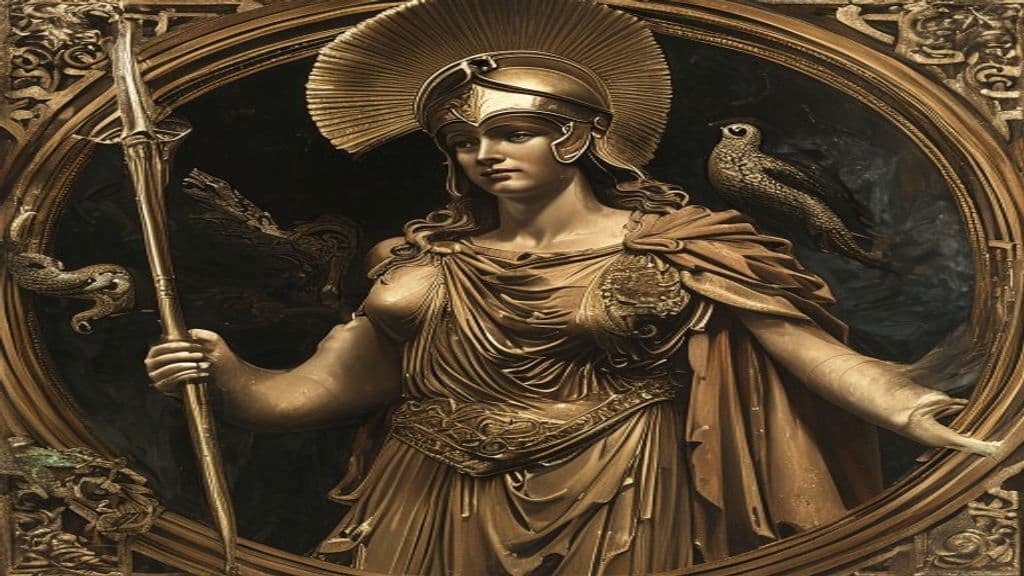
Athena
Athena is a major ancient Greek goddess associated with wisdom, handicraft (notably weaving), and warfare; she serves as a tutelary protector of cities—most prominently Athens—and is central to myth, cult, and civic identity in the Greek world.
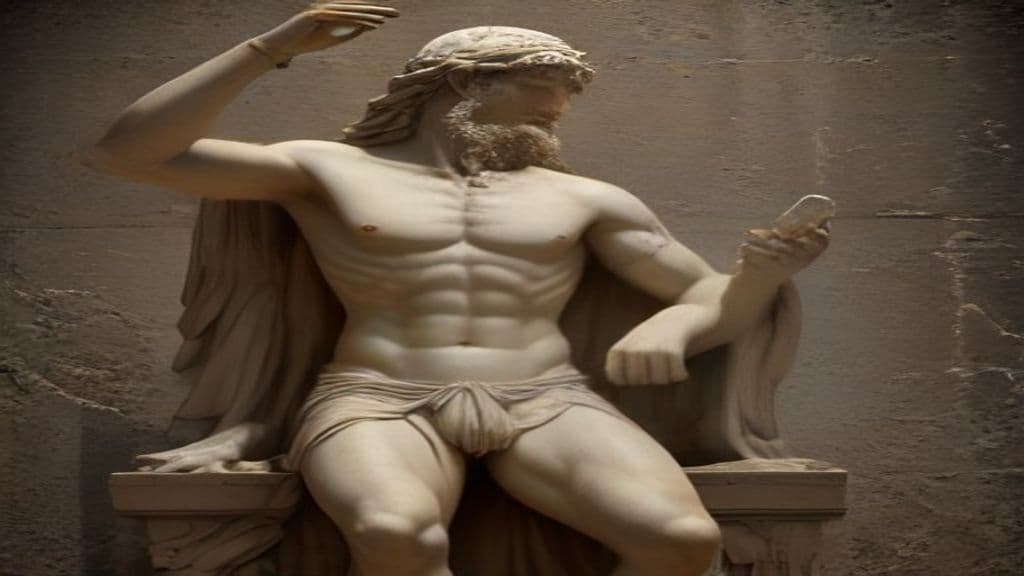
Hermes
Hermes is an Olympian god in ancient Greek religion who functions as the herald of the gods, an intermediary between mortal and divine realms, and a psychopomp guiding souls to the afterlife. He is associated with travel, boundaries, commerce, thieves, oratory, and liminality; in Hellenistic contexts he is syncretized with Egyptian Thoth as Hermes Trismegistus.
*Péh₂usōn (reconstructed)
Péh₂usōn is a hypothetical Proto‑Indo‑European pastoral guardian reconstructed by comparative scholars from parallels in Greek and Vedic traditions. Proposed as a Graeco‑Aryan ancestor‑figure, the reconstruction describes a protector of flocks, roads, and travellers rather than an attested historical cultic personality.
3-D Man
3-D Man is a Marvel Comics superhero identity associated with a 1950s-era origin in which the body of Chuck Chandler can materialize in three-dimensional existence when activated by his brother Hal via a pair of glasses. The mantle was later assumed by Delroy Garrett (formerly Triathlon) in modern continuity.
5 Ronin
5 Ronin is a 2011 Marvel Comics five-issue limited series that reimagines five Marvel superhero archetypes as rōnin (masterless samurai) in a fictionalized post‑Sekigahara feudal Japan. The work places Wolverine, Hulk, Punisher, Psylocke, and Deadpool analogues into period roles to explore displacement, revenge, and identity in an era of political upheaval.
58 Concordia
58 Concordia is a fairly large main-belt asteroid orbiting the Sun, discovered in 1860 and named after the Roman goddess Concordia. Astronomical sources classify it as a C-type (carbonaceous) body with a multi-year orbital period and measurable rotation and pole orientations.
9MOTHER9HORSE9EYES9
An anonymous Reddit screen name and online persona used by the author of the Interface series, a multipart speculative-horror narrative posted in short installments across Reddit in 2016. The name functions as the signature of an authorial identity and as a focal label for a fandom that created archives, a subreddit, and a wiki documenting the story and its fictional phenomena (notably entities called "flesh interfaces").
A.R.G.U.S.
A.R.G.U.S. is a fictional clandestine United States government agency in the DC Comics universe that investigates, contains, and manages superhuman, meta-human, and supernatural incidents and assets. Introduced in The New 52 continuity, it functions as an institutional actor providing intelligence, logistical support, covert task forces (notably Task Force X / the Suicide Squad), and a dedicated magic division across comics and media adaptations.
Aba (disambiguation / name-form)
Aba is a polyvalent name-form attested across many unrelated contexts (place names, personal names, animal names, and brief mythological listings). The provided sources do not support a single, coherent supernatural entity called "Aba" and offer no descriptive or ritual material for such a being.
Abandinus
Abandinus is a locally attested Romano‑Celtic theonym known from a single inscribed bronze feather (votive object) dedicated at Godmanchester (the Roman fort Durovigutum) in Cambridgeshire. Scholars interpret him as a local god or male spirit tied to a specific place and possibly associated with a nearby spring or stream; this association is tentative and based on etymological readings of the name.
Abarbarea
Abarbarea is a name attested in classical Greek and Roman sources for freshwater nymphs (naiads). The name appears for at least two individual mythic figures — a naiad wife of Bucolion and a naiad counted among ancestors of the Tyrians — and Hesychius records plural forms that may indicate the name was also used as a class-name (Abarbareai / Abarbalaiai).
Abas
Abas (Ancient Greek: Ἄβας, gen.: Ἄβαντος) is not a single mythic being but a recurring personal name borne by multiple mortals and minor mythic figures in Greek epic and genealogical traditions — kings, founders, seers, warriors, attendants, a centaur, and a youth transformed by a goddess. The name is glossed in the sources as 'guileless' or 'good-hearted' and appears across Argive, Theban, Trojan, Euboean, and other local cycles.
Abderus
Abderus (Ancient Greek: Ἄβδηρος, romanized Ábdēros) is a mortal heroic figure in Greek myth closely associated with Heracles, remembered as the youth left in charge of the Mares of Diomedes who was killed by them. He functions as an eponymous local/divine-hero ancestor for the city of Abdera and received funerary commemoration and athletic agones at his tomb.
Abellio
Abellio is a theonym attested in Roman‑period inscriptions from the Comminges area of the Pyrenees and reported as worshipped in the Garonne Valley of ancient Gallia Aquitania. Surviving evidence is limited to a small number of inscriptions; scholars have variously hypothesized solar or arboreal associations and compared the name to forms of Apollo or to Celtic Belenus, but the deity's precise role in local cosmology remains uncertain.
Community Record
- [1]Promachus (Wikipedia). Wikipedia, entry 'Promachus'.wiki
- [2]The Iliad, Book XIV (Homer). Homer, Iliad, Book XIV (references to Promachus, son of Alegenor).literary
- [3]Promachus species list. List of Promachus species (taxonomic listings).other
- [4]Promachus — Geller-Grimm (Diptera notes). Geller-Grimm, notes on Promachus (Diptera: Asilidae), including courtship display references.other
- [5]173117 Promachus (asteroid). MarkAndrewHolmes.com, asteroid 173117 Promachus (Jupiter Trojan), discovered September 24, 1973.other
- [6]Promachus (fr.wikipedia). French Wikipedia entry 'Promachus' (additional taxonomic and mythic listings).wiki
- [7]Promachus bastardi — photo and notes. Photograph and species notes for Promachus bastardi (robber fly).other
- [8]Archive: Medea and the Argonauts. Archive materials containing mythographic summaries relevant to Argonautica/Iolcus traditions.other
- [9]The Internet Classics Archive — The Iliad. Translation and passage references to Promachus's death and Homeric lamentation.literary