
Sources present Ptah‑Patek as a diminutive/manifestation associated with the creator god Ptah: Herodotus records the Greek form Pataikos and explains it as 'little Ptah,' describing the figure as a son of or a manifestation of Ptah. The figure appears in popular, domestic religion rather than as a fully independent high cult in the surviving summaries, and its late popularity reflects syncretism with household guardians such as Bes and the childbirth goddess Taweret.
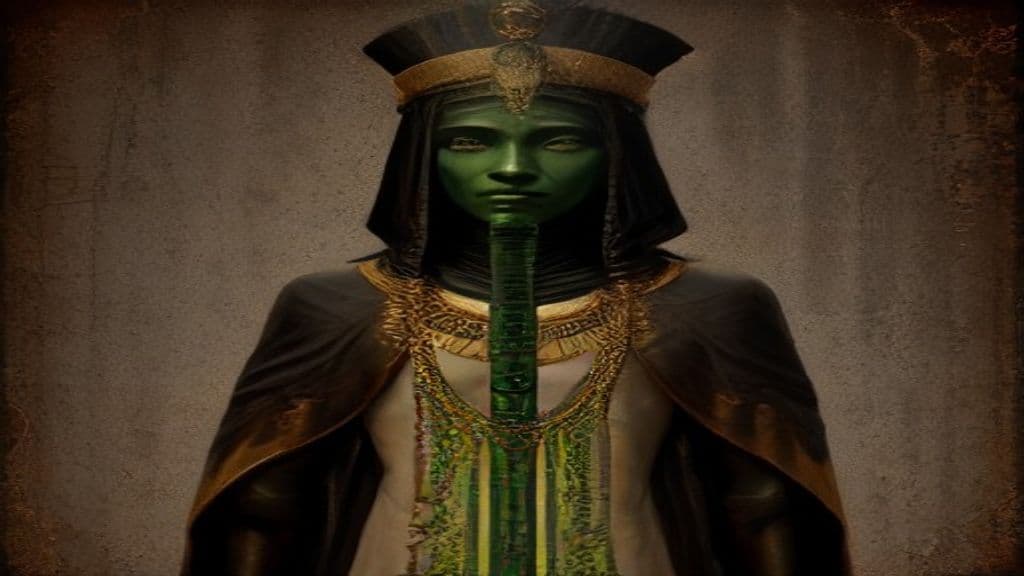
Ptah‑Patek is generally represented as a deformed, naked, green dwarf with a potbelly and a head disproportionate to his body, typically wearing a skullcap. He frequently wore a scarab on his head as a symbol of solar creation and regeneration. In rare cases he is adorned with a necklace and a crown surmounting his skullcap. Late‑period variants sometimes combine attributes of Bes, Harpocrates, and Horus—holding serpents or knives, bearing falcons on the shoulders, or standing on crocodiles.
In Egyptian practice Ptah‑Patek functions primarily as a protective presence embodied in small images: faience amulets and figurines were used to protect the wearer from evil forces, dangerous animals, and chaos. Alongside Bes he acted as an assistant to Taweret in childbirth and was associated with women and children; in childbirth spells a figurine of Bes or Pataikos would be placed on the forehead of the pregnant woman to speed delivery. Late iconographic additions (serpents, knives, falcons, crocodiles) indicate combative/protective capacities, while the scarab motif links the figure to themes of solar creation and regeneration.
Weaknesses
- otherNo traditions of warding against Ptah‑Patek documented
Wards
- ritualPossession/wearing of Ptah‑Patek amulets (faience figurines)
- ritualPlacement of a figurine on the forehead of a pregnant woman in childbirth spells
Ptah
Ptah is the principal Memphite deity of ancient Egypt, venerated as a creator god and patron of craftsmen and architects. He conceives the world 'in the design of his heart' and realizes it by speech, serves as master of ceremonies and justice in state cult, and is central to funerary and royal ritual in Memphis.

Bes
Bes is an ancient Egyptian household protective deity, commonly kept close to domestic life to guard mothers, children, and childbirth; he also defends households against snakes and malevolent spirits and is associated with music, dance, and sexual vitality.

Taweret
Taweret is an ancient Egyptian household protectress associated primarily with childbirth, fertility, and domestic protection. Depicted in composite hippopotamus-derived form, she appears on amulets, birth wands, and funerary objects and is invoked as a pacificatory maternal figure aiding both living birth and symbolic rebirth.
*Péh₂usōn (reconstructed)
Péh₂usōn is a hypothetical Proto‑Indo‑European pastoral guardian reconstructed by comparative scholars from parallels in Greek and Vedic traditions. Proposed as a Graeco‑Aryan ancestor‑figure, the reconstruction describes a protector of flocks, roads, and travellers rather than an attested historical cultic personality.
Aani
Aani (ancient Egyptian jꜥnr) is the lexical term for the baboon in ancient Egyptian language and functions in religious contexts as an animal icon and theophoric epithet. Attested repeatedly in Egyptian texts and images, the baboon image is used to represent or denote aspects of gods such as Thoth, Hapy, Khonsu, and Osiris rather than implying the animal itself is an independent deity.
Aati
Aati (also rendered Ati) is one of the 42 judges of the dead in ancient Egyptian funerary literature, attested in the Book of the Dead tradition (notably the Papyrus of Nebsemy). Described as originating 'from Heliopolis', Aati's documented function is to question the deceased about a specific moral accusation during the Duat judgment; the funerary texts supply a formulaic denial the soul must recite.
Aba (disambiguation / name-form)
Aba is a polyvalent name-form attested across many unrelated contexts (place names, personal names, animal names, and brief mythological listings). The provided sources do not support a single, coherent supernatural entity called "Aba" and offer no descriptive or ritual material for such a being.
Abadiu of Antinoe
Abadiu of Antinoe was a fourth‑century bishop of Antinoe (Antinoopolis, in Roman Egypt) commemorated as a martyr and saint in the Coptic Orthodox Church, with a feast day on 26 December. Sources record that he was killed during a theological dispute with Arian opponents and reference him in collections of Egyptian martyrs.
Abandinus
Abandinus is a locally attested Romano‑Celtic theonym known from a single inscribed bronze feather (votive object) dedicated at Godmanchester (the Roman fort Durovigutum) in Cambridgeshire. Scholars interpret him as a local god or male spirit tied to a specific place and possibly associated with a nearby spring or stream; this association is tentative and based on etymological readings of the name.
Abarbarea
Abarbarea is a name attested in classical Greek and Roman sources for freshwater nymphs (naiads). The name appears for at least two individual mythic figures — a naiad wife of Bucolion and a naiad counted among ancestors of the Tyrians — and Hesychius records plural forms that may indicate the name was also used as a class-name (Abarbareai / Abarbalaiai).
Abas
Abas (Ancient Greek: Ἄβας, gen.: Ἄβαντος) is not a single mythic being but a recurring personal name borne by multiple mortals and minor mythic figures in Greek epic and genealogical traditions — kings, founders, seers, warriors, attendants, a centaur, and a youth transformed by a goddess. The name is glossed in the sources as 'guileless' or 'good-hearted' and appears across Argive, Theban, Trojan, Euboean, and other local cycles.
Abaset
Abaset is a localized ancient Egyptian goddess attested in tomb decoration at El‑Bawiti in the Bahariya Oasis during the 26th Dynasty. She is depicted anthropomorphically with a hedgehog motif incorporated into her headdress and appears on the walls of Qarat Qasr Salim, including twice in the Tomb of Bannentiu. No cult texts, myth narratives, or ritual prescriptions for her are recorded in the cited corpus.
Abderus
Abderus (Ancient Greek: Ἄβδηρος, romanized Ábdēros) is a mortal heroic figure in Greek myth closely associated with Heracles, remembered as the youth left in charge of the Mares of Diomedes who was killed by them. He functions as an eponymous local/divine-hero ancestor for the city of Abdera and received funerary commemoration and athletic agones at his tomb.
Abellio
Abellio is a theonym attested in Roman‑period inscriptions from the Comminges area of the Pyrenees and reported as worshipped in the Garonne Valley of ancient Gallia Aquitania. Surviving evidence is limited to a small number of inscriptions; scholars have variously hypothesized solar or arboreal associations and compared the name to forms of Apollo or to Celtic Belenus, but the deity's precise role in local cosmology remains uncertain.
Abib and Apollo
Abib and Apollo are Christian ascetics and hagiographic saints of Akhmim (Upper Egypt) attested in Coptic sources and the Historia Monachorum. Remembered for extreme asceticism, monastic leadership, angelic encounters, and inclusion in the Coptic Synaxarion (feast day November 4).
Community Record
- [1]Ptah-Patek — Wikipedia. Wikipedia contributors, 'Ptah-Patek', Wikipedia, The Free Encyclopediawiki
- [2]Ptah — Wikipedia. Wikipedia contributors, 'Ptah', Wikipedia, The Free Encyclopediawiki
- [3]Ptah-Patek — Wikidata. Wikidata entry Q3410228 'Ptah-Patek'other