
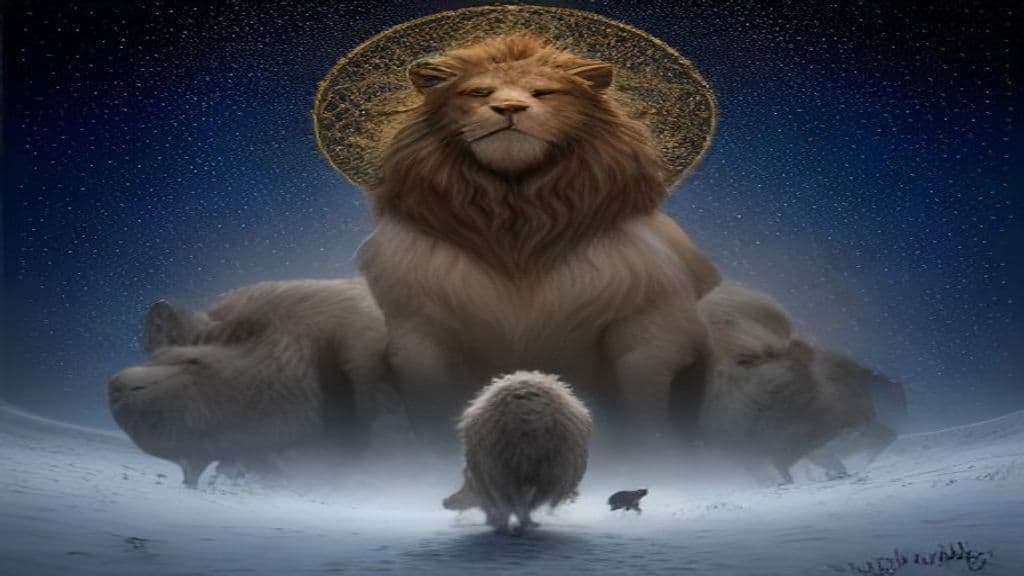
Puzzle originates within C. S. Lewis's fictional cosmology as a donkey living in Narnia who becomes central to the climax of The Last Battle (the seventh book of The Chronicles of Narnia). In the plot summarized by reference sources, the ape Shift convinces Puzzle to impersonate the true divine figure Aslan by dressing and presenting him as that deity; Shift's purpose is to deceive and manipulate the Narnian populace for his own ends. Sources note Puzzle's role is passive—he is used as an instrument in a deliberate false-worship scheme rather than acting as an independent doctrinal or supernatural agent (Wikidata; All The Tropes; Wikipedia character list).
Primary sources supplied identify Puzzle simply as a donkey and do not give a detailed physical description such as coat color or size. Descriptions in the provided summaries emphasize his ordinariness as a beast: he is an ordinary donkey who is harnessed/dressed and presented by Shift as though he were Aslan. Character reactions recorded in source summaries focus on the deception and the community's response to the masquerade rather than on distinctive physical markings of Puzzle himself (Wikidata; All The Tropes; Wikipedia).
The supplied materials do not ascribe any supernatural powers to Puzzle. Instead, sources portray him as gullible and easily manipulated: All The Tropes summarizes that "Puzzle the Donkey is gullible enough that Shift convinces him to go along with his plans," and Wikidata notes he is "presented as the deity Aslan"—indicating his role is behavioral and narrative rather than magical. His notable actions in the plot are passive participation in the impersonation (being dressed and exhibited as Aslan) and exhibiting credulity that allows Shift's scheme to proceed. There is no evidence in the provided sources of independent agency beyond that of an ordinary donkey.
Weaknesses
- conditiongullibility
Wards
None recorded.
Abaddon
In Hebrew scripture Abaddon is primarily a noun meaning 'destruction' or a section/condition of the underworld paired with Sheol; in the New Testament Book of Revelation Abaddon is personified as an angelic figure (Greek Apollyon) described as the king of an army of locusts released from the abyss during the apocalypse.
Abadir
Abadir is a polysemous name attested in distinct cultural contexts: a legendary founding saint and clan ancestor in eastern Ethiopia (Sheikh Abadir Umar Al‑Rida / Aw Abadir), a term applied to cone‑shaped cult stones in Phoenician religious description, and a personal name of a martyr (Abadir/Apater) in the Coptic Synaxarium. The attestations are independent usages of the same name rather than a single supernatural being.
Abadiu of Antinoe
Abadiu of Antinoe was a fourth‑century bishop of Antinoe (Antinoopolis, in Roman Egypt) commemorated as a martyr and saint in the Coptic Orthodox Church, with a feast day on 26 December. Sources record that he was killed during a theological dispute with Arian opponents and reference him in collections of Egyptian martyrs.
Abagtha
Abagtha (Hebrew: אבגתא, ’Ǎḇaḡṯā) is a named human court official in the Hebrew Bible’s Book of Esther, listed among seven chamberlains who ministered before King Ahasuerus and were commanded to bring Queen Vashti before the king. He is attested only in Esther 1:10 and is presented as an institutional palace attendant rather than a supernatural being.
Abanoub
Abanoub is a 4th‑century Egyptian Christian child martyr venerated in the Coptic tradition. Remembered for his public confession of Christ, miraculous healings associated with his passion, and the translation and veneration of his relics, his feast is observed on July 31 (Epip 24) and his cult centers include Nehisa and Samanoud.
Abaskhiron the Soldier
A Coptic Orthodox martyr venerated for refusing imperial idolatry during the Diocletian persecution; reputedly healed by the Archangel Michael, preserved in monastery relics, and commemorated on 14 June (7 Paoni).
Abdel Messih El-Makari
Abdel Messih El-Makari (1892–1963) was a Coptic Orthodox monk and priest venerated as a 20th‑century Coptic saint. Associated with the Monastery of Saint Samuel the Confessor and the Monastery of Saint Macarius (Scetes/Wadi El‑Natrun), he is remembered for humility, asceticism, charity, and reported spiritual gifts such as prescience, discerning of spirits, and healing.
Abdiel
Abdiel (Hebrew עֲבְדִּיאֵל) is primarily a theophoric Hebrew personal name meaning "servant of El/servant of God," attested once in the Hebrew Bible (1 Chronicles 5:15). In later literature—most notably John Milton's Paradise Lost—Abdiel is reimagined as a faithful seraph who opposes Satan's revolt. The provided sources do not treat Abdiel as an autonomous folkloric spirit type or record rituals or wards associated with the name.
Abel
Abel is the second son of Adam and Eve in the Genesis narrative, a shepherd whose accepted offering and subsequent murder by his brother Cain form the biblical account of the first death. Later interpretive traditions expand his role, treating him as an archetypal righteous victim, a postmortem avenging or adjudicating figure, and in some systems (notably Mandaean) identifying him with an angelic lightbeing.
Abib and Apollo
Abib and Apollo are Christian ascetics and hagiographic saints of Akhmim (Upper Egypt) attested in Coptic sources and the Historia Monachorum. Remembered for extreme asceticism, monastic leadership, angelic encounters, and inclusion in the Coptic Synaxarion (feast day November 4).
Abiel
Abiel is attested in the supplied sources only as a male given name — borne by several historical American individuals and listed as two minor biblical figures. The provided materials contain no evidence presenting Abiel as a supernatural, mythological, or folkloric entity.
Abigail
Abigail is a female figure in the Hebrew Bible portrayed in 1 Samuel 25 as the intelligent and beautiful wife of Nabal who intervenes to prevent David from committing violence; later tradition regards her as one of the Tanakh's seven female prophets and as a model of beauty and wisdom.
Community Record
- [1]Wikidata: Q13586707 (Puzzle). Wikidata entry Q13586707 describing Puzzle as a fictional character, donkey presented as the deity Aslan in The Last Battle (Narnia, book 7).wiki
- [2]List of The Chronicles of Narnia characters. Wikipedia character list referencing Puzzle's appearance in The Last Battle and role in the series.wiki
- [3]The Last Battle - All The Tropes. All The Tropes summary noting that "Puzzle the Donkey is gullible enough that Shift convinces him to go along with his plans."other
- [4]Literature Stack Exchange question on allegory (reference). Reader discussion referenced among sources considering allegorical relationships for Puzzle, cited here as evidence of interpretive engagement with the character in literary analysis.other