
There is no single origin myth across sources; rather, the revenant functions as a cross-cultural folkloric category for dead persons who 'return' to the world of the living. In medieval chronicling (e.g., William of Newburgh) revenant episodes are narrated as extraordinary returns—sometimes framed as moral warnings—while archaeological and folkloric records show communities taking preventive measures in burial practice to stop the dead rising. Some traditions link revenant phenomena to disturbed burials or to human sorcery (as in comparative scholarship that echoes vampire-sorcery connections).
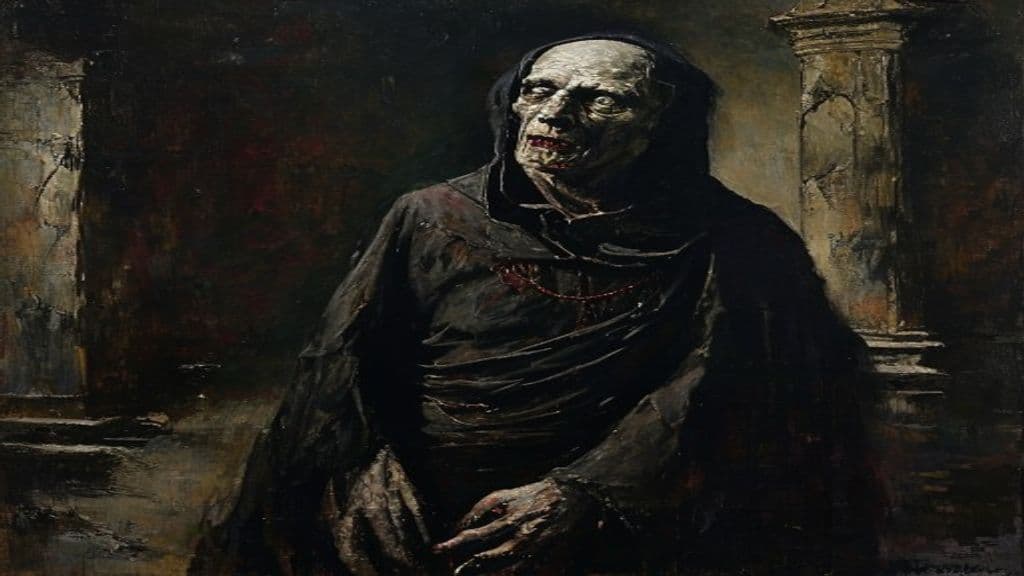
Appearance varies by tradition: from insubstantial ghostly manifestations to vividly corporeal, swollen or blood-suffused bodies recently issued from graves. Norse terms highlight differences of emphasis—aptrgangr ('again-walker') stresses walking dead; haugbui ('howe-dweller') indicates a corpse inhabiting a burial mound; draugr often denotes a corporeal, resisting presence. Medieval anecdote describes a swollen, blood-suffused wrapped corpse; other accounts describe decayed or animated corpses.
Revenants commonly haunt, wander among, and sometimes injure or kill the living. In medieval English accounts a revenant wandered courts and houses and caused fatalities; Norse narratives portray barrow-wights or draugar engaging in direct confrontation and sometimes resisting conventional weapons, requiring special destructive measures. Some comparative scholarship links certain revenant stories to blood-sucking or vampire-like activity, and Finnish 'dead-child' cases indicate restless spirits that can be laid by Christian rites—showing variation in causes and behaviors across traditions.
Weaknesses
- conditionincineration (burning the corpse)
- conditiondecapitation or removal of head
- otherphysical disabling (stones in jaw, legs bound, body parts removed) as preventive measures
- ritualChristian rites (baptism) for certain Finnish 'dead-child' beings
Wards
- otherstones placed over legs
- otherstones placed in the jaw to prevent speech
- otherbodies lodged with bricks or parts removed during burial
- rituallocking doors and remaining inside until sunrise
Vampire (tradition)
A class of revenant beings in southeastern and eastern European folk belief that subsist by feeding on the vital essence (generally blood) of the living. Recorded chiefly in early modern to modern oral traditions, these vampires are typically described as reanimated corpses whose presence explains unexplained illness, death, and post-mortem disturbances in their communities.

Banshee
A female spirit of Irish and Scottish folklore whose wail heralds an impending death in a family of Gaelic descent. Not a cause of death — a witness to it.

Draugr
In Nordic folklore the draugr (plural draugar; anglicized draug) is an archaic term for a malevolent revenant — a dead person who returns and remains active in the world of the living. Accounts emphasize variability: traits, behaviours, and descriptions change between stories and across regions, especially in early medieval Icelandic sagas and surviving Norwegian folklore.
Abdiel
Abdiel (Hebrew עֲבְדִּיאֵל) is primarily a theophoric Hebrew personal name meaning "servant of El/servant of God," attested once in the Hebrew Bible (1 Chronicles 5:15). In later literature—most notably John Milton's Paradise Lost—Abdiel is reimagined as a faithful seraph who opposes Satan's revolt. The provided sources do not treat Abdiel as an autonomous folkloric spirit type or record rituals or wards associated with the name.
Abiel
Abiel is attested in the supplied sources only as a male given name — borne by several historical American individuals and listed as two minor biblical figures. The provided materials contain no evidence presenting Abiel as a supernatural, mythological, or folkloric entity.
Abigail
Abigail is a female figure in the Hebrew Bible portrayed in 1 Samuel 25 as the intelligent and beautiful wife of Nabal who intervenes to prevent David from committing violence; later tradition regards her as one of the Tanakh's seven female prophets and as a model of beauty and wisdom.
Accolon
Accolon is a mortal knight of the Arthurian court, presented in the Post-Vulgate Merlin tradition and Malory's Le Morte d'Arthur as Morgan le Fay's paramour and instrument in a plot to supplant King Arthur; his tale centers on enchanted weapons (Excalibur and its scabbard), love-manipulation, and a tragic duel with Arthur.
Adils
Adils (Old Norse Aðils; also Eadgils, Adillus, Athisl, Adhel) is a semi‑legendary sixth‑century Swedish king attested in Old Norse saga material and later medieval traditions. He appears in saga episodes as a storied royal figure involved in warfare, court acts, and marriage suits rather than as a supernatural being.
Adsullata
Adsullata is attested as a Continental Celtic river goddess associated with the River Savus (modern Sava) in the Roman province of Noricum. Later traditions record her presence in Brittany as a goddess of hot springs and present her as an antecedent or origin-form of the Anglo‑Celtic sun goddess Sul.
Afaon fab Taliesin
Afaon fab Taliesin is a medieval Welsh warrior-counsellor, named as a son of the bard Taliesin and recorded among Arthur’s retinue in Welsh tradition. He appears in the Welsh Triads and in the tale Breuddwyd Rhonabwy (The Dream of Rhonabwy) as a notable martial figure and proverb-speaker rather than as a supernatural being.
Agilaz (Egil)
Agilaz (reconstructed Proto-Germanic) — commonly recorded in medieval sources as Egil or Ægil — is a legendary archer attested in Germanic heroic tradition. He appears as the brother of Völund (Wayland/Weland) in the Old Norse poem Völundarkviða and in the Thidreks saga, and his name is also inscribed on early medieval objects (Franks Casket, Pforzen buckle). The attested material presents him as a named heroic human archer within saga and inscriptional contexts rather than as a recurrent supernatural species.
Aglovale
Aglovale (also Agloval, Aglovan, Aglovaus, Acglavael) is a human knight of Arthurian romance, presented as the eldest legitimate son of King Pellinore and a Knight of the Round Table in the Vulgate/Post‑Vulgate cycles, Malory, and later adaptations. He brings his long‑lost brother Perceval to Camelot, takes part in military actions (including slaying Agrippa in one account), and his death is related in varying ways across traditions (accidental at Gawain's hand, deliberate murder by Orkney kin, or killed during Lancelot's rescue of Guinevere).
Agnarr Geirröðsson
Agnarr Geirröðsson is a mortal prince attested only in the Poetic Edda poem Grímnismál; he aids Odin (disguised as Grímnir) during Geirröðr's torture and, after Odin reveals himself and King Geirröðr dies, Agnarr succeeds as king.
Agne
Agne (also attested Agni, Hogne, Agni Skjálfarbondi) is a semi-legendary king of Sweden in Old Norse saga tradition, preserved in the Ynglingatal corpus and prose expansions such as Snorri Sturluson's Ynglinga saga. He is portrayed as a mighty and famous warrior-king whose campaign in Finland, marriage to Skjalf, and death by hanging form a remembered episode connected to local place-names and a burial mound.
Agravain
Agravain is a literary knight of Arthurian romance cycles: one of the sons of King Lot of Orkney, a member of the Round Table, and a recurring figure in French and English medieval prose and verse. He is portrayed as a skilled but morally problematic courtly knight whose jealousy, malice, and intra-familial violence drive key narrative conflicts (notably the slaying of Lamorak and the exposure of Guinevere).
Community Record
- [1]Revenant (Wikipedia). Wikipedia. 'Revenant'.wiki
- [2]Revenant (Wikidata). Wikidata. Q834114.other
- [3]William of Newburgh (medieval chronicle excerpt as cited). Excerpt summarized in the Wikipedia article citing William of Newburgh's account of a revenant in medieval England.literary
- [4]Archived audio/related references (contextual). Archive.org items referenced in source list (contextual material).other
- [5]Archived audio/related references (contextual). Archive.org items referenced in source list (contextual material).other
- [6]Archived audio/related references (contextual). Archive.org items referenced in source list (contextual material).other