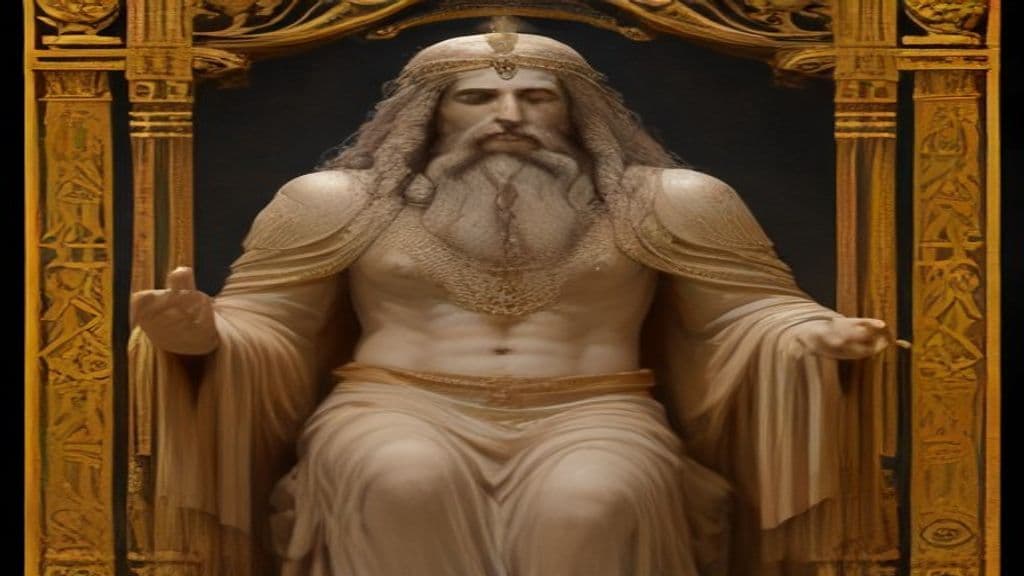
According to classical authors and later summaries, Serapis originated as the fusion of Egyptian Osiris and the Apis bull (Demotic wsjr‑ḥp, Coptic Userhapi). Hellenistic and Roman accounts (e.g., Plutarch as reported in modern summaries) relate a tradition in which Ptolemy I established a cult statue in Alexandria—Plutarch and Arrian mention a statue and cult in 323 BCE—and a story that Ptolemy brought a statue from Sinope after a dream instruction. Modern scholars note this tale is disputed and may refer instead to a pre‑existing Memphis serapeum; sources describe the formation/promotion of Serapis by Ptolemaic rulers as an intentional political‑religious strategy to unify Greek and Egyptian subjects.
Iconography presents Serapis in a chiefly anthropomorphic, Hellenistic form designed to appeal to Greek aesthetics while incorporating Egyptian motifs. Common elements include an enthroned, bearded male figure resembling Hades/Pluto, a modius (grain‑measure) on the head, a scepter of rulership, and chthonic symbols such as Cerberus at the feet and serpentine or uraeus motifs at the base. Additional attributes frequently associated with abundance and rebirth—cornucopia and calathus baskets—appear in some representations, though specific attributes vary by locale and period.
Serapis functioned syncretically across multiple domains rather than as a narrowly defined power. He was identified with chthonic/underworld authority (linked to Osiris and Greek Hades/Pluto), associated with healing (identified in some contexts with Asclepius), acted as protector and provider of asylum in his serapeia, and symbolized abundance and resurrection (through iconographic motifs). The emphasis on any given attribute varied by place and time within the Hellenistic and Roman religious landscape.
Weaknesses
None recorded.
Wards
- otherNo documented wards

*Péh₂usōn (reconstructed)
Péh₂usōn is a hypothetical Proto‑Indo‑European pastoral guardian reconstructed by comparative scholars from parallels in Greek and Vedic traditions. Proposed as a Graeco‑Aryan ancestor‑figure, the reconstruction describes a protector of flocks, roads, and travellers rather than an attested historical cultic personality.
Aani
Aani (ancient Egyptian jꜥnr) is the lexical term for the baboon in ancient Egyptian language and functions in religious contexts as an animal icon and theophoric epithet. Attested repeatedly in Egyptian texts and images, the baboon image is used to represent or denote aspects of gods such as Thoth, Hapy, Khonsu, and Osiris rather than implying the animal itself is an independent deity.
Aati
Aati (also rendered Ati) is one of the 42 judges of the dead in ancient Egyptian funerary literature, attested in the Book of the Dead tradition (notably the Papyrus of Nebsemy). Described as originating 'from Heliopolis', Aati's documented function is to question the deceased about a specific moral accusation during the Duat judgment; the funerary texts supply a formulaic denial the soul must recite.
Aba (disambiguation / name-form)
Aba is a polyvalent name-form attested across many unrelated contexts (place names, personal names, animal names, and brief mythological listings). The provided sources do not support a single, coherent supernatural entity called "Aba" and offer no descriptive or ritual material for such a being.
Abadiu of Antinoe
Abadiu of Antinoe was a fourth‑century bishop of Antinoe (Antinoopolis, in Roman Egypt) commemorated as a martyr and saint in the Coptic Orthodox Church, with a feast day on 26 December. Sources record that he was killed during a theological dispute with Arian opponents and reference him in collections of Egyptian martyrs.
Abandinus
Abandinus is a locally attested Romano‑Celtic theonym known from a single inscribed bronze feather (votive object) dedicated at Godmanchester (the Roman fort Durovigutum) in Cambridgeshire. Scholars interpret him as a local god or male spirit tied to a specific place and possibly associated with a nearby spring or stream; this association is tentative and based on etymological readings of the name.
Abarbarea
Abarbarea is a name attested in classical Greek and Roman sources for freshwater nymphs (naiads). The name appears for at least two individual mythic figures — a naiad wife of Bucolion and a naiad counted among ancestors of the Tyrians — and Hesychius records plural forms that may indicate the name was also used as a class-name (Abarbareai / Abarbalaiai).
Abas
Abas (Ancient Greek: Ἄβας, gen.: Ἄβαντος) is not a single mythic being but a recurring personal name borne by multiple mortals and minor mythic figures in Greek epic and genealogical traditions — kings, founders, seers, warriors, attendants, a centaur, and a youth transformed by a goddess. The name is glossed in the sources as 'guileless' or 'good-hearted' and appears across Argive, Theban, Trojan, Euboean, and other local cycles.
Abaset
Abaset is a localized ancient Egyptian goddess attested in tomb decoration at El‑Bawiti in the Bahariya Oasis during the 26th Dynasty. She is depicted anthropomorphically with a hedgehog motif incorporated into her headdress and appears on the walls of Qarat Qasr Salim, including twice in the Tomb of Bannentiu. No cult texts, myth narratives, or ritual prescriptions for her are recorded in the cited corpus.
Abderus
Abderus (Ancient Greek: Ἄβδηρος, romanized Ábdēros) is a mortal heroic figure in Greek myth closely associated with Heracles, remembered as the youth left in charge of the Mares of Diomedes who was killed by them. He functions as an eponymous local/divine-hero ancestor for the city of Abdera and received funerary commemoration and athletic agones at his tomb.
Abellio
Abellio is a theonym attested in Roman‑period inscriptions from the Comminges area of the Pyrenees and reported as worshipped in the Garonne Valley of ancient Gallia Aquitania. Surviving evidence is limited to a small number of inscriptions; scholars have variously hypothesized solar or arboreal associations and compared the name to forms of Apollo or to Celtic Belenus, but the deity's precise role in local cosmology remains uncertain.
Abib and Apollo
Abib and Apollo are Christian ascetics and hagiographic saints of Akhmim (Upper Egypt) attested in Coptic sources and the Historia Monachorum. Remembered for extreme asceticism, monastic leadership, angelic encounters, and inclusion in the Coptic Synaxarion (feast day November 4).
Community Record
- [1]Serapis - Wikipedia. Wikipedia contributors, 'Serapis', Wikipedia, The Free Encyclopediawiki
- [2]Serapis - Wikidata. Wikidata entry Q214554wiki
- [3]Serapis - NovaRoma. NovaRoma: Serapisother
- [4]Serapis — historical romance (novel by Georg Ebers). Georg Ebers, Serapis (historical novel), Project Gutenbergliterary
- [5]Archive conversation reference: 'Who or What is Serapis?'. Archive: A Conversation on Caesar's Messiah Thesis - segment titled 'Who or What is Serapis?'other