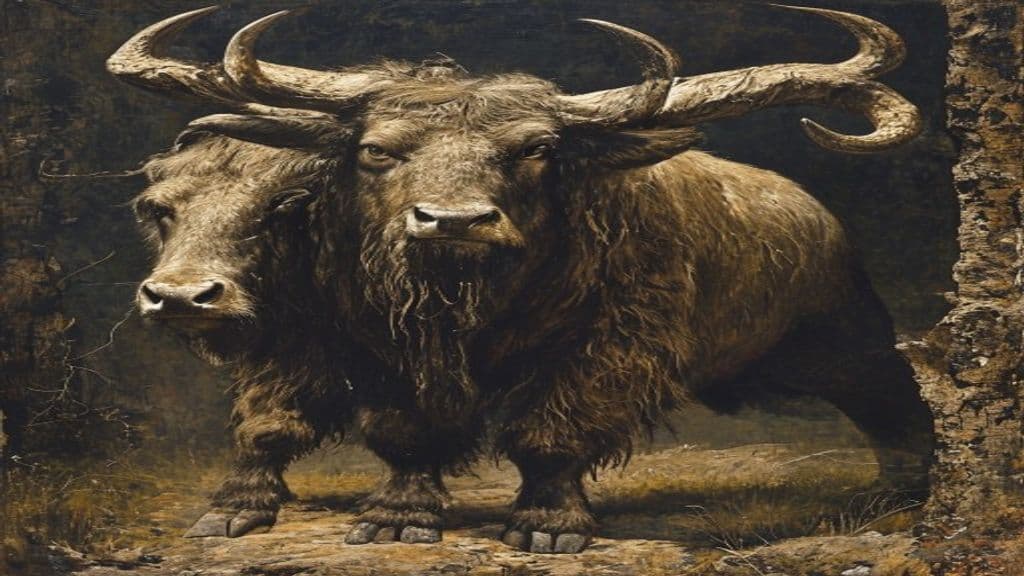
The tarand appears in the corpus of classical natural-history writers rather than in a mythic cosmogony: Aristotle names a rare beast called tarandos in Scythia that changes the colour of its hair to its surroundings; Pliny and Aelian repeat and expand the marvel in their natural histories (placing it in Scythia), and Solinus records a related-sounding Parandrus in Aethiopia. Medieval and Renaissance authors (e.g., the York Mystery Cycle, Rabelais) inherit and adapt the creature from these classical attestations, using it both as a natural wonder and as a rhetorical or allegorical trope.
Classical descriptions present a large, sturdy ungulate about the size of an ox or bullock with a stag-like head bearing branched/branching horns, cloven hooves, very long hair likened to that of a bear, and an exceptionally tough hide. Pliny and later writers emphasize the hide's toughness (noting its use in making breast-plates and covering shields). The overall impression in the sources is of a heavily built, hairy, horned beast with armour-like skin.
The central extraordinary trait reported in the sources is the ability to change external colour — Aristotle and Pliny describe the tarand taking on the colours of trees, shrubs, grass, rocks and the ground so as to be difficult to catch. Pliny explicitly compares the tarand to the chameleon and to other colour-changing animals (polypus, certain wolves/Lycaon). Aelian and Rabelais amplify the account: Aelian stresses transformation of hair as well as skin into many colours, and Rabelais gives anecdotal, quasi-volitional instances (the animal turning grey near one person, red near another; shifting through green, yellow, blue, tawny and purple over time). The classical authors treat the trait as a natural marvel rather than a supernatural power; behaviourally the colour-change is often linked to fear and hiding.
Weaknesses
None recorded.
Wards
- otherHide used as armor by humans (breast-plates, shield coverings)
Pishacha
Flesh-eating spirits of Hindu mythology that haunt cremation grounds and are associated with disease, madness, and possession. The lowest class of demon in the Vedic hierarchy.

Yaksha
Nature spirits of Hindu, Buddhist, and Jain cosmology — guardians of forests, treasures, and wilderness. Ambivalent beings, capable of great benevolence to the respectful and terrible harm to the greedy.
*Péh₂usōn (reconstructed)
Péh₂usōn is a hypothetical Proto‑Indo‑European pastoral guardian reconstructed by comparative scholars from parallels in Greek and Vedic traditions. Proposed as a Graeco‑Aryan ancestor‑figure, the reconstruction describes a protector of flocks, roads, and travellers rather than an attested historical cultic personality.
Aba (disambiguation / name-form)
Aba is a polyvalent name-form attested across many unrelated contexts (place names, personal names, animal names, and brief mythological listings). The provided sources do not support a single, coherent supernatural entity called "Aba" and offer no descriptive or ritual material for such a being.
Abandinus
Abandinus is a locally attested Romano‑Celtic theonym known from a single inscribed bronze feather (votive object) dedicated at Godmanchester (the Roman fort Durovigutum) in Cambridgeshire. Scholars interpret him as a local god or male spirit tied to a specific place and possibly associated with a nearby spring or stream; this association is tentative and based on etymological readings of the name.
Abarbarea
Abarbarea is a name attested in classical Greek and Roman sources for freshwater nymphs (naiads). The name appears for at least two individual mythic figures — a naiad wife of Bucolion and a naiad counted among ancestors of the Tyrians — and Hesychius records plural forms that may indicate the name was also used as a class-name (Abarbareai / Abarbalaiai).
Abas
Abas (Ancient Greek: Ἄβας, gen.: Ἄβαντος) is not a single mythic being but a recurring personal name borne by multiple mortals and minor mythic figures in Greek epic and genealogical traditions — kings, founders, seers, warriors, attendants, a centaur, and a youth transformed by a goddess. The name is glossed in the sources as 'guileless' or 'good-hearted' and appears across Argive, Theban, Trojan, Euboean, and other local cycles.
Abderus
Abderus (Ancient Greek: Ἄβδηρος, romanized Ábdēros) is a mortal heroic figure in Greek myth closely associated with Heracles, remembered as the youth left in charge of the Mares of Diomedes who was killed by them. He functions as an eponymous local/divine-hero ancestor for the city of Abdera and received funerary commemoration and athletic agones at his tomb.
Abellio
Abellio is a theonym attested in Roman‑period inscriptions from the Comminges area of the Pyrenees and reported as worshipped in the Garonne Valley of ancient Gallia Aquitania. Surviving evidence is limited to a small number of inscriptions; scholars have variously hypothesized solar or arboreal associations and compared the name to forms of Apollo or to Celtic Belenus, but the deity's precise role in local cosmology remains uncertain.
Abnoba
Abnoba is a Gaulish theonym and toponym attested in Roman-era sources and inscriptions: a localized deity associated with woods, springs and the sources of rivers (notably the Danube) and simultaneously the name applied to a mountain or mountain range in the Black Forest/Baar/Odenwald region. Roman altars equate her with Diana, reflecting syncretic cult practice in frontier provinces.
Abomination of Desolation
An apocalyptic prophetic phrase originating in the Book of Daniel designating a profaning thing or act that renders the Jerusalem Temple cult desolate; later reused in the Synoptic Gospels as an eschatological sign prompting urgent flight. The term denotes ritual/cultic impurity (Hebrew shiqquts) and is variously interpreted as pagan offerings or altar, a foreign cult statue, or (in some New Testament readings) an acting agent.
Aborigines (mythology)
A mytho-historical label used in Roman and general reference sources to denote the oldest inhabitants of a region (specifically central Italy in the cited Roman context). The term functions as an identity/category for original human populations rather than as a characterized supernatural being in the provided sources.
Absyrtus
Absyrtus (Ancient Greek: Ἄψυρτος) is a Colchian prince in the Greek Argonautic cycle, son of King Aeëtes and brother or half-brother of Medea. He appears in variant traditions either as a companion taken by Medea during her flight with Jason and murdered/dismembered to delay pursuit, or as a pursuer sent by Aeëtes who is overtaken and slain by Jason; his death functions as a key narrative device in the escape from Colchis.
Abundantia
Abundantia is the Roman divine personification of abundance and material plenty, used primarily in imperial propaganda and public iconography to signify secure grain supplies, wealth, and the promise of a 'Golden Age' under the emperor. She also appears in later medieval European folklore as Domina Abundia / Dame Habonde, a household benefactor in accounts condemned by ecclesiastical writers.
Community Record
- [1]Aristotle — Natural-history attestations (summary). Aristotle, referenced in modern summaries: description of 'tarandos' in Scythia that changes the colour of its hair according to its surroundingsliterary
- [2]Pliny the Elder — Natural History (summary). Pliny, as summarized in modern sources: Tarandus in Scythia, ox-sized, stag-like head with branched horns, bear-like hair, hide used for breast-plates, changes colour like the chameleonliterary
- [3]Aelian — On the Characteristics of Animals (summary). Aelian: account stressing transformation of hair and skin into many colours and noting Scythians' use of hide for shieldsliterary
- [4]Solinus — Parandrus in Aethiopia (summary). Solinus' mention of a similarly named Parandrus placed in Aethiopia (uncertain identity with Scythian tarand)literary
- [5]Rabelais — Pantagruel (summary). Rabelais: Renaissance literary adaptation describing ox-sized tarand, bear-like hair, anecdotal colour shifts responsive to surroundings and persons; compares hair-changing to chameleon and polypusliterary
- [6]Wikipedia: Tarand (animal). Modern encyclopedia summary consolidating classical and later attestations (Aristotle, Pliny, Aelian, Solinus, Rabelais, York Mystery Cycle)wiki