
In medieval narratives Raigō was a Heian-period monk whose request for construction of an ordination platform (kaidan) at Mii-dera was opposed by Enryaku-ji on Mount Hiei. After prolonged ascetic practice and death, sources relate that Raigō's grudge manifested as a harmful spirit: Heike Monogatari describes his posthumous haunting of Prince Atsufumi (an ominous white-haired priest apparition associated with the prince's subsequent illness and death), and later accounts and pictorial traditions identify that grudge with a rat-form linked to the monk, producing the names Raigō-nezumi and Mii-dera-nezumi. Institutional responses (see wards) turned the dangerous grudge into an object of local cultic attention.
Descriptions vary by source. Heike Monogatari records an ominous white-haired old priest apparition associated with Raigō's grudge. Other narratives depict a giant rat that eats sacred books. The Taiheiki describes the grudges of Raigō as transforming into "84,000 rats with stone bodies and metal teeth," emphasizing multiplicity and hard/mineral or metal qualities. Edo-period picture-books (e.g., Toriyama Sekien's Gazu Hyakki Yagyō) applied the name Tesso to rat-yōkai imagery, fixing the rodent-shaped visual identity in popular culture.
Sources attribute a set of destructive and uncanny behaviors to Raigō's grudge. Heike Monogatari presents an onryō that appears beside Prince Atsufumi's pillow, bringing illness that culminates in the prince's death. Tale variants state the grudge "became a giant rat" that ate sacred books at Enryaku-ji (Heike Monogatari / related summaries). The Taiheiki depicts massed assaults in which "84,000 rats with stone bodies and metal teeth" climbed Mount Hiei and consumed sacred texts and Buddha statues. In late-Edo yomihon (Takizawa Bakin's Raigō Ajari Kaisoden) Raigō appears in dreams to instruct a human in rat sorcery, enabling the summoning or direction of rats for narrative purposes. Each attributed ability is tied to the specific textual source that records it.
Weaknesses
- ritualplacation by enshrinement (Nezumi no Hokura)
Wards
- ritualNezumi no Hokura (鼠の秀倉) — shrine-enshrinement at Higashisakamoto / Hiyoshi Taisha area

Onryō
Onryō are vengeful spirits in Japanese folklore who return after death to redress wrongs suffered in life by harming the living; they are commonly portrayed in literature and film as wronged individuals—frequently women—whose resentment manifests as lethal retribution, and in some accounts as causing wider calamities.
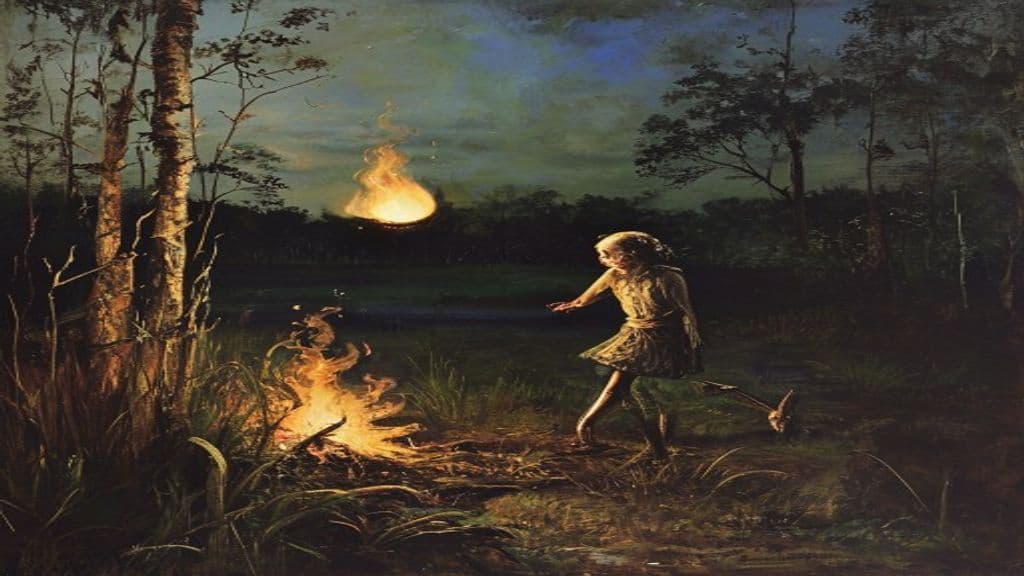
Will-o'-the-wisp
An atmospheric 'ghost light' — a small, mobile, lamp-like light seen at night over marshes, bogs, wet ground, or graveyards. In many cultures the phenomenon is interpreted as a supernatural being or manifestation (wandering nature-spirit, soul of the dead, transformed witch, or treasure-indicator); modern science offers chemiluminescent explanations for some occurrences.
*Perkʷūnos
*Perkʷūnos is the reconstructed Proto-Indo-European thunder‑god hypothesized by comparative linguistics and mythology. Scholarly reconstructions portray him as a storm or thunder figure associated with fructifying rain and as the combatant who fights a multi‑headed water‑serpent to release life‑giving waters; no direct attestations from the Proto‑Indo‑European period survive and the figure is inferred from later Indo‑European traditions.
*Péh₂usōn (reconstructed)
Péh₂usōn is a hypothetical Proto‑Indo‑European pastoral guardian reconstructed by comparative scholars from parallels in Greek and Vedic traditions. Proposed as a Graeco‑Aryan ancestor‑figure, the reconstruction describes a protector of flocks, roads, and travellers rather than an attested historical cultic personality.
5 Ronin
5 Ronin is a 2011 Marvel Comics five-issue limited series that reimagines five Marvel superhero archetypes as rōnin (masterless samurai) in a fictionalized post‑Sekigahara feudal Japan. The work places Wolverine, Hulk, Punisher, Psylocke, and Deadpool analogues into period roles to explore displacement, revenge, and identity in an era of political upheaval.
57 Mnemosyne
57 Mnemosyne is a large main-belt asteroid (S-type) discovered in 1859 and named after the Greek Titaness Mnemosyne. It is a non-sentient astronomical body studied for its orbital and rotational properties and has been used in dynamical measurements related to Jupiter.
Abaddon
In Hebrew scripture Abaddon is primarily a noun meaning 'destruction' or a section/condition of the underworld paired with Sheol; in the New Testament Book of Revelation Abaddon is personified as an angelic figure (Greek Apollyon) described as the king of an army of locusts released from the abyss during the apocalypse.
Aban Yasht
The Aban Yasht is a hymn from the Persian tradition that praises Anahita, a goddess associated with water, fertility, and wisdom. It consists of 132 stanzas and is part of the 21 Yashts collection. (Note: - Power tier should be "Primordial" or possibly "Cosmic", given that it's a hymn of great spiritual significance and associated with a goddess. - The article incorrectly states that Anahita is associa)
Abath
No corroborated folkloric entity named "Abath" is documented in the provided sources. The string appears in the supplied material only as a surname/personal name in Aruban/Dutch-Caribbean archival records and as an unrelated taxonomic or encyclopedic hit; no mythic attributes, origin stories, rituals, or apotropaic practices for an entity called Abath are present in the documents reviewed.
Abatur
Abatur is an uthra (celestial emanation) in Mandaeism described as the 'father of the Uthras' and called the Ancient (ʿattīqā). He resides on the boundary between the World of Light and lower regions, functions as a judge who weighs souls (Abatur Muzania), and supplies instructions and materials to the demiurgic uthra Ptahil in accounts from the Diwan (Scroll) of Abatur.
Abatwa (Twa / Batwa)
Abatwa (also recorded as Twa, Batwa, Mutwa; singular forms Barhwa or Murhwa in some transcriptions) are indigenous hunter‑gatherer peoples of the Great Lakes region of Central Africa, historically identified as some of the earliest inhabitants of the area. The available sources treat them as human ethnic groups whose livelihoods, lands, and populations have been severely affected by conservation policies and modern violence.
Abellio
Abellio is a theonym attested in Roman‑period inscriptions from the Comminges area of the Pyrenees and reported as worshipped in the Garonne Valley of ancient Gallia Aquitania. Surviving evidence is limited to a small number of inscriptions; scholars have variously hypothesized solar or arboreal associations and compared the name to forms of Apollo or to Celtic Belenus, but the deity's precise role in local cosmology remains uncertain.
Abraham
Abraham (originally Abram) is the foundational patriarchal ancestor in the Hebrew Bible whose life establishes a covenantal relationship between his family/people and God. He functions as an exemplar of faith, the progenitor of promised descendants, and a narrative anchor for claims of land, blessing, and communal identity in later religious traditions.
Abraun
Abraun is an attested name in German-language plant-legend scholarship (Der abraun, ein beitrag zur pflanzensagenkunde, 1916) and a short database entry (Wikidata) labels it as a spirit from German mythology. Surviving accessible documentation is extremely limited: the principal academic treatment is a 1916 contribution to pflanzensagenkunde (plant-saga studies), but the excerpts available here contain only bibliographic metadata and do not record tales, descriptions, or rituals.
Community Record
- [1]Tesso (Wikipedia). Wikipedia entry 'Tesso' summarizing Heike Monogatari, Taiheiki, Takizawa Bakin, Toriyama Sekien, and shrine records.wiki
- [2]Wikidata: Tesso (Q37443735). Wikidata entry for Tesso (listed but provided little substantive material for these notes).other