
The vanishing hitchhiker is not a single mythic origin figure but a narrative type documented by folklorists. Jan Harold Brunvand classifies it among 'urban belief tales' and traces modern versions back to at least the nineteenth century; comparative notes indicate resonances with a roughly 400‑year‑old Swedish manuscript and a documented cluster of American variants collected by Beardsley and Hankey. Beardsley and Hankey's survey of U.S. accounts identified multiple distinct versions (they reported four primary versions in their sample), showing the motif's long persistence and adaptation to local contexts rather than a single point of origin.
Accounts vary by local variant: many American and British retellings feature a young woman or girl (a common motif has a girl returning from a dance who borrows an overcoat), while a regional cluster recorded around Chicago emphasizes an old prophetic woman. Other variants present the passenger as an ordinary, unremarkable traveler who shows no overtly supernatural traits at pickup. In some localized traditions (notably Hawaiian accounts invoking Pele) the traveler may be a divine or semi-divine figure traveling incognito. The only consistent descriptive feature in the sources is ordinariness at the moment of encounter rather than a fixed supernatural visage.
Narratively, the figure's core 'abilities' are to appear to the living as an ordinary passenger, to vanish from a vehicle or place (sometimes while the vehicle is in motion), and occasionally to leave corroborating evidence: supplying an address that, when investigated, reveals the passenger had been dead for some time; a borrowed garment later found draped on a grave; or issuing a prophecy or warning. Variants differ in moral valence—some serve as harmless or tragic reminders of mortality, others (e.g., Pele variants) reward or rebuke behavior—rather than exhibiting consistent hostile or combative powers.
Weaknesses
- conditionNo uniform vulnerability — sources record no consistent weakness
- otherPractical avoidance: refusal to pick up strangers (modern sociocultural preventive measure rather than folkloric magical weakness)
Wards
- conditionAvoiding pickup — modern practical caution noted in sources as a way to reduce encounters
- otherProper conduct/kindness in culture‑specific variants (e.g., Hawaiian versions involving Pele): culturally appropriate behavior influences outcome rather than functioning as a ritual ward

La Llorona
The Weeping Woman of Mexican folklore — the ghost of a mother who drowned her children and now wanders rivers and lakes, weeping for them and taking other children she finds at night.

Rusalka
Water spirits in Slavic folklore — the spirits of young women who died by drowning or suicide, bound to rivers and lakes. Beautiful and dangerous, they can bewitch men to their deaths.

Banshee
A female spirit of Irish and Scottish folklore whose wail heralds an impending death in a family of Gaelic descent. Not a cause of death — a witness to it.
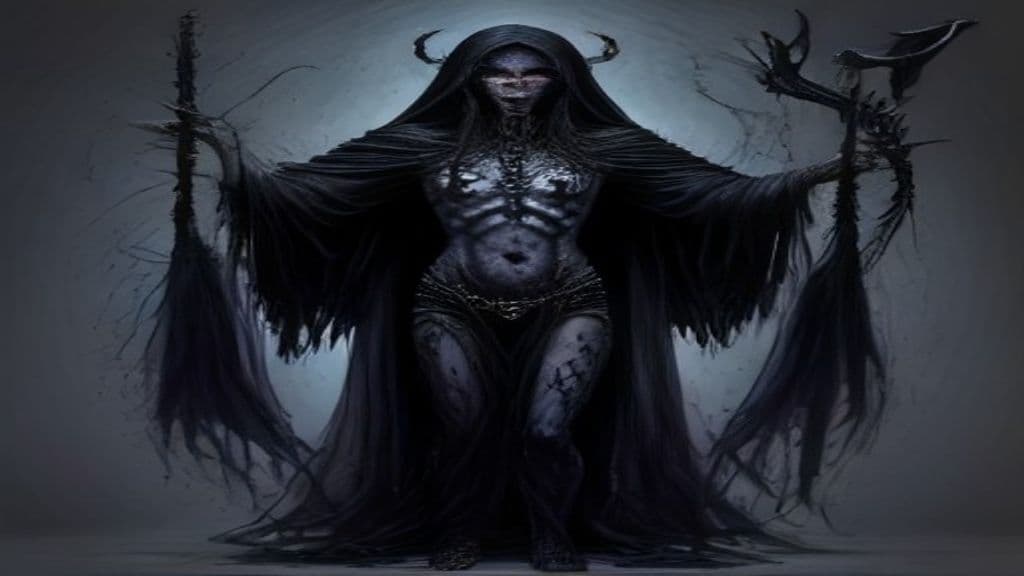
Ghoul
A ghoul is a demon-like or monstrous humanoid originating in pre-Islamic Arabian religion, traditionally associated with graveyards and the consumption of human flesh. The concept later entered broader folklore and has been widely reused and transformed in modern fiction and popular culture.
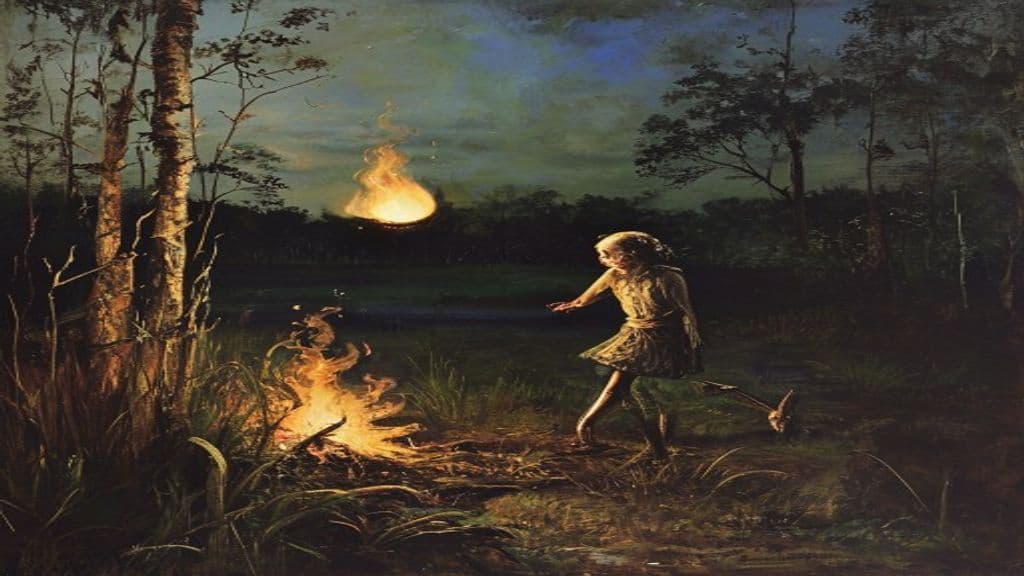
Will-o'-the-wisp
An atmospheric 'ghost light' — a small, mobile, lamp-like light seen at night over marshes, bogs, wet ground, or graveyards. In many cultures the phenomenon is interpreted as a supernatural being or manifestation (wandering nature-spirit, soul of the dead, transformed witch, or treasure-indicator); modern science offers chemiluminescent explanations for some occurrences.
3-D Man
3-D Man is a Marvel Comics superhero identity associated with a 1950s-era origin in which the body of Chuck Chandler can materialize in three-dimensional existence when activated by his brother Hal via a pair of glasses. The mantle was later assumed by Delroy Garrett (formerly Triathlon) in modern continuity.
5 Ronin
5 Ronin is a 2011 Marvel Comics five-issue limited series that reimagines five Marvel superhero archetypes as rōnin (masterless samurai) in a fictionalized post‑Sekigahara feudal Japan. The work places Wolverine, Hulk, Punisher, Psylocke, and Deadpool analogues into period roles to explore displacement, revenge, and identity in an era of political upheaval.
58 Concordia
58 Concordia is a fairly large main-belt asteroid orbiting the Sun, discovered in 1860 and named after the Roman goddess Concordia. Astronomical sources classify it as a C-type (carbonaceous) body with a multi-year orbital period and measurable rotation and pole orientations.
9MOTHER9HORSE9EYES9
An anonymous Reddit screen name and online persona used by the author of the Interface series, a multipart speculative-horror narrative posted in short installments across Reddit in 2016. The name functions as the signature of an authorial identity and as a focal label for a fandom that created archives, a subreddit, and a wiki documenting the story and its fictional phenomena (notably entities called "flesh interfaces").
A.R.G.U.S.
A.R.G.U.S. is a fictional clandestine United States government agency in the DC Comics universe that investigates, contains, and manages superhuman, meta-human, and supernatural incidents and assets. Introduced in The New 52 continuity, it functions as an institutional actor providing intelligence, logistical support, covert task forces (notably Task Force X / the Suicide Squad), and a dedicated magic division across comics and media adaptations.
Abdiel
Abdiel (Hebrew עֲבְדִּיאֵל) is primarily a theophoric Hebrew personal name meaning "servant of El/servant of God," attested once in the Hebrew Bible (1 Chronicles 5:15). In later literature—most notably John Milton's Paradise Lost—Abdiel is reimagined as a faithful seraph who opposes Satan's revolt. The provided sources do not treat Abdiel as an autonomous folkloric spirit type or record rituals or wards associated with the name.
Abena Mansa
A name attested in a single contemporary Ghanaian blog anecdote as a 'mysterious being'; available sources do not establish Abena Mansa as a coherent, traditional supernatural figure or provide corroborating ethnographic detail.
Abiel
Abiel is attested in the supplied sources only as a male given name — borne by several historical American individuals and listed as two minor biblical figures. The provided materials contain no evidence presenting Abiel as a supernatural, mythological, or folkloric entity.
Abigail
Abigail is a female figure in the Hebrew Bible portrayed in 1 Samuel 25 as the intelligent and beautiful wife of Nabal who intervenes to prevent David from committing violence; later tradition regards her as one of the Tanakh's seven female prophets and as a model of beauty and wisdom.
Abin Sur
Abin Sur is a fictional extraterrestrial Green Lantern from the planet Ungara in DC Comics. A former history professor turned Green Lantern of Space Sector 2814, he discovered and investigated a prophecy tied to the "Blackest Night," died wounded on Earth and chose Hal Jordan as his ring-successor, and was later reanimated as a Black Lantern in the Blackest Night storyline.
Abishai
Abishai is a personal name attested in several distinct sources: a biblical individual described as the eldest son of Zeruiah (sister of King David); a Semitic chief named in an inscription at Beni-Hasan in Middle Egypt; and modern cultural uses including a named monster in Dungeons & Dragons and as an artist/stage name. The supplied materials do not present Abishai as a supernatural being within a living cosmology.
Abraham Cornelius
Abraham Cornelius is a fictional human scientist in Marvel Comics, a senior Weapon X technician who helped develop the technique to bond adamantium to bone and who features in Wolverine's origin and later storylines, including Death of Wolverine.
Community Record
- [1]Vanishing hitchhiker. Wikipedia, 'Vanishing hitchhiker'wiki
- [2]The Vanishing Hitchhiker: American Urban Legends and Their Meanings (sample). Jan Harold Brunvand, The Vanishing Hitchhiker: American Urban Legends and Their Meanings (sample archive)academic
- [3]Beardsley and Hankey survey (summarized). Beardsley & Hankey survey of U.S. accounts summarized in secondary literature (as cited in Wikipedia)academic
- [4]Archive: Analysis and Decomposition of Narratives in Security: DARPA (Honeypot). Archive collection referencing narrative analysesother
- [5]Frankly Curious: The Vanishing Hitchhiker and the Charming Return to Glennascaul. Frankly Curious essay on vanishing hitchhiker variantsfolk
- [6]Multo (blog): Revisiting the Vanishing Hitchhiker. Multo blog revisiting variants and cultural notesfolk